Investment Trends’ annual CFD Report is based on the largest survey of investors conducted in Australia each year.
Key findings of annual Investment Trends Australia Contracts for Difference (CFD) Report:
- The Australian CFD market continues to grow: 44,000 Australians traded CFDs in the 12 months to May 2012, up from 41,000 a year earlier
- Potential for an even stronger growth exists, if the economic conditions improve: Volatility and the current economic climate are among the largest barriers to further adoption
- Traders take advantage of the widening range of markets available: Overseas indices, individual overseas shares and commodities play an increasing role in the underlying instrument mix
- CFD traders go mobile: 58% of current CFD traders use a smartphone and/or tablet to trade
Traders embrace CFDs in the tough conditions for investing
44,000 Australians traded CFDs at least once in the 12 months to May 2012, 3,000 more than in the corresponding period a year earlier. This represents a faster growth rate (7%) compared with the 2010-2011 period (5%) .
The Investment Trends May 2012 Australia CFD Report is the seventh iteration of the in-depth study on the use of CFDs, based on a survey of 17,197 investors conducted in May 2012.
Senior Analyst Pawel Rokicki commented on the findings: “Against a backdrop of challenging economic conditions, the market has shown considerable resilience. Traders are adapting to the lacklustre performance of the local share market. While most Australian CFD traders graduate from domestic equity trading, they are increasingly willing to trade overseas assets and commodities – a sign that the market is maturing.”
An improvement in the economic climate would help the industry grow further
While the main focus of the report is on current traders, it also looks into the psyche of the next wave of traders—people who have not traded CFDs previously but intend to begin in the next 12 months.
Asked what stopped them from trading CFDs, four out of ten next wave traders pointed to market conditions, including 29% citing the current economic climate and 28% citing volatility levels as barriers to trading. Thirty-one percent were held back by inadequate knowledge about the product.
“Volatility is a double-edged sword for the industry. The more seasoned traders thrive on it, but there is a large group of potential traders who wait for the waters to calm, before they jump in”.
International markets beckon
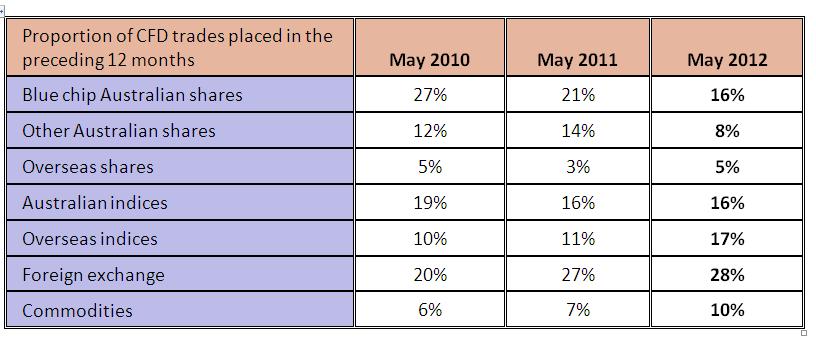
International markets are becoming increasingly attractive to Australian traders. Between May 2011 and May 2012 the proportion of trades placed over international indices and shares grew from 14% to 22%. Commodities and, to a lesser extent, currencies were the other underlying assets to see a relative increase in trading volumes. Individual Australian shares gave ground. The table below shows the details.

CFD traders go mobile
Fifty-eight per cent of current CFD traders use their smartphone and/or tablet to trade and another quarter intend to start doing so.
“Based on our international experience, the English speaking countries clearly lead the way here”, said Rokicki.
“Australia now has the highest level of adoption of mobile trading platforms, closely followed by the other English-speaking: US and UK where the mobiles and tablets are also used by the majority of leveraged product traders. Europe is significantly behind with the penetration in Germany and France at about half of what we see here.”
The market continues to consolidate around the two leaders
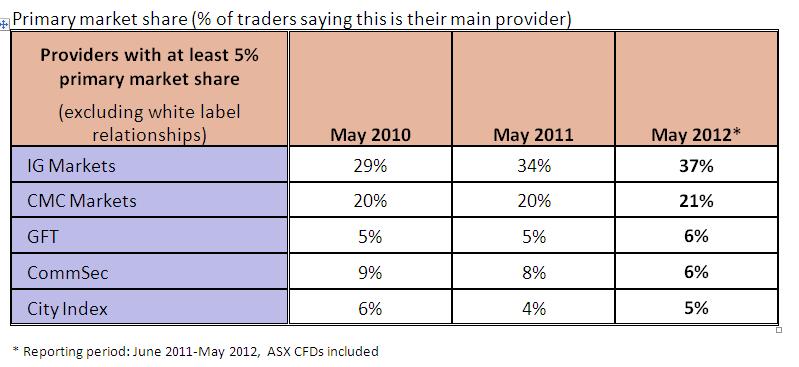
The top two providers—IG Markets and CMC Markets—now control almost 60% of primary relationships, up from 55% in 2011.
“Both incumbents have benefited from MF Global’s exit”, commented Rokicki, “but the competition is likely to intensify in the near future, with large international players such as Saxo Bank and London Capital Group looking to make their mark in Australia.”