In our industry, a fund manager caught holding large proportions of cash in his portfolio invariably invites a tough line of questioning regarding his fees:
“How could you justify charging a 1% MER for holding 10% in cash for the past 6 months?” or “Are you not paid to pick stocks?” or again “Are you not overstepping the boundaries of your mandate and going against your investors’ will by holding cash?”.
The history of investment management is certainly not short on managers who charged a lot and delivered little, but our insatiable appetite for contrarian views made us wonder whether there was another side to this debate. As it turns out, Warren Buffett certainly believes so.
In a recent interview with Canadian newspaper The Globe and Mail, Alice Schroeder, author of The Snowball: Warren Buffett and the Business of Life and an avid follower of the Oracle from Omaha for years prior to becoming his biographer, declared:
“He thinks of cash differently than the conventional investors. This is one of the most important things I learned from him: the optionality of cash. He thinks of cash as a call option with no expiration date, an option on every asset class, with no strike price.”
In Buffett’s mind, holding cash is a sound, active, investment decision. It stems from the belief that one or several assets will lose value in the near future and will then become attractive buys. Holding cash is like buying a call option because the only two possible end results are identical: either the investor was wrong, in which case the option expires and the loss is limited to the price already paid for the option, or the investor is vindicated and he or she can now hold the desired asset from an advantageous entry point.
However, one might reasonably argue that Buffett’s investment objectives and capabilities are not comparable to those of the average Australian retail investor. We therefore need to establish whether the optionality of cash is a concept that can be successfully implemented for the latter. If cash is to be likened to a call option, our first step should be to price the said option. Any conventional method of option pricing (for example, the Black and Scholes model) is not applicable here since our cash option has no defined underlying asset, expiration date or strike price. Instead, a sensible approach could be to deduct the return on cash from the opportunity cost, i.e. from how much I am missing out on by not investing elsewhere. For the sake of simplification, let’s agree that this “elsewhere” is the rest of my portfolio. The cost of holding cash for a period of time is therefore equal to the return on my portfolio over this time minus the return on cash. The first conclusion we can immediately draw from this equation is that the price of holding cash will change over time, and that certain market environments will render cash “cheap” or “expensive”. But more on that later.
Second, let’s consider the expected return from holding cash. The main driver of this return should be the difference in price for the asset(s) I will be buying between now and then. In other words, the return on cash, while a contributor to the return, should not be the key consideration. Investing in cash should not be prompted by high term deposit rates, which merely facilitate the trade by reducing its cost. Holding cash is a sound investment decision only when it can be linked to a forecasted drop on a given asset and its subsequent attractiveness.
We have stated that certain market environments are more conducive to maintaining a substantial portfolio allocation to cash, and we believe that we currently are in such an environment. Term deposit rates in Australia, while on a downward slope, remain high by historical and international standards. Expected returns on traditional asset classes have been revised downward in light of disappointing performance over the past 5 years. Cash is definitely cheap. The challenge is now to position a portfolio so it can take advantage of such opportunities.
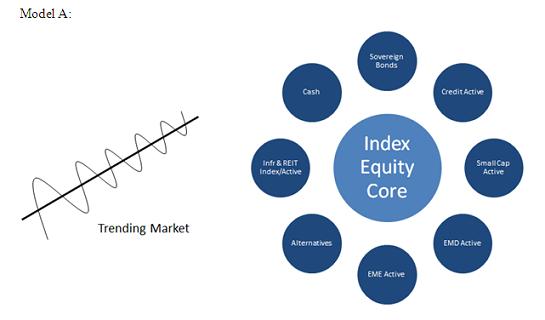
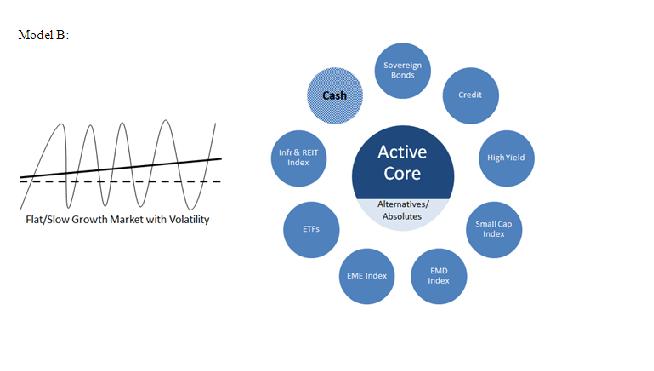
Since 2008, van Eyk has progressively shifted its portfolios from a traditional structure (Model A below) towards a structure where core managers are given wider constraints (Model B), which we believe is more appropriate in the range bound but volatile market environment that we envisage during the next few years. We perceive the need to be more proactive on how we allocate to satellite asset classes, including cash, as markets will create valuation-driven opportunities.
When considered through this lens, as a simple cost/benefit analysis, it is clear that retail investors can benefit from using cash in this way.
The optionality of cash, so prized by Warren Buffett, is indeed available to all.