The rally in shares continued over the past week with the Australian All Ordinaries index rising above the 5000 level for the first time since April 2011, helped by good profit results adding to confidence that the profit cycle is turning up, a strong rise in consumer confidence and news that a Chinese company is taking a stake in Alumina.
- While the market is due for a pause in the short term having risen 16% since the last correction in mid November and with some technical resistance around current levels as was the case in 2010 and 2011, our assessment remains that the market will head much higher as the profit outlook continues to improve and shares remain cheap relative to bank deposits and bonds which is likely to encourage investor rotation back into shares.
- The G7 and G20 made their usual comments that exchange rates should be market determined and warning about excessive volatility, which was interpreted to be aimed at Japan. However, such statements usually have no lasting impact. After a possible correction we see the Yen moving much lower this year.
Major global economic events and implications
- US economic data was mostly good. Retail sales rose just 0.1% in January but this was pretty much as expected given the payroll and high income tax rate hikes. If anything it was a bit better than feared. Industrial production fell slightly in January but previous months were revised up. Meanwhile small business optimism improved slightly, consumer sentiment rose, manufacturing conditions in the New York region rose sharply and unemployment claims fell. President Obama’s State of the Union address focussed on growth, raising the minimum wage, speeding up energy permits, improving infrastructure and reducing the budget deficit by another $US1.5 trillion over ten years. However, there was nothing particularly conciliatory towards the Republicans suggesting that a budget reduction deal was any closer. US December quarter earnings remain good. With 393 S&P 500 companies having reported, 74% have beaten earnings expectations & 67% have beaten on sales.
- The Euro-zone recession continued late last year with a 0.6% GDP contraction in the December quarter. Fortunately, forward looking indicators such as PMIs point to a lessening of the recession ahead.
- Japan’s recession also continued in the December quarter with GDP falling 0.1% reflecting weakness in exports and investment. Growth is likely to return in the current quarter though, partly reflecting the fall in the Yen and further monetary easing. Although the further contraction in the Japanese economy strengthened the case for further monetary stimulus, the Bank of Japan left monetary policy unchanged with further easing unlikely until the new Governor takes over in April.
Australian economic events and implications
- While a fall in housing finance for December was disappointing, a further slight gain in business confidence according to the January NAB survey and an 8% leap in consumer confidence in February are positive signs that the interest rate cuts since late 2011 are starting to get traction. In fact the level of consumer confidence is now 20% up from its 2011 low and is now only just slightly below the average level it had reached this far into the last three rate cutting cycles. Strengthening consumer sentiment augurs well for improved consumer spending and housing demand ahead.
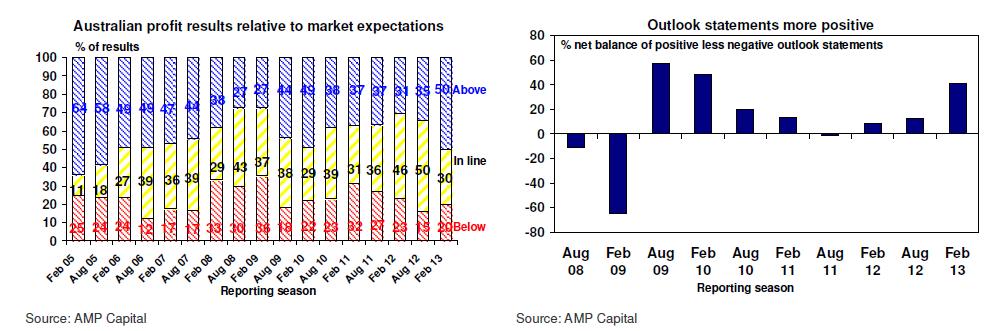
- Although its still early days with the December half profit reporting season only 25% complete, the results to date have been much better than had been feared. This is reflected in some big share price gains for stocks such as JB Hi Fi, Bradken, Leightons, Downer and Resmed. So far 50% of companies have exceeded expectations which is the best in a long time and above the long term average of 44%; 60% have seen profits rise from a year ago; 62% of companies have increased their dividends from a year ago and only 4% have cut them; and positive outlook comments have been beating negative outlook comments by four to one.
- Reflecting this, analyst earnings estimates are starting to creep higher. While there was much fear coming into this profit reporting season, so far it doesn’t seem to have been justified. Which of course partly explains why the Australian share market has continued to move higher so far this month.

Australian economic events
Major market moves
- Most share markets saw further gains over the past week helped by good economic and profit news. US and European shares rose only 0.1% but Australian shares rose 1.3%.
- The $A was little changed, but helped by the strong rise in consumer confidence and likely capital inflows associated with the Alumina placement. The euro was little changed but the Yen fell further despite the G7 statement regarding currency volatility.
- Bond yields in “safe” countries generally rose as the “great rotation” continued, but fell in Italy and Spain.
What to watch over the next week?
- In the US, the focus will return to the housing sector, with a survey of home builders conditions (Tuesday) and data for housing starts and permits (Wednesday) expected to show that the pick up in US housing activity remains on track. Existing home sales data and a couple of manufacturing conditions surveys will also be released Thursday and inflation data (Thursday) is expected to have remained benign.
- In Europe, advance business conditions PMIs for February (Thursday) will be watched to see whether the improvement evident over the past few months has continued. We expect to see further gains led by Germany, which is expected to be confirmed by the IFO business conditions survey (Friday).
- In Australia, the minutes from the RBA’s last rate setting meeting are expected to confirm that it retains an easing bias. The main focus though is likely to be on Governor Stevens’ Parliamentary Testimony on Friday, which I expect may see the Governor sounding a bit more upbeat given the further improvement in business confidence and consumer confidence data seen since the last Board meeting. Wages data for the December quarter (Wednesday) is expected to confirm that wages growth remains benign.
- Australian December half profit results will continue to flow with over 90 major companies due to report, including Amcor, Coca Cola Amatil, BHP, Toll Holdings, AMP and Fairfax. Expect profit growth to have remained weak but with evidence building that the profit cycle is turning up. Resources sector earnings are expected to have fallen further as commodity prices fell to their lows during the December half, but financials and industrials are likely to see modest positive growth. After sharp downgrades to earnings expectations for 2012-13, to show near zero growth, the risk of another round of significant earnings disappointment is low.
Outlook for markets
- Any short term set back in share markets, eg on the back of US budget worries or the Italian election next week, should be seen as a buying opportunity as shares are likely to head much higher this year. The positive momentum seen in recent months in share markets is indicative of a bull market, during which corrections are usually short lived and mild.
- More fundamentally, equity valuations remain reasonable, the strengthening growth outlook points to stronger profits ahead and investors are likely to increasingly switch from low yielding cash and bonds into shares as confidence continues to build. A pick up in M&A activity, already up 24% this year in the US, is also likely to be positive for shares. So notwithstanding the usual bumps along the way this all adds up to a positive backdrop for share markets. Our year end target for the ASX 200 has been revised up to 5250. Similarly the US share market is likely to hit a new record high within the next few months.
- While sovereign bonds have been a great diversifier and a great investment in recent years they are now very vulnerable as yields are very low and the improving global growth outlook will likely see bond yields move higher over the year ahead resulting in capital losses for investors in sovereign bonds.
- The outlook for the Australian dollar remains messy. Mixed Australian economic data is a negative but growing quantitative easing in the US and now Japan is a positive. The likely outcome is for a $US0.95 to $US1.10 range. In fact since July last year its been stuck in a narrow range between $US1.02 and $US1.06, so at least it hasn’t been causing any more damage to trade exposed Australian companies.