Nikko AM, the global parent company of Tyndall AM, conducted research last year into stocks with high dividend yields and was of the opinion that:
- Relatively high returns could be expected for such stocks compared with ordinary ones in the medium and long term; and
- Fluctuations in the prices of high dividend yield stocks would be relatively small and the risks involved fairly low.
One year on, the equity market environment has undergone changes. There are signs of slow improvement in parts of the global economy and it is hoped that this trend will continue. The monetary authorities and central banks in various countries have attempted a wide range of actions to boost their economies and, as a result, markets have seen historically low interest rates and high capital liquidity. This has prompted capital inflows into stock markets, boosting stock prices substantially over a short period of time.
However, governments’ fiscal problems are becoming increasingly serious and central banks’ balance sheets are continuing to swell. If their countries’ economies recover, interest rates will be revised sooner or later and capital will start to flee from the markets. The attention of the markets has recently been focused on when the US Federal Reserve will begin to scale back its third round of quantitative easing (QE3). It seems that market participants have started to factor in a rise in interest rates in the near future. High capital liquidity has channelled new investment funds into stock markets, creating an environment in which capital is seeking higher returns than can be provided by the historically low interest rates. Under these circumstances, we examine how stocks with high dividend yields, one of the main appeals of which is high income, are expected to fluctuate and whether our previous evaluations should be revised based on these expectations.
We (Nikko AM) use the MSCI Standard Indices (STD Indices) and the MSCI High Dividend Yield Index (HDY Index) (net, Yen-converted). The STD Indices are commonly used and include the MSCI Japan Equity Index and MSCI Kokusai Index. The HDY Index comprises those stocks used for the STD Indices that meet two major requirements:
- Passing dividend continuity screening tests, and
- Producing a dividend yield exceeding the average for STD Index stocks.
For this reason, we think that the HDY Index is effective for examining how stocks with high dividend yields differ from ordinary ones in the same market.
The following charts indicate monthly returns for the two types of equity in major stock markets for the first five months of 2013 (as of May 31; net and Yen-converted).


Both the STD Indices and the HDY Index had been achieving extremely high returns since the start of the year. However, interest rates responded sensitively following the US Federal Reserve’s recent announcement about possible tapering of quantitative easing (QE). Following this, the HDY Index performed poorly compared with the STD Indices. It can be understood from the performance of these two types of indices that fluctuations in interest rates have certain effects on equity performance and that stocks with high dividend yields tend to be more affected. But can such a tendency be actually observed in the stock markets?
The chart below compares the performance of the US HDY and STD Indices with yields for 10-year US Treasury bonds. The yield for 10-year U.S. Treasury bonds trended at about 5% around 2001, but since then has fallen to nearly 2%, showing a long-term downturn trend.
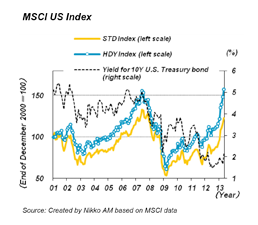

After the tech bubble burst around 2000, the recessionary phase continued until around 2003. Subsequently, the economy bottomed out and then started to pick up in the five years up to the collapse of Lehman Brothers. At the same time, interest rates continued to rise, if slowly. From the start of 2003 when they bottomed out, to the middle of 2007 when they peaked, both the HDY and STD Indices moved continuously in parallel, eventually registering an increase of over 90% as interest rates trended upwards. During this period, despite the fears of some market watchers, the rises in interest rates had absolutely no effect on the performance of stocks with high dividend yields.
If these facts are taken into consideration, it is reasonable to expect that future interest rate rises will have a smaller effect on stock prices than during the previous period when interest rates were on an upward trajectory. A similar tendency was observed in Europe, Japan and Australia (see charts below), and there was no evidence that the performance of stocks with high dividend yields was conspicuously inferior.


Stable changes in stock prices expected for high-dividend-return equity
Stock prices tend to rise when interest rates go up and to fall when interest rates go down. In addition, it seems that the STD Indices experience greater stock-price fluctuations than the HDY Index. Since the time period examined in this report included a period of economic deterioration during which investors became adverse to risky assets as the future of the economy became increasingly uncertain (the so-called risk-off effect), this does not necessarily suggest future trends in these indices. However, it does appear that over a long period of time, as interest rates fluctuate, stocks with high dividend yields are more stable than ordinary stocks. The analyses of the European, Japanese and Australian markets all produced similar results.
Appeal of high-dividend-return stocks unlikely to wane
Market watchers hold various expectations for the future based on the prospects for economic recovery and rises in interest rates. However, it cannot necessarily be said that stocks with high dividend yields are more affected by fluctuations in interest rates. From a longer-term perspective, it is unlikely that the appeal of stocks with high dividend yields will diminish because they can avoid risks at the same time as earning a higher return than ordinary stocks. In addition, we expect an increasing number of investors will seek high income (dividends) and companies will attempt to respond to such expectations by paying more dividends and raising their payout ratios. It’s likely that this will, in turn, lead to improved evaluations of the prices of stocks with high dividend yields.
Disclaimer
Parts of this document have been prepared by Nikko AM. Nikko AM carries on business in Australia through its wholly owned subsidiary Tyndall Investment Management Limited ABN 99 003 376 252 AFS Licence 237563 (Tyndall AM). To the extent that any statement in this document constitutes general advice under Australian law, the advice is provided by Tyndall. Nikko AM does not hold an AFS Licence. This material has been prepared for general information purposes only for sophisticated investors.