
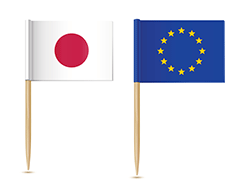
Nikko AM maintains its preference for European and Japanese equities.
Nikko AM’s Global Investment Committee (GIC), which consists of senior investment professionals from the group’s global offices, has updated its views on the global economic situation, financial markets and asset allocation calls.
The committee meets at least quarterly and its views form the basis of Nikko AM’s quarterly asset allocation house view.
In the latest GIC meeting, the committee concluded that equity markets remain attractive and forecast that the MSCI World Total Return Index will increase 4.0% by March 2014[1]. Both the economies of the U.S. and Japan have shown strong signs of growth, while the Eurozone economy has improved significantly. In China, the economy has stabilised somewhat, while inflation remains tame.
“Nikko AM maintains its two-year overweight stance on global equities, with a preference for European and Japanese equities,” said John F. Vail, Chief Global Strategist and Chair of the Nikko AM Global Investment Committee. “In our view, Japan’s GDP in the second half of 2013 will be above consensus due to low inventories, and we expect this will provide a boost to financial markets. The consumption tax in Japan, which will be lifted to 8% from 5% next April, is likely to cause a dip in 2014 second quarter GDP, but we expect growth to recover promptly. Further evidence of strong economic growth will pave the way for additional reforms to be implemented under Abenomics.”
On the fixed income side, the house view is to continue an underweight stance on G-3 bonds, particularly underweighting Japanese Government Bonds relative to ex-Japan bonds. Targets for 10-year bonds as at March-end 2014 are 3.00% for US Treasuries, 0.85% for JGBs and 2.20% for German Bunds.
“We expect the yen to weaken further in the quarters ahead, as the Bank of Japan maintains its easing stance relative to the expected tapering measures from the Fed,” Vail said. “After the September FOMC meeting, we now expect tapering to start in December or January, QE to end in the third quarter of 2014 and the first rate hike in the second quarter of 2015. We believe the U.S. government shutdown will be short-lived and that investors would be best advised to hold onto risk positions through the turbulence. ”