Key points
- Low investment yields from most major asset classes mean the medium term return outlook remains constrained. For example, 7 to 7.5% pa for a diversified mix of assets, not double digits.
- For investors the implications are: have realistic return expectations; focus on asset allocation; and focus on assets providing decent and sustainable income flows.
Introduction
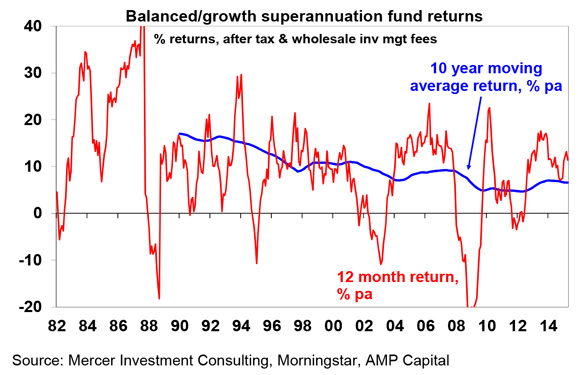
Way back in the early 1980s it was pretty obvious that the medium term (five year) return potential from investing was pretty solid. The RBA’s “cash rate” was averaging around 14%, 3 year bank term deposit rates were around 12%, 10 year bond yields were around 13.5%, property yields were running around 8-9% (both commercial and residential) and dividend yields on shares were around 6.5% in Australia and 5% globally. Such yields meant that investments were already providing very high cash income and for growth assets like property or shares only modest capital growth was necessary to generate pretty good returns. Well at least the return potential was obviously attractive in nominal terms as back then inflation was running around 9% and the big fear was it would break higher. As it turns out most assets had spectacular returns in the 1980s and 1990s. This can be seen in returns for superannuation funds which averaged 14.1% in nominal terms and 9.4% in real terms between 1982 and 1999 (after taxes and fees).

Now it’s not quite so clear as yields have fallen across the board. The RBA cash rate is just 2%, 3 year bank term deposit rates are just 2.7%, 10 year bond yields are just 2.9%, gross residential property yields are around 3% and while dividend yields are still around 6% for Australian shares (with franking credits) they are around 2.5% for global shares. While the recovery from the GFC and the Eurozone debt crisis and the fall in yields (which goes hand in hand with capital growth for bonds and growth assets) has seen solid double digit returns from a
diversified mix of assets over the last few years, it would be dangerous to assume that we have now returned to a world where double digit annual returns are the sustainable norm.
This note takes a look at the medium term return potential from a range of assets and what it means for investors.
Don’t look back – what drives potential returns?
We all know the disclaimer that past returns are not necessarily a guide to future returns. This applies just as much to investment markets as it does to managed funds. Simply taking a long term average of historical returns may be a guide to future returns, but it can be very misleading for the medium term as it ignores the significant impact of starting point valuations. Eg, if current yields – say bond yields and dividend yields – are lower than normal then this will potentially constrain returns relative to what has been seen over the long term.
Investment returns have two components: capital growth and yield (or income flow). The yield is the most secure component and generally speaking the level it starts at when you undertake the investment is key, put simply the higher the better. So our approach to get a handle on medium term return potential is to start with current yields for each asset and apply simple and consistent assumptions regarding capital growth. We also prefer to avoid a reliance on forecasting and to keep the analysis as simple as possible. Complicated adjustments can just lead to compounding forecasting errors.
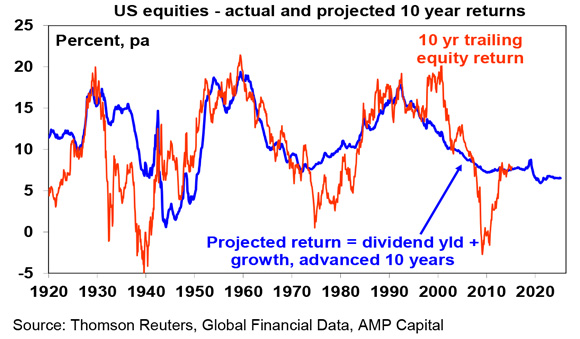
- For equities, a simple model of current dividend yields plus trend nominal GDP growth (as a proxy for earnings and capital growth) does a good job of predicting medium term returns. This approach allows for current valuations (via the yield) but avoids getting too complicated.[1] The next chart shows this approach applied to US equities, where it can be seen to broadly track big secular swings in returns.
- For property, we use current rental yields and likely trend inflation as a proxy for rental and capital growth.
- For unlisted infrastructure, we use current average yields and capital growth just ahead of inflation.
- For bonds, the best predictor of future medium term returns is the current five year bond yield. In other words, capital growth is zero because if a five year bond is held to maturity its initial yield will be its return.

Projections for medium term returns
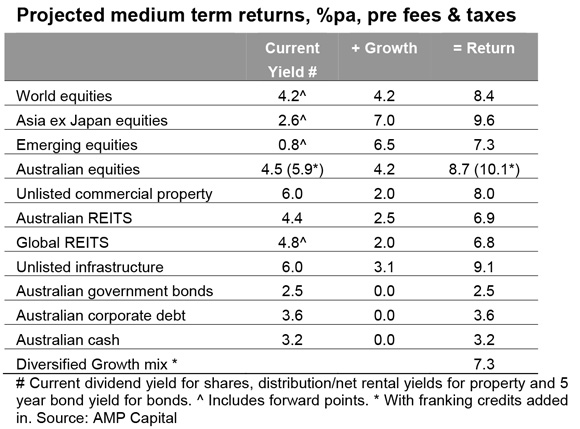
This approach results in the return projections shown in the next table. The second column shows each asset’s current income yield, the third their five year growth potential and the final column their total return potential. Note that:
- We assume central banks meet their inflation targets over time, eg 2.5% in Australia and 2% in the US.
- We allow for forward points in the return projections for global assets based around current market pricing – which adds 1.8% to the return from world equities.
- The Australian cash rate is assumed to average 3.25% over the next five years. Cash is one asset where the current yield is of no value in assessing the asset’s medium term return potential because the maturity is so short. So we assume a medium term average. Normally, for cash this would be around a country’s potential nominal growth rate, but adjusted for higher than normal bank lending rate margins over the cash rate and higher household debt to income ratios which have pulled down the neutral cash rate.
The return implied for a diversified growth mix of assets has now fallen to 7.3% pa and is shown in the final row.

Megatrends influencing the growth outlook
Several themes are allowed for in our projections for capital growth: low inflation; aging populations; slower household debt accumulation; a continued downtrend in commodity prices; ongoing technological innovation and automation; reinvigorated advanced countries versus emerging markets; increased geopolitical tensions in a multi-polar world; increased regulation and scepticism of free markets. Most of these will likely have the effect of constraining nominal economic growth and hence total returns. But not necessarily. Increasing automation is positive for profits and the downtrend in commodity prices is positive for commodity users such as the US, Europe, Japan and Asia but not so good for Australia (where we have lowered our real economic growth assumptions).
Observations
Several observations flow from these projections.
- The medium term return potential remains low. In fact the rally in most assets of the last few years has seen it steadily decline. The next chart shows projected medium term returns using this approach for a diversified growth mix of assets since 2008 over which time there has been a decline from 9.2% pa to 7.3% pa. In fact, at the GFC low point this approach was signalling an attractive 10.3% pa return.
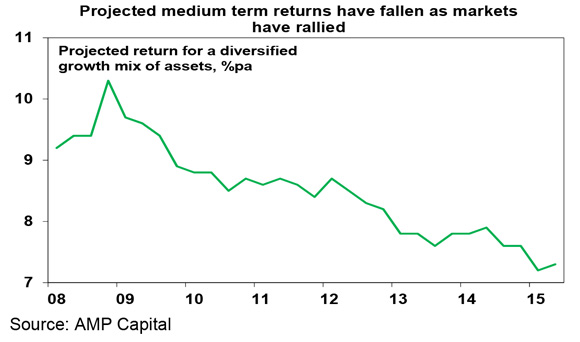

The starting point for returns today is far less favourable than when the last secular bull market in bonds and shares started in 1982, due to much lower yields. Our medium term return projections implying a 7.3 % pa return now from a diversified mix of assets, compares to a 14% pa return by Australian balanced growth super funds over 1982-2007 (pre fees and taxes).
- Government bonds offer very low return potential – the combination of low yields and the risk they will rise causing capital loss implies low medium term return potential.
- Unlisted commercial property & infrastructure continue to come out well reflecting their relatively high yields.
- Australian shares stack up well on the basis of yield, but it’s hard to beat Asian shares for growth potential and falling commodity prices are a headwind for Australian shares.
Implications for investors
There are several implications for investors:
- First, have reasonable return expectations. The GFC is way behind us but the combination of low inflation, low starting point yields and constrained GDP growth indicate it’s not reasonable to expect year after year of double digit returns. In fact, the decline in the rolling 10 year moving average of superannuation fund returns (first chart) indicates we have been in a lower return world for some time now.
- Second, using a dynamic approach to asset allocation makes sense as a way to enhance returns when the return potential from the underlying markets is constrained. This is likely to be enhanced by continued bouts of volatility (eg, regarding the Fed and Greece) & as the correlation between bonds and equities remains low providing opportunities to enhance returns by varying the allocation between them.
- Third, there is still a case for a bias towards Australian shares for yield focused investors, but it makes sense to have a bit more offshore including in traditional global shares, which are looking a bit healthier after a long tough patch, and in Asian ex-Japan shares.
- Fourth, focus on assets providing decent sustainable income as it provides confidence regarding returns, eg commercial property and infrastructure.
Dr Shane Oliver, Head of Investment Strategy and Chief Economist, AMP Capital
[1] Adjustments can be made for: dividend payout ratios (but history shows that retained earnings often don’t lead to higher returns so the dividend yield is the best guide); the potential for PEs to move to some equilibrium level over time (but this relies on forecasting the equilibrium PE correctly which can be hard to get right and in any case extreme dividend yields send a strong enough valuation signal anyway); and adjusting the earnings/capital growth assumption for some assessment regarding profit margins (but again this has been shown to be very hard to get right at the country level, eg US profit margins have been strengthening for decades). So we prefer to avoid forecasting these things.
————