Investment markets and key developments over the past week
Share markets had a mixed ride over the last week not helped by renewed weakness in Chinese shares early in the week but this was offset to a greater or lesser degree depending on the market by good US earnings results, a benign Fed and good data in Europe. While Chinese shares fell, Japanese and Eurozone shares were little changed and US and Australian shares rose. In fact the Australian share market is set for its best monthly gain since February, albeit this followed a bad June. Bond yields were largely flat except in Europe where they fell. Commodity prices and currencies were little changed with the $A remaining just below $US0.73.
Chinese shares had a bad week with their biggest one day fall in eight years, largely in response to a rumour that the China Securities Finance Corp was no longer committed to stabilising the share market. While this was subsequently denied volatility remained high. After very sharp share market falls like the 1987 share crash or through the tech wrecks and GFC it’s quite normal to see a volatile period of base building around the bottom. So the same is likely to apply in relation to China. That said further policy stimulus is still needed in China.
Fed on track to hike but no clearer on whether the first move will come in September or December. While the Fed sounded reasonably, its description of the risks to the US economy being “nearly balanced” as opposed to “balanced” suggests it’s not itching to hike just yet. A further improvement in growth and confidence that inflation will rise is needed and at this stage its 50/50 as to whether it kicks off in September or December. By the time the Fed does eventually hike it will be the most anticipated rate hike ever, which should mean it will hardly be a shock to financial markets.
Are Australian companies really paying out too much in dividends? With the August profit reporting season the focus will no doubt return again to the high dividend payout ratios of Australian companies in response to yield hungry shareholders. Some allege that this is robbing future growth potential and risks a “doom loop” turning Australia into a “backwater.” But is it really? First let’s put it in perspective. The dividend payout ratio of Australian companies at around 75% is not out of line with its long term range. See the chart below.
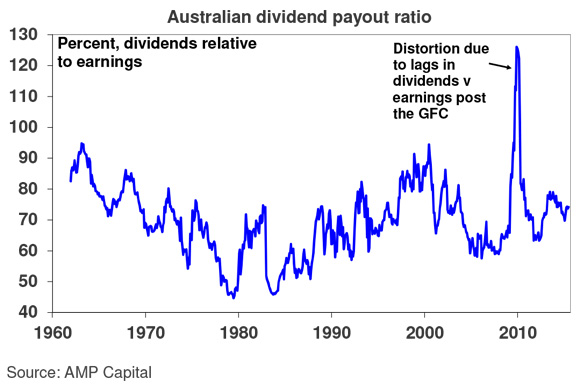

Yes it’s increased since 2012 but this has been driven by higher payouts for resources stocks and there is a good reason for this. After their huge investment in new mining capacity it makes sense to use excess cash flow now to return to investors via dividends. For the rest of the market the payout ratio has been going sideways! Second, it’s far healthier for companies to pay strong dividends (provided they are not being paid using debt) because it signals sustainable cash flows, confidence in future earnings and helps prevent corporate hubris leading to wasteful investment. Finally, capex in Australia is now too low and needs to rise – but the reason its low has nothing to do with investors’ desire for dividends. Miners would be crazy to ramp up in investment now and the reason industrial companies are reluctant to invest owes to the beating they got through the mining boom years and a lack of corporate confidence post the GFC which is a global phenomenon.
Major global economic events and implications
US economic data was a bit disappointing. June quarter GDP growth bounced back, but only to a 2.3% annualised pace, the March quarter was revised up less than expected and previous years’ growth was revised down. On top of this durable goods orders, consumer confidence, home prices and pending home sales all disappointed. Against this, the Markit services conditions index rose to a solid 55.2 and a surge in household formation to around 1.6 million a year suggests demand for housing will remain solid. Overall the US economy is continuing to grow but it’s a long way from booming.
The US June quarter earnings reporting season continues to better expectations. We are now 70% done and 74% of companies have beat on earnings, 50% have beat on sales and earnings growth expectations for the 12 months to the June quarter have improved from -5.3% at the start of July to -0.5%.
Eurozone economic confidence rose in July to a four year high, despite the noise around Greece, and is running around levels consistent with decent growth. On top of this bank lending is continuing to improve and the Spanish economy grew 1% in the June quarter with annual growth at its fastest since before the GFC. Clearly Spain is not a Greece!
Japanese economic data was mixed with household spending down and unemployment up, but against this the jobs to applicants ratio held at its highest since 1992, industrial production rose more than expected in June with an improvement in the July PMI pointing to further gains and core inflation at least rose to 0.6% year on year in June.
Finally, the messy picture in the emerging world is continuing with Brazil hiking rates for the 16th time since April 2013 as consumer confidence there continues to crash. Continue to be selective in investing in the emerging world. Asia – from India to China – looks best.
Australian economic events and implications
Australian data was weak with a sharper than expected fall in building approvals and another sharp decline in export prices in the June quarter. While the fall in building approvals is not really a concern being driven by normally volatile apartment approvals and with the trend remaining very strong, the continuing slump in export prices indicates a continuing fall in the terms of trade and national income. Credit growth also moderated with all components soft except lending to investors which at 10.7% yoy is well above APRA’s target. But with APRA now biting hard this is likely to be a last gasp for lending to property investors.
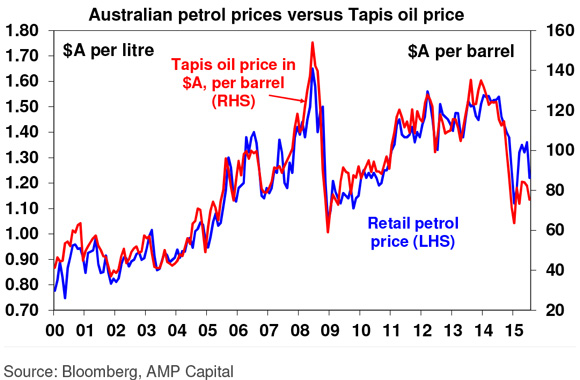
It’s interesting to note that we are starting to see some petrol stations selling petrol for around $1.22/litre. Maybe petrol prices are at last starting to fall back into the line with their normal relationship with global oil prices adjusted for the lower $A.

What to watch over the next week?
In the US the focus will be on the July ISM manufacturing conditions PMI (Monday) which is expected to remain solid at 53.5 and July jobs data (Friday) which is likely to show continued strong jobs growth of 220,000 but unemployment remaining unchanged at 5.3%. Monthly wage earnings data will be watched closely for the long awaited acceleration.
The Bank of Japan (Friday) is unlikely to change monetary policy, although a further step up in quantitative easing remains on the cards given that inflation remains well below target.
In China, expect a slowing in export and import growth for July and inflation data (Sunday) is likely to show an increase driven by higher pork prices but with non-food inflation remaining very low.
In Australia, the RBA will probably leave interest rates on hold (Tuesday), but it’s a very close call and it wouldn’t surprise me at all if they cut. Recent commentary from Governor Stevens suggests the RBA is not in a hurry to cut rates again and stronger than expected jobs data in recent months, the fall in the $A and a desire to confirm that APRA’s efforts to slow property investment are working all suggest the RBA will leave rates on hold on Tuesday. However, the odds are strongly skewed in favour of another cut, if not Tuesday then in the months ahead thanks to the bleak outlook for investment, continued sub-par economic growth, the $A still being too high, inflation remaining benign and increasing signs that APRA’s efforts to rein in property investment are starting to really bite. The RBA’s August Statement on Monetary Policy (Friday) will likely confirm that the RBA retains an easing bias.
We’ll also see the usual data avalanche that occurs at the start of each month. Expect to see a moderation in Core Logic-RP Data home price growth (Monday), a slight improvement in the trade balance and a modest 0.3% gain in June retail sales (both Tuesday), a 5000 gain in July employment and unemployment rising to 6.1% (Thursday) and a 4% bounce back in housing finance (Friday).
Finally, the June half profit reporting season will start albeit with only 7 major companies reporting results with one being Rio. Profit growth for 2014-15 is likely to be around -1% as resource sector profits slump 28% thanks to the hit from lower commodity prices, but with the rest of the market seeing profit growth of around 9% as banks and financials continue to perform well and industrials ex financials benefitting from low interest rates, the lower $A and cost cutting. Key themes are likely to be: weak revenue growth, ongoing cost cutting, competitive pressures amongst consumer staples but tailwinds for building material companies and continued strength in dividend growth.
Outlook for markets
Share markets are likely to remain volatile as we are still going through a seasonally weak period of the year for shares, uncertainties remain regarding Chinese economic growth and a likely Fed interest rate hike lies ahead for later this year.
But beyond the near term, the cyclical bull market in shares likely has further to go: valuations against bonds are good; economic growth is continuing at a not too cold but not too hot pace; and monetary conditions are set to remain easy. As such, share markets are likely to remain in a broad rising trend. My year-end target for the ASX 200 remains 6000.
Still low bond yields point to soft medium term returns from bonds, but it’s hard to get too bearish on bonds in a world of too much saving & spare capacity. Central banks won’t ratify a bond crash like in 1994, by raising interest rates aggressively.
The broad trend in the $A remains down as the Fed is likely to raise rates later this year whereas there is a 50/50 chance the RBA will cut again and the trend in commodity prices remains down. Our view remains that it is heading into the $US0.60s, and this could now come before year end.
———