The investment marketplace in Australia is characterised by preference debates, where adherents of one school of thought battle it out with those of another – think property versus shares, domestic versus international shares, growth versus value stocks, active versus passive investment management.
To the savvy adviser, however, these often-fierce debates posit a choice they don’t have to make. Each side of these debates makes valid points – and there is nothing stopping the adviser from cherry-picking these points to use in their clients’ portfolios, designed to suit their investment philosophy, requirements and risk tolerance.
Increasingly, advisers understand they do not have to be a passionate fan of active management, for example, and criticise passive management for capturing the dud performers in the index as well as the stars. Nor should they opt wholly for indexed management, and savage the active managers as over-charging for promised out-performance that may not be delivered or sustained.
What they should be doing is selecting the best of both worlds – using active management where it works best, and the same for passive.
In Australian equity funds management, investors have to deal with the highly concentrated nature of the stock market. The Australian market is one of the most concentrated in the world: according to IRESS as at September 2015, the top 20 largest companies on the Australian Securities Exchange (ASX) accounted for 62% of the total value of the S&P/ASX 300 Index. Moreover, the Financials and Resources sectors account for almost two-thirds of total market capitalisation. The majority of the market’s beta is generated by the top echelon of stocks, in a handful of sectors.
In effect, there are two Australian stock markets: the top 20, and the rest. The large equity funds see the top 20 as an easy opportunity to deploy a similarly large percentage of their funds: the top 20 stocks are among the most liquid, and heavily weighting them entails less risk, at least in terms of tracking error.
Because of this concentration – and the commercial pressure on big-brand fund managers to show little tracking error, so as to avoid relative under-performance – many active portfolios end up holding more than half of their portfolios in weightings very similar to the index. It is not unusual to see these funds holding at least three of the big four banks (CBA, Westpac, ANZ and/or NAB), a major miner (usually BHP), one of the large retailers (Woolworths or Wesfarmers), and perhaps an insurer (Suncorp or IAG).
With so much overlap, it is difficult for a manager to differentiate performance from the index, or from peers. This concentration – and the tendency it breeds towards homogenised portfolios – has resulted in a marked correlation between the performance of the average Australia equity fund and the index, as shown in the accompanying chart. But in some cases, investors are paying the actively managed fund almost three times the charge for an index fund – while receiving virtually the same performance as the latter.
That situation is not sustainable.
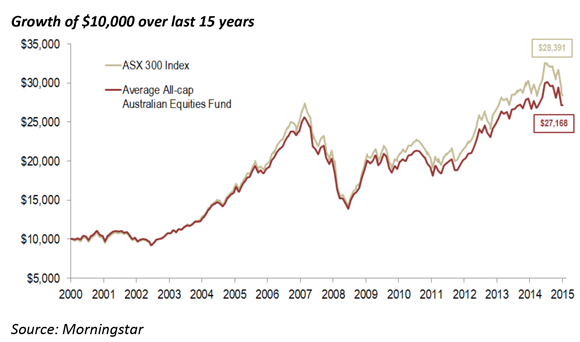

However, the high level of concentration of the Australian market – in terms of both market capitalisation and manager holdings – throws up some opportunities that can be harnessed by the informed investor.
It is difficult for active managers to add value in large-cap Australian stocks, because they are often held in weightings very close to those of the index, and they are intensely scrutinised by both stockbroking analysts and the fund managers’ internal analysts. But the corollary to this is that outside the market concentration – in the population of stocks outside the top 20 – there is ample scope for portfolio managers to gain, and back, their own insight into the companies.
This “other” Australian stock market is a far less efficient market in terms of information. As companies go down the capitalisation scale – outside the top 50, top 100, and top 200 etc. – the analyst coverage decreases, while the potential to outperform the market by undertaking proprietary research rises. Here, the risk/return opportunities favour the managers who know the stocks best.
According to research house Zenith Investment Partners, over the three years to 31 December 2014, the median small-cap manager rated by the firm outperformed the small-cap benchmark, the S&P/ASX Small Ordinaries Accumulation Index, by an impressive 18.5% a year.
That is the level of excess returns – or alpha – that certainly justifies paying active management fees. The situation shown in the accompanying chart does not. This bifurcation of the market can be used by smart investors to get more bang for their buck: to pay active management fees where managers can demonstrate that they can leverage their skill and insights to generate excess performance, but not to waste those fees where this is not so easily demonstrated.
Increasingly, advisers are unwilling to think in terms of black versus white in the investment exposures they use. They are more than capable of choosing to use active management where it offers them value for money, and passive management where they are more likely to get the index performance than any premium. While cost is a big factor in this choice, it comes down to growing preparedness to use active management only where it counts.
From Bennelong Australian Equity Partners (BAEP, a Bennelong Funds Management boutique)