Investment markets and key developments over the past week
The “risk on” rebound took a bit of a breather over the last week. The rebound in shares, commodities and commodity currencies like the $A had been so fast that it had taken them to a point where they were technically overbought and in many cases up against resistance and on the flipside the US dollar had become oversold. So we were primed for a pullback and the trigger has been provided by various Fed officials expressing confidence in the US economy and the Fed’s desire to continue raising interest rates with its April meeting being “live”. As a result the US dollar reversed a bit of its recent fall and most share markets, commodities including oil and the Australian dollar pulled back a bit. Bond yields were little changed.
On the Fed, it was inevitable that after the March meeting various Fed officials would express their individual views. But so far we have only heard from a handful of mainly non-voting Fed officials and there is nothing to indicate that the Fed has suddenly become more hawkish. Our assessment remains that while the April meeting is live, it won’t see a hike but that a June hike remains a reasonable base case. The US money market is currently attaching a 6% probability to an April hike and a 38% probability to a June hike which looks a bit too low (it’s more likely 55%).
While the short term pull back may have further to run, we see it as just that, ie a pull back, and still see the broad trend as up. Supportive of this are slightly better March business conditions readings globally, lessening concerns regarding China and confidence that the Fed is aware of global risks and doesn’t want to accentuate them by tightening too aggressively and reigniting significant upwards pressure in the US dollar which would only renew pressure on oil prices, the Chinese Renminbi and the emerging world.
The horrible attacks in Brussels have provided a reminder of the terrorist threat. This is first and foremost a human issue and my thoughts are with those affected. However, from an investment perspective the reaction in Eurozone shares to the Brussels attacks was pretty muted which is consistent with the muted share market reaction to the Paris attacks last November. Two things are worth noting. First, recall that parts of Europe have lived with terrorism in decades past, eg the IRA campaign regarding Northern Ireland, the Red Army Faction in Germany. After a while these came to be seen as the norm and people just went about their lives around them. Secondly, the experience of the last decade or so has highlighted that terrorist attacks on soft targets like buildings and sports venues don’t really have a lasting economic impact. So while the 9/11 attacks in the US had a big short term share market impact with US shares initially falling 12%, they had recovered in just over a month, the Bali and Madrid bombings had little market impact and the impact on the UK share market of the London bombings of July 2005 was reversed the day after. So while the terror threat is negative for confidence, there is unlikely to be a significant economic or financial market impact.
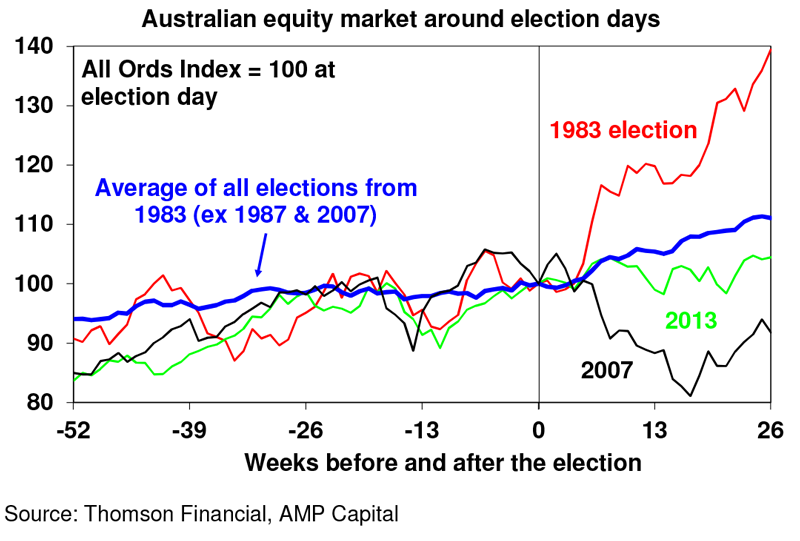
Australia back in election mode? Well not quite but it seems that way with the Government moving another step closer to a July 2nd election by bringing the Budget forward to May 3rd so it has plenty of time to pass supply bills ahead of calling such an election on May 11th if it gets a double dissolution trigger. The downside for the economy is the uncertainty that election campaigns create. The upside may be more rational policy making out of Canberra if the Senate gets cleaned up with a double dissolution election. In terms of the economic impact of Federal elections on the economy while there is some evidence that people adopt a more cautious approach to spending during campaigns there is no clear evidence that election uncertainty affects growth in election years as a whole. Since 1980, economic growth in election years has averaged 3.7% pa which is stronger than the 3.2% average growth over the period as a hole. For shares there is some evidence of the Australian share market tracking pretty much sideways in the run up to elections but on average it has gained 4.9% in the three months after elections since 1983.

Major global economic events and implications
US economic data was mostly okay. While existing home sales fell sharply this may be partly related to limited supply and new home sales rose. On the manufacturing front the Markit manufacturing conditions PMI rose 0.1 points to 51.4 which is well above the ISM manufacturing index and solid gains in regional manufacturing indexes add to evidence that the worst may be over for US manufacturing.
A rebound in Eurozone business surveys for March add to confidence that the falls seen in February were driven more by share market turmoil rather than fundamentals. The March business conditions PMI and German IFO index rose to levels associated with good growth.
Japan’s manufacturing conditions PMI for March was less favourable though, falling 1 point to 49.1.
Australian economic events and implications
In Australia, ABS data confirmed a loss of momentum in home price growth in the December quarter last year consistent with what private surveys had already shown – since then timelier data suggests that it has picked up again but is still down from last year’s highs. Meanwhile, largely due to lower immigration levels, population growth continued to edge down to 1.3% for the year to the September quarter last year which is well down from the recent high of 1.8% in 2012. This will mean a slight slowing in underlying demand growth for housing, but that said population growth is still solid and the slowdown may be being offset by a pick-up in short term student arrivals on the back of the lower $A. The latter are not included in the population stats for obvious reasons but they still need to be housed.
Meanwhile, RBA Governor Glenn Steven’s commented that Australia is adjusting well to the end of the mining boom, that it has more room to ease monetary and fiscal policy than most other countries and that the rise in the value of the $A may have got a bit ahead of itself. All of which I agree with. The Governor’s comments on the $A clearly indicate a degree of discomfort with its recent rise and echo similar sentiment from other RBA officials over the last few weeks. The Australian dollar’s ascent though has not been enough yet on its own to provide a trigger for another rate cut, although it does add to the case.
What to watch over the next week?
In the US its back to watching payrolls and the ISM manufacturing conditions index with both due on Friday and expected to show the US economy doing okay. Expect to see a solid 200,000 gain in March payrolls with unemployment unchanged at 4.9% and wages growth picking up slightly and the ISM manufacturing conditions index bouncing back to around 50.5 (from 49.5) consistent with stronger regional surveys. Meanwhile the core private consumption deflator (Monday) for February is expected to show a further rise to 1.8% year on year, pending home sales (also Monday) are expected to move up as are home prices and consumer confidence (both Tuesday).
In the Eurozone, money supply and credit data for February (Tuesday) will be watched for any impact of the turmoil in bank shares seen early this year and March inflation data (Thursday) is expected to remain low.
Japanese data is expected to show labour market strength but soft household spending (all due Tuesday) and industrial production (Wednesday). The Tankan business conditions survey will also be released Friday.
Chinese business conditions PMI’s due Friday are expected to show a slight improvement in conditions for March.
In Australia, expect to see continued modest credit growth (Thursday) and it will be interesting to see whether the recent strength in the value of the Australian dollar has dented the AIG’s manufacturing conditions PMI due Friday. Core Logic RP Data house price data is expected to show continued modest growth in national home prices for March.
Outlook for markets
After strong gains from their February lows shares are overbought and vulnerable to a pull back. Beyond the near term uncertainties though, we still see shares trending higher this year helped by a combination of relatively attractive valuations compared to bonds, further global monetary easing and continuing moderate global economic growth.
Very low bond yields – with something like 25% of global sovereign bonds now having negative yields – point to a soft medium term return potential from them, but it’s hard to get too bearish in a world of fragile growth, spare capacity, weak commodity prices and low inflation. Bonds in higher yielding countries like Australia, the US and maybe even China are relatively attractive.
Commercial property and infrastructure are likely to continue benefitting from the ongoing search by investors for yield.
National capital city residential property price gains are expected to slow to around 3% this year, as the heat comes out of Sydney and Melbourne. Prices are likely to continue to fall in Perth and Darwin, but growth is likely to pick up in Brisbane.
Cash and bank deposits are likely to continue to provide poor returns, with the RBA expected to cut the cash rate to 1.75%.
The ongoing delay in Fed tightening and stronger data in Australia pose further short term upside risks for the $A. However, just as we saw with the early 2014 9% bounce in the $A, any short term strength in the $A is unlikely to go too far and the broad trend is likely to remain down as the interest rate differential in favour of Australia narrows as the RBA eventually resumes cutting the cash rate or at least resorts to jawboning and the Fed eventually resumes hiking, commodity prices remain weak and the $A undertakes it’s usual undershoot of fair value.
By Shane Oliver, AMP Capital