Today, Britain will vote on whether or not to leave the European Union. Given the deep economic ties between Britain and the EU, “Brexit” would have implications across the global economy. Before we understand the implications, it’s important to establish that Britain is an open economy actively involved in the global economy and heavily intertwined with the EU. Here’s what that looks like.
Britain’s EU membership Britain joined the EU in 1973 and is now one of 28 current member states. Nineteen of these share the euro as a common currency, accounting for around three quarters of EU gross domestic product (GDP). Britain is not part of the common currency and continues to use the British pound. The existence of the British pound with a floating exchange rate has given the Bank of England an array of policy options to manage the shocks to which Britain’s economy is subject.
The sizable impact of Britain’s role in the EU While we may not be able to measure the precise impact of EU membership on Britain’s economy, we can demonstrate the interconnectedness of Britain and the EU. The following is extracted from the EU membership and Bank of England Report, published October 2015. British pounds have been converted to U.S. dollars based on an estimated exchange rate of 1.42.
Population
- 505 million people live in the EU, approximately 7% of the world’s population.
- Britain is home to 12.5% of the EU’s population, the second most populous EU country.
Economies
- EU is the largest economy in the world with GDP worth £11.3 trillion (approximately $16 trillion) in 2014, which is larger than the U.S. ($15 trillion).
- Within the EU, Britain is the second largest economy.
- The U.K. GDP was worth £1.8 trillion (approximately $2.6 trillion) in 2014, nearly onesixth of EU output.
Cross-border trade
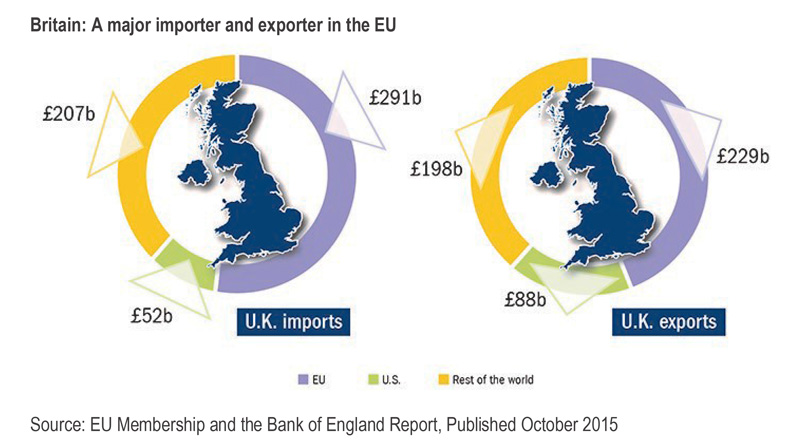
- One-third of all global trade is with the EU, the largest exporter and importer in the world.
- The EU is Britain’s biggest trading partner.
- The U.K.’s exports and imports are worth 60% of its GDP.
- 70% of Britain’s largest import and export markets are fellow EU members

Investment
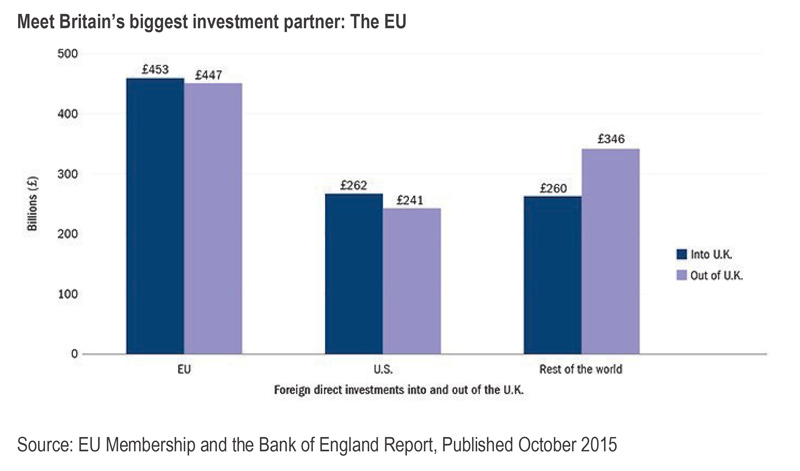
- The EU is Britain’s biggest investment partner.
- The EU serves as the destination for or source of more than two-fifths of Britain’s cross-border investments.
- Britain is one of the top destinations for foreign direct investment (FDI) within the EU and globally.
- Two thirds of all global cross-border investment involves the EU.
- Foreign investors own £10.6 trillion (approximately $15 trillion) of U.K. assets while U.K. investors own £10.2 trillion (approximately $14 trillion) of foreign assets.

Large financial services sector
- The EU has one of the world’s largest financial service sectors, second only to the U.S.
- The EU is home to 14 of the world’s 30 globally systemically important banks (GSIBs) versus eight for the U.S., and accounts for half of all global exports of financial services.
- Britain is the largest financial center in the EU, with financial services accounting for 8% of Britain’s national income.
- The British financial sector is heavily interconnected with the rest of the EU, with 80 of the 358 banks operating in Britain headquartered elsewhere in Europe.
A long goodbye
Even if the referendum passes, a decision to leave the EU will not be effective for two years after a formal notice to leave is issued by the British government. The time between vote and exit would be critical to untangle the myriad of interconnections and negotiate new agreements. Agreements on trade, people movement, investment and financial services are important to both Britain and the EU. They are also important to the global economy.
Bottom line
Overall, it is clear that a post-Brexit world would have its challenges. Only time will tell how the world reacts if Britain decides to leave the EU, but this is a global event not just a British or EU event. Many financial markets are at or above fair value and any disruption to growth would be cause for concern. In the event of market disruption caused by the vote, investors should keep in mind that an exit from the EU is not immediate and the required changes would take years to see through.
By Colin Moore Global Chief Investment Officer, Columbia Threadneedle