Economic Update
Inflation becalmed; poised to lift only slowly
Consumer price index
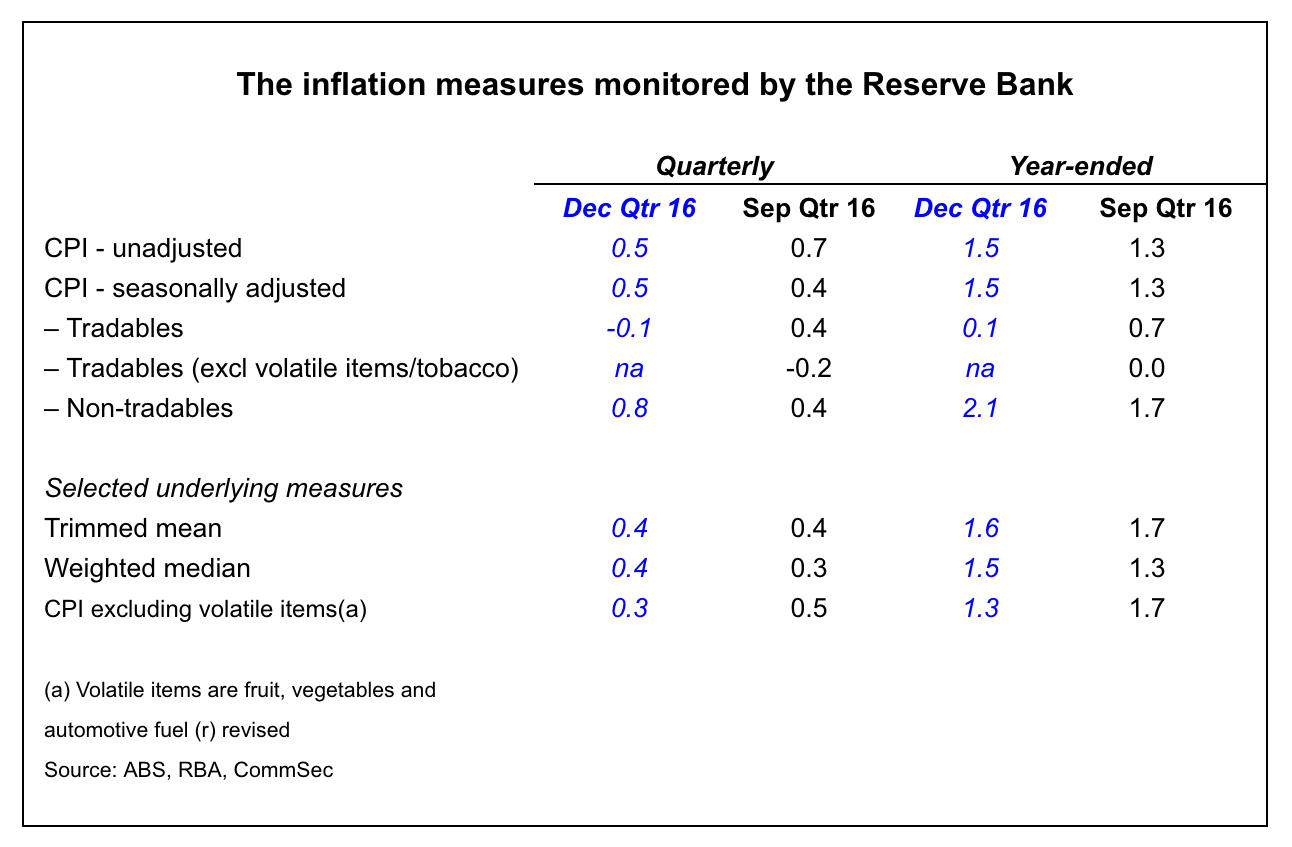
- Inflation: The Consumer Price Index – the main measure of inflation in Australia – rose by 0.5 per cent in the December quarter, below expectations for a lift of 0.7 per cent. In seasonally adjusted terms the CPI rose by 0.5 per cent. The annual rate of inflation rose from 1.3 per cent to 1.5 per cent.
- Underlying measures: The Reserve Bank monitors three measures to derive the underlying inflation rate. The trimmed mean rose by 0.4 per cent in the December quarter (1.6 per cent annual); the weighted median rose by 0.4 per cent (1.5 per cent annual) and the CPI less volatile items rose by 0.3 per cent (1.3 per cent annual). Overall, underlying inflation rose by 0.4 per cent in the quarter and by 1.5 per cent over the year.
- Main changes: Tobacco prices rose by 7.4 per cent, with petrol up 6.7 per cent, domestic travel and accommodation up 5.5 per cent and home purchase up 0.5 per cent. The CPI was dragged lower by a 2.6 per cent fall in international holiday travel and accommodation, 5.1 per cent fall in clothing “accessories” and 3.2 per cent fall in waters, soft drink and juices.
What does it all mean?
- Inflation has bottomed, but it certainly doesn’t seem on a sharp acceleration path. Annual inflation has lifted from 1.0 per cent to 1.5 per cent over the past six months, but it remains well below the Reserve Bank’s 2-3 per cent target band.
- But while inflation is not yet a concern for the Reserve Bank, interestingly consumers have other ideas. The latest weekly consumer sentiment survey by Roy Morgan and ANZ put inflationary expectations (out two years) at the highest level in 4½ years. No doubt the lift in petrol prices has spooked consumers and caused them to take their eyes off other prices which are either falling or becalmed.
- It is clear that interest rates will stay low for an extended period. The Reserve Bank doesn’t need to cut rates again with inflation trending higher, rather than lower. And there are doubts that rate cuts would actually do much in terms of driving the economy higher and lifting inflation. And rate hikes are off the agenda. Crucially, global competition ensures that retailers can’t lift prices in the current environment.
- Indeed global competition is still a significant factor in restraining price pressures. Simply, consumers can buy goods whenever they want and wherever they are. Retailers have to watch their local as well as their global competitors.
- While inflation is still low, there is no room for complacency. “Non-tradable” goods prices rose by 0.8 per cent in the December quarter. These prices are more influenced by conditions in Australia, rather than global factors. And as noted, consumer inflationary expectations have lifted.