

Why does staff engagement matter?
Happy staff, happy clients, happy shareholders
A company’s biggest asset – as the saying goes – is its people.
It’s a truism that applies equally to the largest corporations and the smallest suburban businesses. Despite this, many smaller business owners often see the formal process of people (HR) management as something that is not only beyond their capabilities but worse still, a distraction, or a secondary priority, believing it to be a ‘warm and fuzzy’ that doesn’t have a direct link to business revenue. A proactive focus on staff engagement is thus seen as taking valuable time away from running a business.
In reality, nothing could be further from the truth. There is an extensive body of research linking staff engagement with a range of key business performance metrics, including:
- Staff turnover
- Productivity
- Absenteeism
- Revenue, and
- Customer satisfaction.
Furthermore, ‘people issues’ can be more important for small businesses than larger ones, because their impacts are magnified.
A small business is more dependent on its individual employees, and so their performance, absence, and interactions and relationships with other team members and clients can have a much bigger impact on the bottom line.
Staff engagement should therefore be a key business priority for all financial planning practices.
What is staff engagement?
In simple terms, engagement is an employee’s commitment to helping their organisation achieve its goals. Engaged team members share a passion for the business and its clients and will independently work hard to reach the group’s goals – even when you’re not there. It means your staff care as much about your business – and its success – as you do.
Why does it matter?
The myriad benefits of engaged staff – far from being ‘warm and fuzzy’ – are evident in the numbers. Consider these for a moment:
- Increased performance and productivity – research[1] shows engaged employees are more likely to help the company achieve its goals
- Better staff retention – a survey[2] by Oxford University researchers found engaged employees are 87% less likely to leave their organisation, which means reduced costs in having to recruit new staff, train them and wait for them to ramp up to full productivity
- Increased revenue – a global study of workplaces by the Gallup Group[3] found highly engaged teams are on average 21% more profitable, and those teams in the top engagement quintile realise a 41% reduction in absenteeism, and experience 59% less attrition
- A better customer experience – the same Gallup study found that highly engaged workplaces see a 10% increase in customer ratings and a 20% increase in sales.
The cost of getting it wrong can be substantial. According to the employer body Australian Industry Group[4], the cost of replacing an individual employee can be up to 150% of their annual salary. The direct and indirect costs include:
- Termination costs for the employee who leaves
- Recruitment and advertising costs
- Lost productivity of business covering for that vacancy
- Lost productivity of managers involved in recruiting process
- Impact to morale of remaining staff if they have to pick up extra workload
- Potential loss of clients served by that employee
- Poor client experience due to incomplete ‘handover’ of files
- Newer employees may demand higher salary
- Lost productivity of personnel required to training new team member
- Lower productivity amongst new starters while they ‘come up to speed’.
Putting time and money into initiatives that improve employee engagement may seem like a luxury – especially during a pandemic – but, in fact, investing in your team will pay significant dividends now and into the future.
Measuring staff engagement
Whilst in a simple sense measuring staff engagement involves the assessment of data captured from employee surveys, the complexity lies in what questions are actually asked. Asking a question as direct as ‘are you engaged’ is unlikely to provide meaningful insights, either because people don’t think in terms of ‘engagement’ or they aren’t sure what it means. (They may also be reluctant to provide the answer although that’s more related to confidentiality, which can be challenging for smaller businesses.)
Typically, staff engagement survey questions are framed more in terms of the underlying drivers of engagement. Respected engagement specialist Qualtrics[5], for example, measures engagement as a composite measure of 5 factors, designed to understand intended behaviours like intent to stay, likelihood to go above and beyond what is required of employees, and willingness to recommend a company. The 5 specific factors are:
- Intent to stay – the likelihood that people will still be with the company in the next 2 years
- Work involvement – the psychological and emotional contribution people apply to their work
- Discretionary effort – the level of effort above the minimum required that people are willing to put into their work
- Pride in the company – the extent to which people feel proud to work there
- Willingness to recommend their organisation – how likely people are to recommend their organisation to friends and family
Each of these items provides a score which, when combined, gives an overall metric of employee engagement.
A variety of downloadable, free, staff engagement surveys can be found online.[6]
Relying on your own ‘finger in the air’ assessment of team engagement – “we’re a happy team here at ABC Financial Planning” – is not a robust way of tracking staff engagement. And those who do take the time to measure it more scientifically may be surprised by the results.
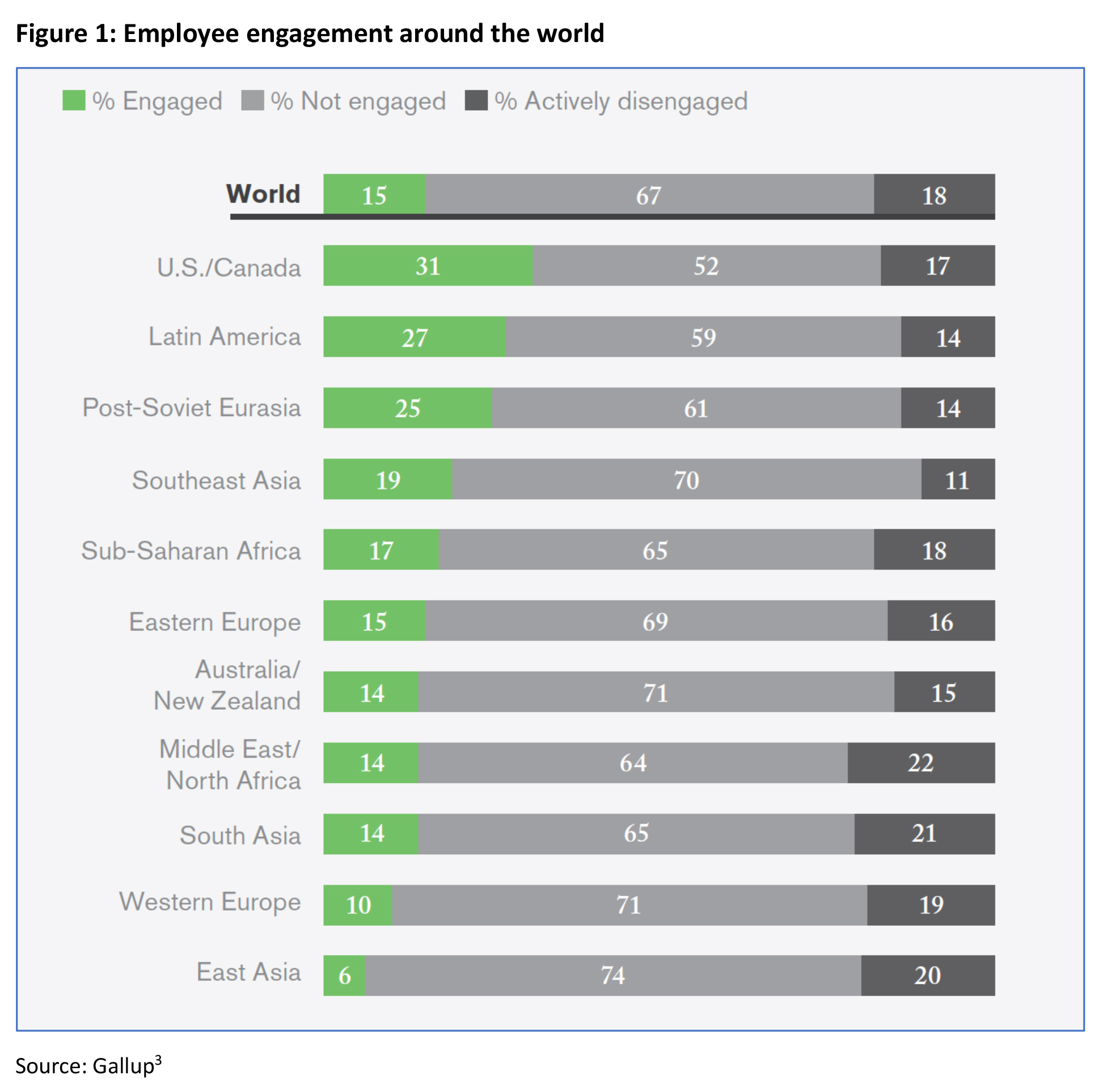
Gallup examined employee engagement across the world in its 2017 ‘State of the Global Workplace’ report[7] and found engagement levels alarmingly low.
Australian workplaces were found to be amongst the worst in the world when it comes to employee engagement and satisfaction, with employees reporting a lack of respect and little opportunity for collaboration.
The Gallup report found on average only 14 per cent of employees in Australia and New Zealand are engaged in their jobs. An overwhelming 71 per cent are not engaged and as many as 15 per cent are actively disengaged.
The report saw Australia rank seventh out of 11 global regions, trailing behind Sub-Saharan Africa and Eastern Europe!

The good news is that as an employer, there are practical steps you can take to improve staff engagement (or maintain existing high engagement levels).
The even better news is that the drivers of engagement, which include a sense of empowerment and involvement – ‘making a difference’ – can actually be easier to influence in a small business than a large one.
Practical ways to drive staff engagement in financial planning practices
- Create a clear and meaningful company purpose, a vision that each employee can connect with: when you have a clear vision of why you exist and what you want to deliver, it’s much easier for the team to get excited about it. This should be authentic and come from the heart. For those of you familiar with Simon Sinek[8], this is the ‘why?’ for you and your business. Make your people as passionate about helping your clients as you are.
- Know your people, and ensure your workplace is set up for them to thrive, develop and feel valued this means:
-
- hiring the right people to start with
- onboarding them properly
- giving them a voice
- celebrating team and individual successes; and importantly
- investing in their development through training and performance management.
Remember, the time and financial cost of training your people is an investment, not a cost. It’s an investment in their productivity and value to the business but also in their engagement and loyalty. As the apocryphal conversation between the CFO and CEO goes:
CFO: What happens if we invest in training our staff and they leave?
CEO: What if we don’t, and they stay?
- Create an atmosphere of trust and safety by being honest, vulnerable and transparent in your communications: whenever there is an issue in your practice, the most important gift your team can give you is honest information about what the problem is/was. But people won’t be honest and transparent if they feel as though it will come back to bite them. Your team has to feel that it’s not only safe to be honest, but that honesty is actually valued and can help the business go forward. Trust is essential.
- Communicate and encourage two-way conversations where you really listen to your team: this requires you to be accessible – have an open-door policy – and to make the time for regular dialogue with all your team. This could be weekly meetings, or informal team get-togethers (lunch, morning tea, external events etc).
- Make staff feel they are genuinely making a difference: in a small business context, the role of individual employees, and their ability to genuinely make a difference, is greater than in bigger organisations. Leverage this to your advantage. Have them involved in business strategy days. Let them present to your broader team on an expert topic. Allow them to make suggestions about improving the business. Build a culture of collaboration – for example, by having all staff involved in designing the customer experience they are responsible for delivering.
- Get the basics right as well: whilst monetary compensation is obviously important (make sure to keep up with market benchmarks), countless studies[9] show the paramount importance of non-monetary benefits. These can include:
-
- The physical workspace – some people will gladly trade off salary for a contemporary workspace with colour and light and openness and a little bit of fun;
- Food (free lunches, fruit, breakfasts, a Friday drinks trolley)
- Subsidised or discounted memberships
- Flexible working arrangements (a COVID must)
- Volunteering/study leave (does your business support a charity or community cause?)
- Free additional leave (e.g. birthdays, ‘mental health days’) or the ability to ‘buy’ extra leave
- Offering salary sacrifice arrangements (e.g. cars, laptops)
The remote challenge – engaging staff during COVID and beyond
COVID has revolutionised the way we work, accelerating the trend towards more flexible and remote working out of sheer necessity. Financial planning businesses haven’t been immune to this trend, and as a profession based on deep, trusting, personal relationships, the ability to connect and engage with both clients and colleagues has no doubt been keenly felt by advisers and their staff.
Whilst the move to more digital engagement channels has been embraced by many clients, remote and flexible working can make it harder to build and maintain team culture and engagement levels.
The fundamental drivers of engagement discussed above not only remain important in times of disruption, but they can also actually help a business navigate the consequences of such disruption more smoothly and confidently. That said, the rapid shift to remote working did throw a spotlight on challenges less previously understood:
- A sense of isolation amongst remote workers: this can be more problematic when some people are in the office and some are at home. Remote workers can feel ‘out of the loop’. Plus, impromptu ‘water cooler’ interactions are not only a great way to build relationships, but they are also often an important channel for key business communication, decision making and idea generation. Missing out on these can be bad for one’s mental health and productivity.
- Diet choices: at home we are all closer to the fridge and not always eating as healthily as we might do if when in the office.
- Exercise: with all the extra screen time involved in remote working, there is a risk that levels of exercise and fitness will drop off too (although the spike in bike sales suggests some people are actually exercising more!).
Many small businesses have been creative in maintaining staff engagement during COVID. Whilst – in Australia at least – many workers are returning to the office, others have embraced a true sea/tree change and so remote and flexible working to some degree looks here to stay. The lessons learned during COVID will still be relevant to a reshaped workforce going forward, especially as we see more hybrid arrangements with a mix of remote and office-based workers. As well as employers being more diligent in scheduling physical team events when all employees are in the office, the value of virtual social connection shouldn’t be forgotten, and ideas seen in action over the last year which may still have a place include:
- virtual one on one ‘coffee catch ups’
- virtual team drinks or lunches (perhaps with a focus on health eating)
- virtual trivia sessions
- virtual yoga/team exercise challenges (for example, app-based walking or running challenges).
Maintain the passion, uphold the vision, and thrive
One of the biggest challenges facing small business owners, especially as they grow, is that others within the business don’t share their level of passion and emotional connection with the business and their commitment to success.
We’ll leave the last word to Simon Madder[10], co-founder of financial advisory firm Prime Financial:
“As a leader, you can’t be everywhere at once but when you have a highly engaged team, you can at least make sure your vision is upheld at every level of your business and that’s the next best thing.”


———