
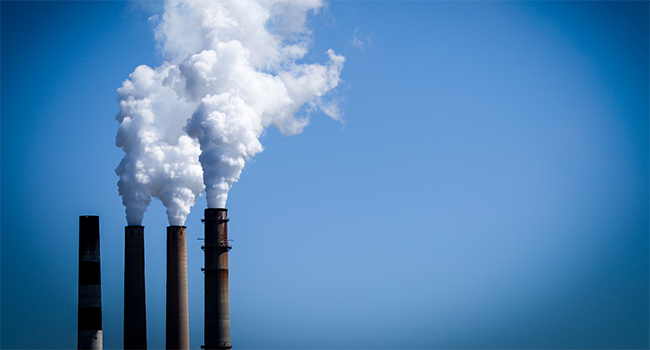
The world’s ongoing failure to price carbon has led to a mishmash of command-and-control policies.
Nearly three decades after it first agreed to tackle climate change, the world has failed miserably to curb the growth in CO2 emissions. To succeed, it urgently needs to establish an effective price for carbon.
In the 1820s, French mathematician Joseph Fourier calculated an object the size of Earth, and at its distance from the Sun, should be considerably colder than the planet is if warmed only by the effects of incoming solar radiation. His consideration of the possibility the Earth’s atmosphere might act as an insulator is widely recognised as the first proposal of what came to be known as the greenhouse effect.
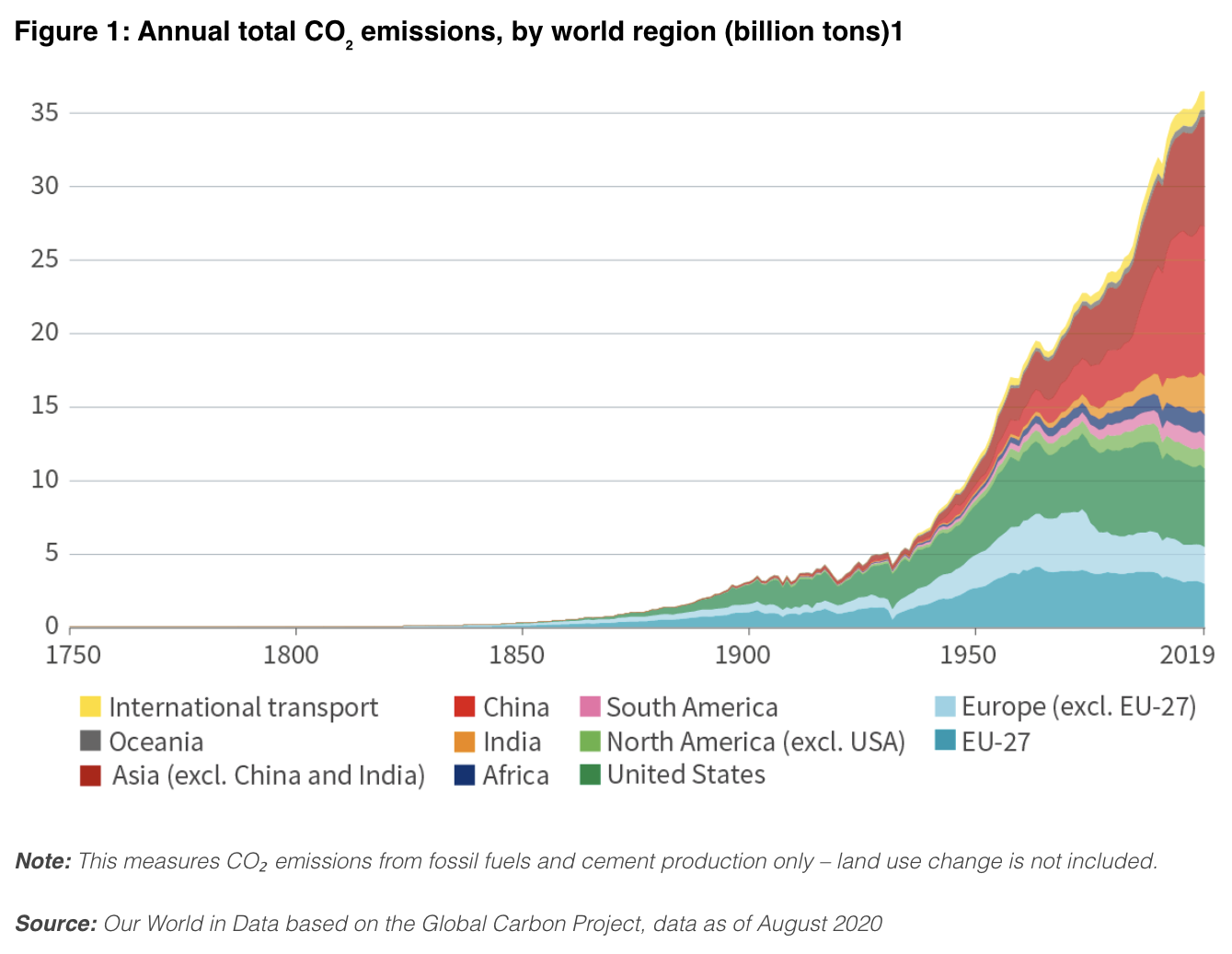
By 1992, with evidence of the perils of man-made climate change mounting, 154 countries agreed to begin to address the problem. Signatories to the United Nations Framework Convention on Climate Change (UNFCCC) in Rio de Janeiro committed to reduce atmospheric concentrations of greenhouse gases (GHGs). Nearly three decades and countless international conferences on, efforts to curb climate emissions have failed miserably.

Common problems
Climate change is a problem of the ‘commons’. The atmosphere is shared between countries and while a CO2-abating country incurs the full cost of its abatement, it receives only a small fraction of the benefits. As with any such public good, the self-interested response is to ‘free ride’ in the hope others will foot the bill. Instead, ways of addressing the problem by either taxing or imposing limits on emissions must be negotiated among sovereign nations.
The Kyoto negotiations in 1997 tried to create a global cap-and-trade system, whereby a limit on emissions was set at a global level following which individual countries would commit to cutting emissions beneath 1990 levels to varying degrees to meet that cap. The result was a patchwork of weak and unenforceable commitments that failed to address the free-rider problem. Nations have since stumbled through a series of summits and conferences to find a replacement without success.
How not to negotiate
According to Dr Stephen Stoft, co-editor of the 2017 book Global Carbon Pricing, the failure of successive negotiations is telling. To see where things have gone wrong, he says game theory, particularly the work of political scientist Elinor Ostrom, is instructive. She was awarded the Nobel Prize in economics for her innovative work which, against the grain, argued that common-pool resource over usage was not inevitable, or subject to a ‘Tragedy of the Commons’ as the ecologist Garrett Hardin suggested in 1968. Drawing on both the science of game theory and real-world examples, Ostrom showed cooperation could be maintained by the interaction of reciprocity, reputation, and trust.
Stoft says what Ostrom and others show is that to promote cooperation, a collective goal must be translated into a reciprocal accord: an agreement to abide by rules that specify ambitious behaviour, provided others abide by the same rules. Moreover, penalties for breaking the rules are needed to discipline free riders.
Yale professor William Nordhaus says if there is a single lesson to be learnt from economics, it is that “economic participants – thousands of governments, millions of firms, billions of people, all taking trillions of decisions each year – face a market price of carbon that reflects the social costs of their consumption, investment, and innovation”.
While Stoft agrees a uniform price would be economically efficient, he argues establishing a global minimum carbon price as a starting point would give the negotiations a much better chance of success. By providing a salient focal point for discussions, talks would likely be much more straightforward than those over a global cap-and-trade deal proved to be.
Skirting round the issue
All of which makes it hard to understand why successive UN climate change conferences have tended to skirt around the issue.
“Go all the way back to Rio, they talked about internalising the externality. It just hasn’t happened. We’re running out of time and urgently need a concrete plan of action,” says Thomas Tayler, senior manager in Aviva Investors’ Sustainable Finance Centre for Excellence.
Although the Paris Agreement talked about the need for a global carbon market, negotiators essentially kicked the can down the road. Article 6 is central to the integrity of the accord and negotiators have warned weak rules could undermine the entire agreement. Yet few appear to have much idea how the rules governing this mechanism could be made to work. Many doubt they ever can.
While some say resolving the article could make or break this year’s COP26 summit, both Tayler and Aviva Investors’ chief responsible investment officer Steve Waygood believe such expectations are unrealistic. The main impediment is that unanimity, or near unanimity, is required for agreement to be reached.
“Blaming the UNFCCC for not coming up with a global carbon price is unfair. It’s an inappropriate forum,” says Waygood.
Nordhaus holds out some hope for negotiations though. “In light of the failure of the Kyoto Protocol, it is easy to conclude that international cooperation is doomed to failure. This is the wrong conclusion,” he says.
Join the club
In April 2021, IMF chief Kristalina Georgieva said a “focus on a minimum carbon price floor among large emitters, such as the G20, could facilitate an agreement covering up to 80 per cent of global emissions”.[2]
She appears to have taken her cue from Nordhaus, who in 2015 advanced the idea of establishing a ‘climate club’ as a means of breaking the deadlock.
Luca Taschini, associate professorial research fellow at the London School of Economics’ Grantham Research Institute, agrees this may offer the best prospect of meaningful progress. While establishing such a club would not be simple, even if just the EU and China could agree to impose a uniform price on all their carbon emissions “that would be a major step forward; you could then envisage the US wanting to join”.
By pricing carbon, governments capture the costs that the public pays for in other ways, such as healthcare costs from pollution, heatwaves and droughts, and damage to property from fires, flooding, and sea level rise.
However, establishing what that carbon price should be is not straightforward. It depends on a multitude of assumptions about future emissions, how the climate will respond, the impacts this will cause and crucially the discount rate applied to damages, some of which will be felt far into the future.
Currently, the IMF says a global carbon price of $75 or more per tonne is needed by 2030 to restrict global warming to below 2Cº[3]; the Bank of England reckons a price of £150 might be needed[4]; while the International Energy Agency said in May the price in advanced economies needed to rise to $130 by 2030 and to $250 by 2050.[5]
The price is right?
Theoretically, countries or trading blocs could be given leeway to determine how to price emissions, whether via taxation, a cap-and trade system or a combination of the two, even if most economists tend to believe taxation would be the cleanest, most readily comparable, and therefore optimal method.
Forming a club would not be without its difficulties. But although it would need to be determined at what point in the production process a carbon price was to be collected, and countries would need to be monitored to ensure they were not cooking the books, few hurdles are insurmountable.
For the system to work, the thorniest issue would be the need for richer nations to transfer money to poorer ones. However, although discussions over the size of transfer payments undermined the Kyoto discussions, this does not mean renewed attempts are doomed to failure as well. Rather, it is an argument for setting a realistic initial carbon price, especially since there would be nothing to prevent richer nations from being more ambitious.
Taschini says that as well as the carrot of transfer payments to induce developing countries to set a minimum carbon price and join the club, a stick would be needed to discipline free riders and prevent carbon leakage. To avoid this, the obvious stick to use would be tariffs on imports from countries that refused to join the club.
This explains why the EU in July said it planned to introduce a carbon border levy by 2026. By holding products such as imported steel, aluminium, fertiliser and cement responsible for their emissions the same way domestically produced products are, the aim is to maintain the bloc’s competitiveness, prevent carbon leakage, and ultimately encourage other countries to match the EU’s ambition.
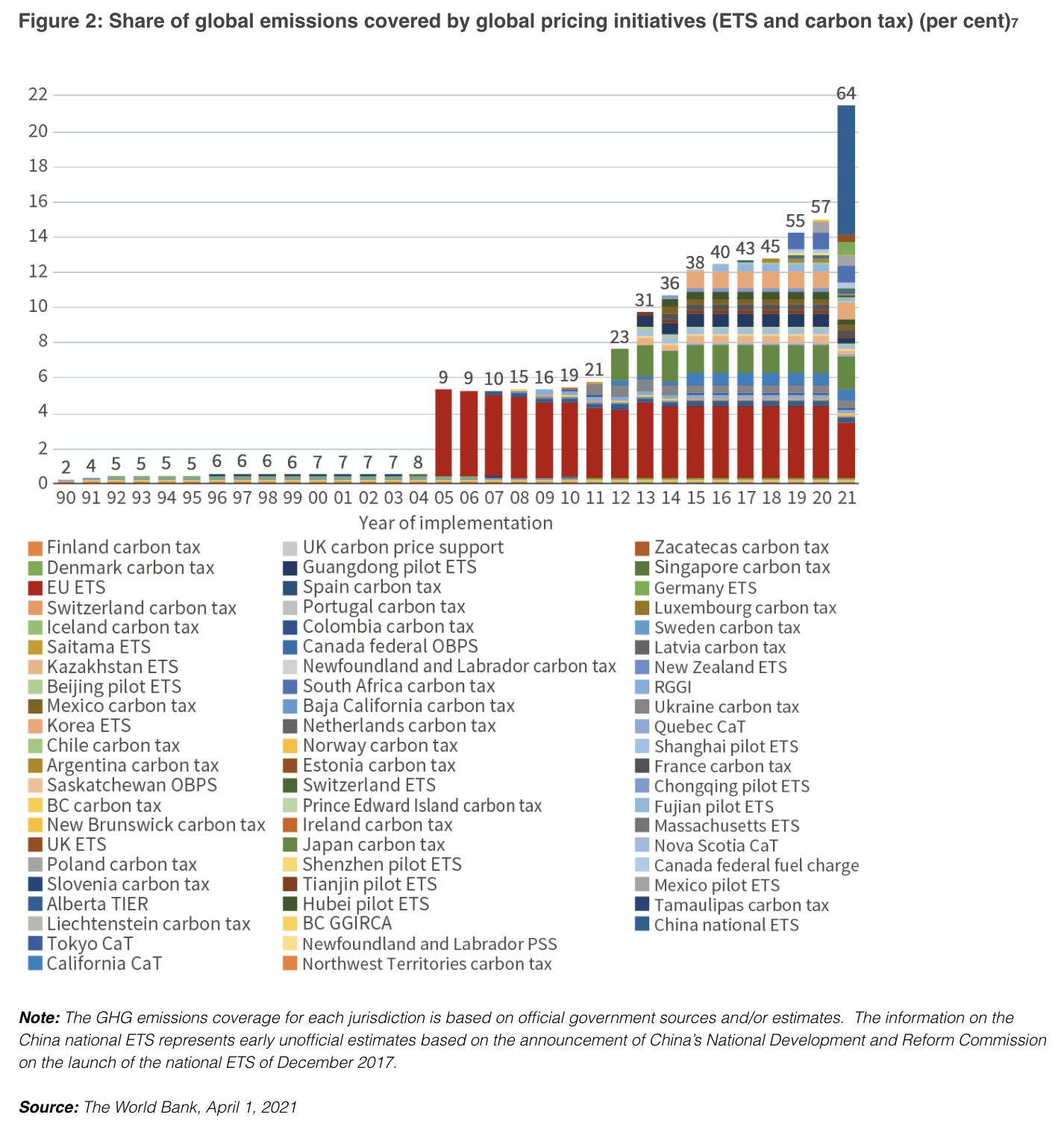
Carbon pricing schemes have been growing both in number and ambition. According to the World Bank, as of April 2020 there were 61 initiatives – 31 emissions trading schemes and 30 carbon taxes.[6] However, those covered just 22 percent of global emissions.

Pricing power
One reason the world struggles to kick its addiction to fossil fuels is the perceived cost of doing so.
Although many activists and politicians promote climate mitigation policies as an opportunity to create jobs and boost growth, the argument looks specious. The fact so few countries come even close to doing their fair share speaks volumes. After all, burning carbon enables valuable activities to happen such as driving cars, heating houses and manufacturing steel. Taxing carbon, until greener replacements become more available, inevitably leads to a reduction in consumer welfare as those activities are reduced.
Having said that, establishing an effective carbon price seems unlikely to be as ruinous as some fear. Take a carbon price of $40. That would add around $74, around 12 per cent, to the price of a tonne of steel, $72 to the cost of a return flight between London and New York and would be equivalent to just 9.2 US cents (6.6 British pence) on a litre of petrol.
The world’s ongoing failure to price carbon has led to a mishmash of command-and-control policies. They range from the imposition of auto emissions standards or the complete phasing out of internal combustion engine car sales, to the subsidisation of various green technologies. In many cases these come at a high cost and are of questionable benefit.In many instances, with politicians unwilling to grasp the nettle, the problem is being outsourced to the private sector. While not denying the private sector has a vital role to play, for example by refusing to finance a coal-related project or demanding higher returns from investments in oil exploration companies, Waygood says it needs a carbon price to perform this function efficiently.
“We have the world’s biggest market failure in climate change, and this will go on until we start to price at least a significant chunk of worldwide carbon emissions more appropriately. While no one would suggest we immediately stop driving, flying, or using steel, the sooner we admit these activities come with a cost, the better,” he argues.
———-