

Matt Gaden
Australian dividends have recovered from a challenging 2020, registering record payouts in Q3 according to the latest Janus Henderson Global Dividend Index. Australia’s concentration in banks and miners boosted its performance, as financials restored dividends towards pre-pandemic levels and miners capitalised on high commodity prices.
In its most important dividend quarter for the year, Australia’s payouts grew by 126% on a headline basis, reaching a record A$41.9bn, compared to growth of just 11.3% for the rest of the world. Altogether, Australian companies were responsible for more than a third of the year-on-year A$69bn global increase in payouts delivered in Q3. This highlights the major contribution Australian companies are making to the global dividend recovery. The result is in part because Australian companies were among the worst hit last year, and payouts are rebounding from a low base.


Every Australian company in the index either raised their dividends or held them steady in Q3. This is one of the strongest readings since the Index began and reflects the pace of Australia’s dividend recovery, which is expected to record growth of 60% in 2021, at a rate around four times faster than forecast for the rest of the world. Australia’s recovery helped drive global dividends up 22.0% in USD terms to an all-time high for the third quarter of US$403.5bn (A$550bn).
Local mining sector biggest contributor to Q3 payouts
Soaring commodity prices resulted in record profits for many companies and more than 60% of Australia’s Q3 payouts were contributed by miners, tripling their year-on-year dividends. Three quarters of mining companies in Janus Henderson’s index at least doubled their dividends compared to Q3 2020. Globally, the sector delivered an extraordinary A$74.5bn of dividends in Q3, more in a single quarter than the previous full-year record set in 2019. Australian mining giant BHP will be the world’s biggest dividend payer in 2021, contributing A$25.6bn from the combined payouts of its UK and Australian divisions.
The financial sector also made a significant contribution, mainly because prudential limits have been lifted, allowing Australia’s big banks to resume regular payouts, and thanks to lower-than-expected loan impairments. Australia’s biggest bank, Commonwealth Bank, lifted its final dividend to within one eighth of its pre-pandemic level, with ANZ not far behind. NAB and Westpac both increased their payouts, and full-year dividends across the sector are expected to be just 15% lower than their pre-pandemic level.
Steepest cuts lead to biggest rebounds
As one of the nations most exposed to the mining boom and the restoration of banking dividends, Australia is undergoing a rapid recovery, alongside similarly structured peers such as France and the UK. Europe, parts of Asia and emerging markets also saw large increases on an underlying basis.
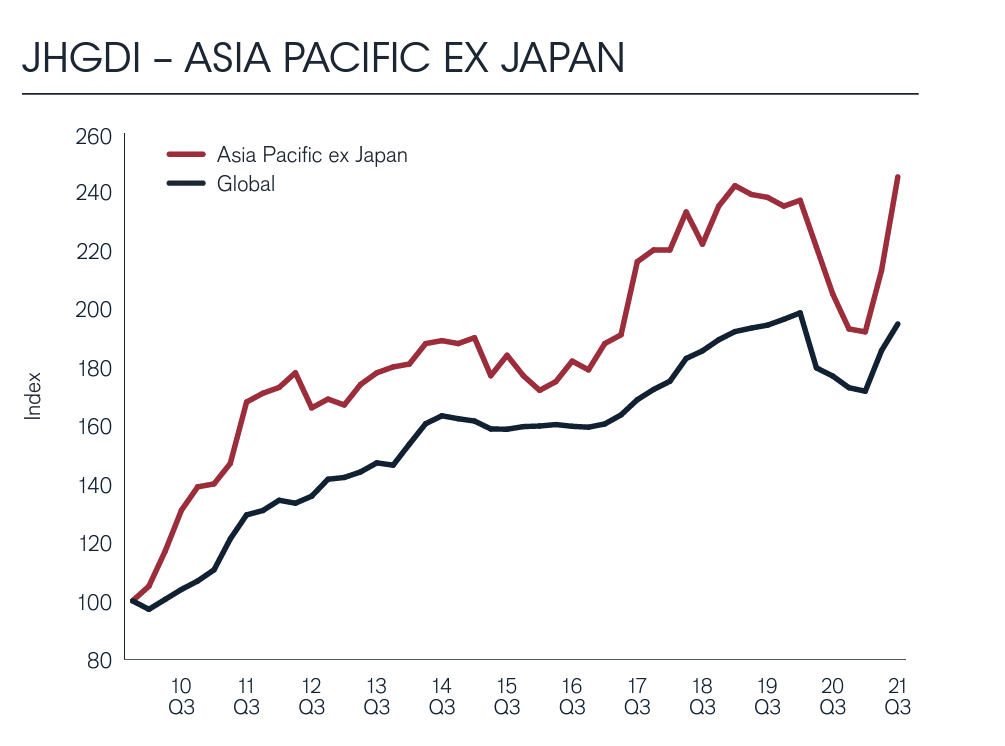

Those parts of the world, like Japan and the US, where companies did not cut much in 2020 naturally showed less growth than the global average. Nevertheless, US company dividends rose by a tenth in USD to a new Q3 record. A strong Q3 means Chinese companies are also on track to deliver record payouts in 2021.
Jane Shoemake, Client Portfolio Manager on the Global Equity Income Team at Janus Henderson said: “A raft of important factors have led to Australia’s outstanding third quarter dividend performance. First and most importantly, mining companies all around the world have benefited from sky-high commodity prices. Many of them delivered record results and dividends followed suit.
“Secondly, banks took quick advantage of the relaxation of limits on dividends and restored payouts to a higher level than seemed possible even a few months ago. Additionally, Australia has been able to record outstanding results against the backdrop of a very difficult 2020, that saw it suffer from the COVID-19 pandemic.
Given Australia’s dividends are necessarily more concentrated in mining and financials than its global peers, high commodity prices and the removal of dividend limits from banking stocks have supercharged its Q3 performance.”


Matt Gaden, Head of Australia at Janus Henderson said: “These results will come as welcome news to Australian investors, particularly self-funded retirees. On the back of these results, we’re forecasting Australian dividend growth to reach around 60% this year, a significant increase on earlier expectations.
“While the relatively high concentration of Australia’s dividend payers in banks and miners still calls for seeking greater sectoral and geographical diversification, the Q3 result is undoubtedly a strong outcome for Australian investors.”
Ben Lofthouse, Head of Global Equity Income at Janus Henderson, added: “Dividends are recovering more quickly than expected, driven by improving corporate balance sheets, and increased optimism about the future. Two of the most impacted sectors last year were the commodity and financial sectors, and the report highlights that these sectors have been the most significant driver of dividend growth during the period covered.
We have added to these sectors over the last year, and it is great to see shareholders being rewarded by increased distributions.”
Upgraded forecast
The exceptional strength of Australia’s Q3 payout figures along with improved prospects for Q4, have led Janus Henderson to upgrade its forecast for the full year. Janus Henderson now expects global growth of 15.6% on a headline basis in USD terms, taking 2021 payouts to a new record of A$1.93 trillion. Janus Henderson anticipates that global dividends will have recovered in just nine months from their mid-pandemic low point in the year to the end of March 2021. Underlying growth is expected to be 13.6% in USD terms for 2021. Translated to AUD, headline growth will be 4.9% and underlying growth 2.9%. This is because the Australian dollar has been stronger against the USD in 2021 than it was in 2020.