Domain, a leading property marketplace has released their annual First-Home Buyers Report, which reveals the time Australians need to save when planning for the purchase of their first home.
Domain’s First-Home Buyers Report is focused on identifying the time it takes for a couple aged between 25-34 to save a 20 per cent deposit for an entry priced property across our capital cities and regionally based on the average dual income. The Report also reveals the areas and types of properties that are providing Australians with the strongest opportunities to get onto the property ladder.
Across the majority of Australia’s capital cities, the journey to entry-home ownership has increased compared to the same time last year, on average adding an extra 11 months of time spent saving. For units, there has been an increase of 3 months.
In a climate where incremental wage growth and rising mortgage repayments and rental prices are paired with escalating property prices, the prospect of saving the lump-sum deposit is becoming more challenging. Testament to this is that over the past 20 years, average annualised growth in capital city dwelling prices has been over double that of the annualised wage price growth.
Sydney continues its reign as the city to have the longest time to save an entry-house deposit, at 8 years and 1 month. Canberra has overtaken Melbourne in second place, at 7 years and 1 month. Sydney and Canberra have also seen the largest increases over the past year, spiralling by 18 months.
Perth remains the best city for first home buyers, with the quickest savings time at 3 years and 7 months for an entry-house, less than half of the time taken in Sydney. Fortunately, Perth has only seen an increase over the past year of one month and has even declined by one month over the past five years.
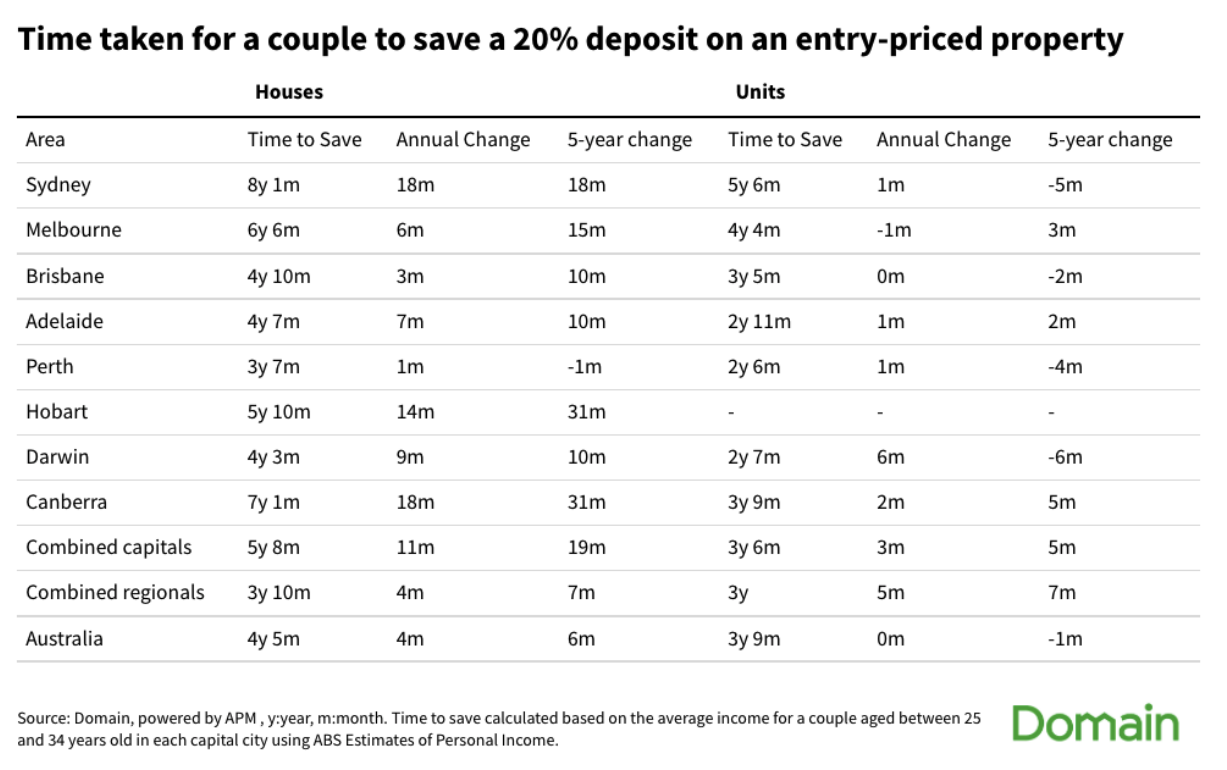

Encouragingly, first home buyers will find the time to save for an entry-unit significantly shorter than a house, with a modest increase in time to save across most cities. Units offer a more budget-conscious approach, with an average of 18.4% of income dedicated to mortgage repayments across the capitals compared to 27.1% for a house.
Discussing the findings of this year’s report, Domain’s Chief of Research and Economics, Dr Nicola Powell, commented: “The annual Domain First-Home Buyers Report enables us to analyse the market variables that contribute to housing affordability, and compare annual growth across cities and areas. First home buyers are facing a growing financial hurdle when it comes to saving a deposit, and this is becoming more daunting in the context of rising living costs, low wage growth, weak saving rates and the rapid rise in property prices. Our hope with this report is that we are able to equip first-home buyers with the latest information to help consider location, size and type of property as they embark on their property journey.”
First home buyers have traditionally looked further afield to seek value for money and compromised on commute times, or compromised on space and purchased something smaller but more centrally located to the CBD or public transport hubs. Remote working has made this balance easier for those able to adopt a hybrid way of working between the office and the home and opened up where they can reside, with more people willing to push further afield from their employment base. In turn, this has prompted a rise in keywords searches on Domain associated with lifestyle, greater space, garden and yard as doors to greater affordability have been opened for those who are now able to live in the outer suburbs.
On this, Dr Nicola Powell commented, “The decentralisation of our workforce is being embraced by middle Australia, with some working from home, even if it is for a couple of days a week, and awakening affordability. In saying this, we know that not everyone is able to do this, with often lower-income workers needing to be close to their workplace as they are unable to work from home. When navigating the first home buyer’s market, considering property type and location, or even becoming a rentvestor, can all be worthwhile. Government incentives such as the First Home Loan Deposit Scheme or the First Home Super Saver Scheme, which allows prospective first-home buyers to make additional superannuation contributions that are later accessible for a first home deposit, can also be advantageous to shave years off the time it takes to save for an entry-priced deposit.”