

Fiona O’Neill
Fidelity International’s annual ESG Analyst Survey finds signs of year-on-year progress towards netzero but confirms there is a long way to go on the journey towards a more sustainable economy.
The Fidelity ESG Analyst Survey studies the views of its in-house analysts across the world and is based on almost 200 responses from equity and fixed income teams*.
Europe is still out in front on the transition to net zero, with the highest proportion of companies recognised as “leading the charge” by Fidelity’s analysts. And while China has the smallest proportion of companies leading the charge for now, more than half of Chinese companies are starting to change according to Fidelity’s analysts, meaning over 70 per cent are considering the transition to a low carbon economy.
Fiona O’Neill, head of strategic initiatives, Global Investment Research, Fidelity International, comments: “This year’s survey has found tangible signs of corporate progress towards net zero, despite the impact of the war in Ukraine, and an increase in the immediate demand for substitute fossil fuels, including coal, to alleviate higher prices.
“The positive trajectory of China’s transition shows that Chinese companies are responding positively to increasing investor awareness and top-down cues after Beijing’s 2020 announcement that it is targeting net zero by 2060.
“However, many businesses are still early in their ESG journey and have a long way to go. Overall, progress is slower than we would like but it is happening. As a business, we continue to focus on identifying those companies taking concrete actions and continue allocating capital to where we believe it can do the most good.”


The survey also finds Fidelity’s analysts in aggregate see more opportunity than risk from the green transition, especially over the long term. Japan stands out, with analysts highlighting significant opportunities expected to emerge in autos, consumer staples and semiconductors over the next decade. China is also likely to benefit from green opportunities and is already a leader in areas such as solar panels.
Ms O’Neill continues: “A key theme we are watching is that of a ‘just transition’. This is the idea that the move to a greener economy risks adversely impacting some individuals and communities, such as those working in the fossil fuel industry, and that efforts should be made to mitigate such risks.
“Our analysts see signs of incremental progress, with a greater proportion of businesses having announced initiatives to promote a just transition by supporting displaced employees.”
More companies adopting policies on key ESG issues
It’s not just greenhouse gas emissions dominating discussions in meetings with boards and managements in the last 12 months. The survey highlights the marked increase in interactions across the board on social topics like employee welfare and diversity.
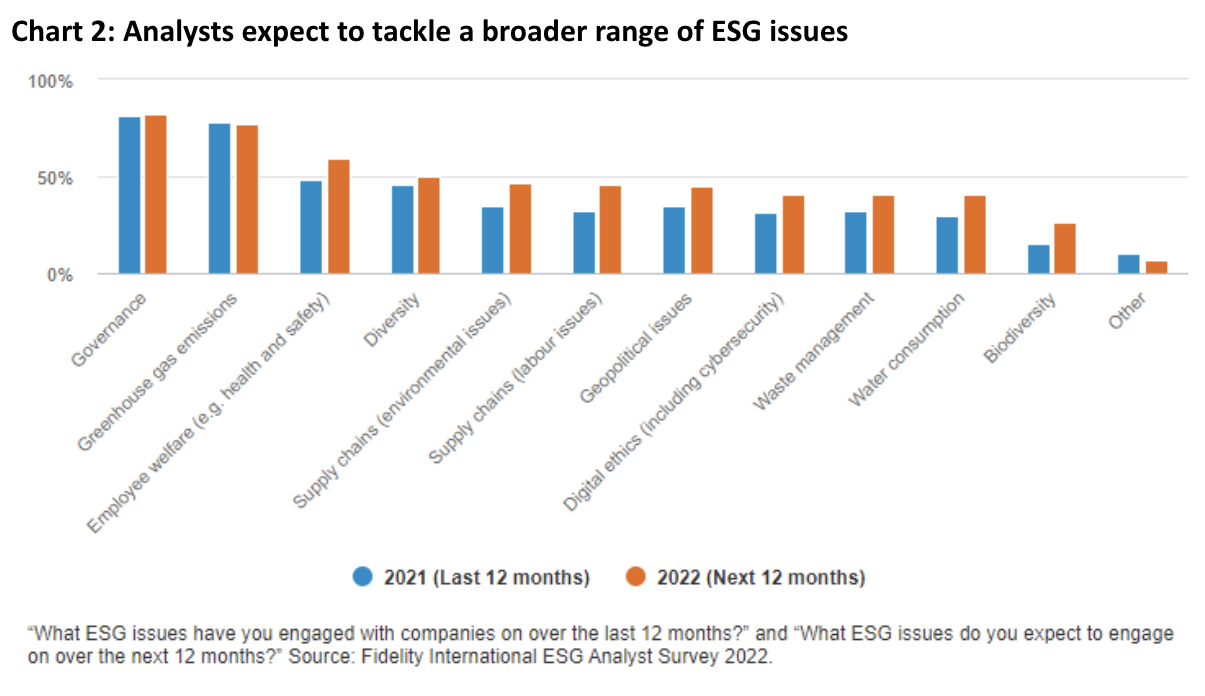

Ms O’Neill adds: “After the disruptions of the past year, supply chains are in focus, especially labour concerns, which showed the largest increase in mentions by the analysts. But the natural world is a key concern and, from a low base, biodiversity features in 26% of analysts’ conversations, with our team expecting that to rise in the year ahead.”