

Many experts believe the key to future success for Australian advice practices is specialisation.
The courage to be different
“In order to be irreplaceable, one must always be different.”
Coco Chanel.
One of the most foundational concepts in marketing, and indeed business more generally, is the Unique Selling Proposition (USP). In less technical terms, this the nature of your business/brand/product that stands out from the crowd, such that customers should choose to buy from you and not your competitor.
But whilst most people will happily agree with the sentiment – the value of differentiating your offering is pretty hard to argue with after all – successful execution is much less commonly seen, especially in financial advice.
Closely tied to concept of differentiation is a strategic question, one that is frequently asked by many a financial adviser. That question is whether to pursue a generalist approach – simplistically being (in an advice sense) many things to many people – or more of a niche approach, where the expertise offered is narrower but deeper.
Some industry observers fervently believe that specialisation is the way of the future for financial advisers, and certainly there are many advantages that accrue to niche players, many of which pertain to efficiency – in process, in marketing, and in professional development. But there are downsides too. Getting a niche strategy wrong can be an efficient way to shrink a business!
In this article, we will explore the concept of niche marketing as it pertains to financial advice, including both the advantages and disadvantages. We will also look at the steps in developing a niche-base strategy and examine examples of advice niches, including real market examples.
What is a niche market?
In simple terms, a niche is a narrow subset or segment of customers, within the total market.
For it to be viable, a niche must have the following characteristics:
- customers within that niche must have identifiably unique characteristics relative to the overall market – whether in the products or channels they prefer, their demographics, needs, or lifestyle
- they must be able to be identified and reached as a niche (meaning it is possible to speak to that niche individually), and
- the niche must be of sufficient size, and with sufficient purchasing power, to make serving that niche financially viable.
Examples of niches, depending on the context, might include surgeons, fitness fanatics, millennials, and life insurance buyers. (A hyper niche might be people who fall into all four of these categories!).
The advantages of a niche marketing
At face value, the expression ‘the riches are in the niches’ suggests the gold in a more focused approach is all about increasing revenue. And certainly, the more focused marketing approach that a niche strategy necessitates should lift revenues. But it’s not the only outcome that matters. The business sustainability equation has many elements – including the cost of doing business, quality of client relationships, and efficiency – and a well-executed niche strategy can drive improvements across all these areas.
Advantage 1 – Stand out from the crowd
It’s human nature to think of ourselves as unique and special, and as consumers this manifests as an attraction to products and brands that seem more tailored to our uniqueness. There’s no shortage of advisers offering the same thing (build wealth, secure your retirement, reduce tax etc), but advisers who genuinely speak to a specific audience are relatively scarce, meaning they stand out.
Of course, standing out in a modern context means standing out online, where most consumer journeys begin. Being a niche player makes it easier for you to standout in Google search too, particularly as our search behaviour becomes more natural language and voice based, either via our mobile devices, or using smart speakers such as Alexa and Google Assist (see below). In the US for example:
- 50% of all mobile users search via voice[1]
- Mobile users are 3 times more likely to use voice than text search[2]
- Around one third of households own a smart speaker[3].
Given our reputation as an early adopter of mobile technology[4], these figures could be even higher in Australia.
Advantage 2 – more focused marketing is cheaper and more responsive
When you more narrowly define your target audience, and tailor your message, the efficiency of your marketing and communication improves from two directions.
Firstly, your target audience is likely to be more responsive to messaging that speaks more directly to them and their unique – niche – needs.
Secondly, you can be more targeted in the channels you use to speak to that audience. There is no need to spend money reaching prospects who aren’t in your target. That means less wastage.
From a practical perspective, this could mean you promote your services on those websites specifically dedicated to your niche community.
Importantly, it allows your Google search marketing to be far more targeted and affordable.
Insurance and funds management are amongst the most expensive keywords categories you can buy[5]. The more refined you can be, the less competition and the cheaper those terms are likely to be.
So, your marketing is cheaper and more responsive. Nirvana!
Advantage 3 – It’s easier to articulate your value and earn what you are worth
According to CEG Worldwide research[6], 70% of top financial advisers (those earning $1 million or more annually) focus on a particular niche. This shouldn’t come as a surprise. In the same way that surgeons earn more than GPs, and barristers charge more than suburban solicitors, specialists are generally able to charge a premium for their deep subject matter expertise.
Advantage 4 – there are efficiencies across other aspects of your business
When your business is geared around a specific segment, you don’t need to waste time – or resources – catering to others.
There could be efficiency in process, for example if you designed an engagement experience that was completely virtual (if your niche involved younger or more tech savvy clients).
Tailoring your CRM to the unique needs of your niche can also create longer term efficiencies, and a more homogenous client group can also make the task of outsourcing (paraplanning, virtual assistants, data clean-ups) easier.
Your professional development can be more efficient too because you can focus on developing skills and knowledge specific to your speciality.
Other aspects of your marketing and communication, such as your collateral, your client events, and your newsletters, can also be more focused and streamlined because you only need to cater to one audience who are all share the same niche characteristic(s).
And importantly, dealing with a narrower set of products and/or customers can create efficiencies in terms of the amount of regulatory change you need to keep on top of.
Advantage 5 – less competition and greater client loyalty
Research published in the Adviser Ratings 2020 Landscape Report suggests that the highest earning advisers spent around 44% of their time with clients and 36% on business development. By comparison, the lowest earners spent only 24% and 10% of their time respectively in these critical areas. (The lowest earners spent 26% of their time on general administration, compared to 4% for the highest earners.)
This intuitively makes sense. The more time you spend with clients, the deeper, more loyal, and more profitable those relationships are likely to be.
As a niche player, your deep expertise and genuine interest in that niche will make it easier for you to build deep relationships.
Additionally, niche players have less direct competition, meaning clients are less likely to ‘shop around’.
Advantage 6 – it can be easier to build Centres of Influence
Having a more clearly identified speciality can be attractive to potential referrers, because you are less of a direct competitor, and because it easier to understand what type of referrals you seek.
In an earlier article, we mentioned the experiences of Phil Thompson, a Melbourne based financial adviser who recently transitioned from generalist to risk specialist. One of Phil’s most powerful observations was that his traction with referral sources increased. In his words:
“Referral partners won’t promote opaque benefits to their treasured customers. Getting narrow has increased clarity in my referral relationships. My referral partners have sent me more clients because it’s cut and dry where I can help”.[7]
How to become a niche player
The complexity and sheer volume of financial services products, and the diversity of the clients using them, makes financial services ideal for niche plays. For those planning to become more specialised, there are some critical steps to be undertaken.
Step 1 – overcome the fear
Some business owners hold – quite reasonably – a fear that narrowing their target audience will mean they will attract less customers. But the paradox of a niche strategy is that the opposite is generally true. With more clarity about the value you add, and to who, niche players can actually attract more customers.
Phil Thompson again:
“Niching is scary, I have wanted to do it for a long time and have avoided it because it means you need to say no to people. My business grew almost 250% during 2020 and getting specific on what advice I was providing and for who, was a significant contributor to that uplift. Ironically, narrowing my scope generated a high level of ideal new clients and efficiency”.[8]
Step 2 – assess your strengths and interests
Having conquered any doubts, the most fundamental step is to obviously decide what niche to specialise in, a decision which has several dimensions.
The first dimension is all about you, and which niche are you suited to in terms of your qualifications, experience, interests, and existing networks.
- Do you already have some clients, or social connections, in that niche?
- What aspect of advice are you passionate about?
- Are there some clients who rub you up the wrong way?
- Do you share a common interest with people in this niche?
Deciding to specialise in SMSFs or High net worth clients (who often have complex needs) is easy, but fruitless if you can’t back it up with the specialised expertise or deep insights into the lives of clients in that niche
Step 3 – scope out the viability of the niche
Next, the niche has to be scoped out in size and nature. How big is it? Is it big enough to support a new player?
There are numerous ways you can quantify the size of a niche.
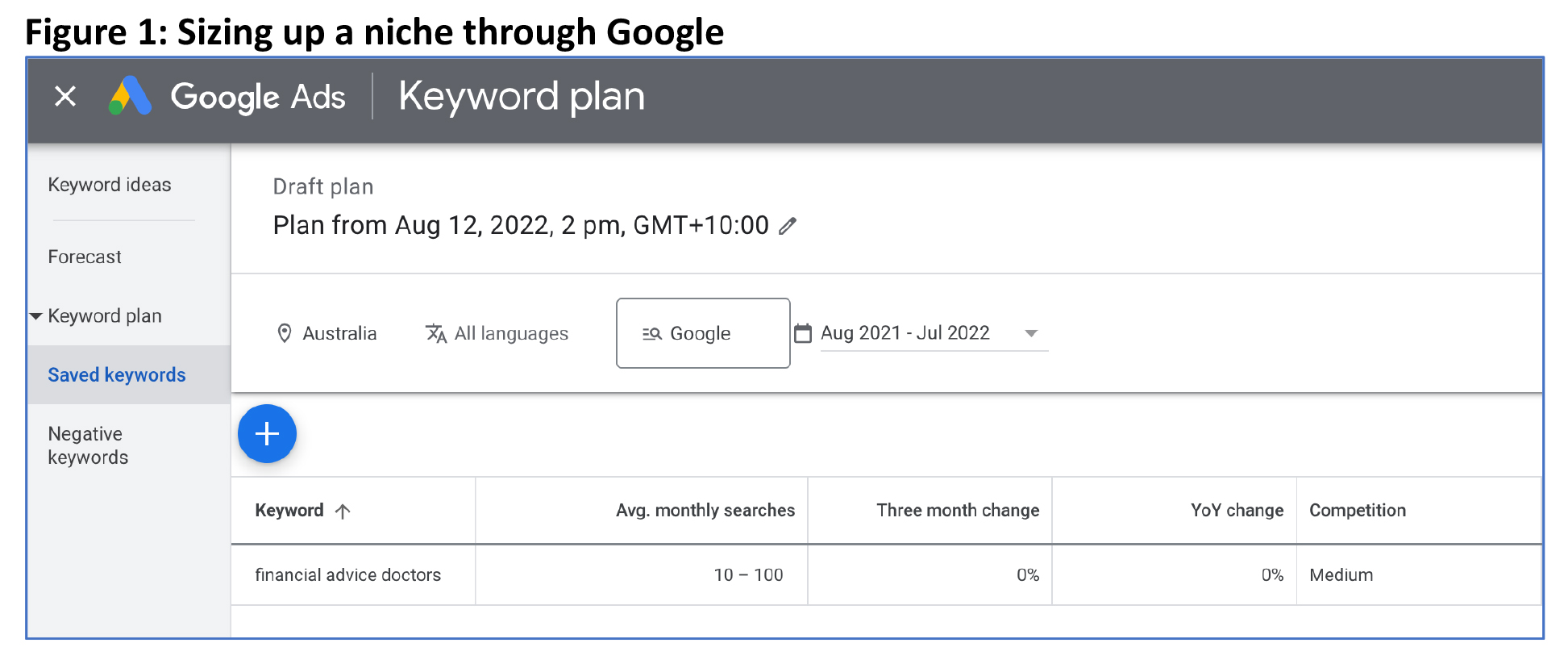
Google is a good starting point – either a general search (for example how many GPs are there in Australia? answer, around 31,000 as of 2020[9]) or check the popularity of certain keywords in Google Ads (an example for ‘financial advice doctors’ is shown below). Other useful resources can include industry publications, member forums, and specialised clubs and associations.

Step 4 – Aligning your offering
Next you need to align your offering to that niche. This means every aspect of your offering need to be tailored and appropriate to the needs and expectations of that target audience, including:
- premises
- client experience
- staff and their training
- website, marketing collateral, search presence and advertising
- content and social media activity
- professional development and conferences
- product and service offerings
- processes
- fees.
A failure to totally align the business to the target audience is arguably the single biggest driver of unsuccessful niche plays.
An example is the High Net Worth segment/niche, increasingly attractive as the economics of advice become more challenging. This segment has complex advice needs, and elevated service expectations, and not every firm is able to credibly compete in that space.
As one HNW specialist observed[10]:
“There’s only a certain number of businesses that can play at that level. At that higher-end client level they want to speak the chief investment officer, they want to understand what’s going on as you’re moving forward. They want to have assets that not everybody is finding, so you have to gear your business to do that. If you’re just giving them vanilla assets, then you’re not adding as much value as they demand.”
Step 5 – monitor and refine
Keep abreast of developments in your niche and your own business performance. Over time, refine your offering and narrow or broaden your focus as needed.
Examples of niches in advice
Many niches in advice are based around client type of product offering, or a combination of both.
Common examples are advisers who specialise in working with a specific profession, such as
- pharmacists, surgeons, commercial pilots, or
- manual occupations such as miners and tradies.
Some advisers specialise in SMSFs, while others specialise in
- expat professionals
- estate planning, or
- business life insurance,
all of which require deep technical expertise.
Life insurance as a niche or hyper-niche play
As the number of dedicated risk specialists continues to decline, life insurance advice is arguably becoming a niche play, but a healthy one, thanks to continued strong community demand for life insurance.
Investment Trends data[11] from 2019 suggests the proportion of advisers specialising in risk had dropped from 34% to 15%, equating to around 2500 risk specialists. Certainly, when compared to the 31,000 GPs in Australia (referenced earlier), risk advice is beginning to look very specialised!
The complexity of life insurance strategies and processes (including underwriting and claims management) also lends itself to specialisation, especially when talking about the needs of specific segments. Indeed, if risk advice is a niche, then there are also a number of hyper niche opportunities, some of which we see already in the market:
- life insurance for medical professionals
- mey man and buy/sell agreement specialists
- life insurance for ultra high net worth individuals.
A niche play in this space with much potential is that of claims management specialist.
Managing claims can be problematic for many non-specialist advisers. The processes can be resource intensive and complex, and for those advisers who don’t charge for this work (which is the majority of those paid by commission), uneconomic.
Additionally, they can be stressful. One recent survey of Australian advisers[12] revealed that 60% found life insurance claims stressful and emotionally challenging.
The impinging of the ‘no win- no fee’ law firms into life insurance claims space is a good indicator that this space is lucrative, no doubt because of its size (there are around 20,000 retail life claims paid every year[13]) and because claimants are happy to pay (if they get a result).
The future is specialisation
Many experts agree that – on a number of front – increasing specialisation in advice is inevitable.
One high profile licensee CEO, who had overseen the acquisition of over 60 practices, said he had concluded that having a niche strategy was the most important ingredient for a firm’s success and growth.
“Generalist practices who do a bit of everything are going to find the future a bit harder than those practices with some form of capability that is deep and narrow.”[14]
Many, including former FPA CEO Dante DeGori, believe more specialised educational paths will also open up once we have achieved a consistent minimum level of ‘core’ education for advisers[15].
The growing normalisation of video-conferencing means that geography is no longer a barrier, making some ‘hyper niches’ more viable (while making geography-based niches less relevant).
And certainly, the continuing squeeze on advice practice profitability will make the potential financial benefits of specialisation even more enticing.
Of course, whether Australia is large enough to support the type of niches seen in the US remains to be seen. In that market, for example, specialist advice for widows and divorcees is not uncommon. In the case of the latter, there are even multiple professional associations, with specialists having a choice between membership of the Institute of Divorce Financial Analysts (IDFA) or the Association of Divorce Financial Planners (ADFP)[16].
Regardless, it seems inevitable that niche plays in financial advice will become more common, and more creative.

