
Financial advice versus wealth management: Which is right for your financial future?

Kristen Bell
Australians are becoming wealthier, but this means financial decisions are also becoming more complex. There is a myriad of services to help with making financial decisions easier but what is the best option for you?
What is wealth management?
Wealth management is a holistic, long-term strategy to grow your wealth. Suited for high-income professionals, business owners or retirees, wealth creation strategies involve sophisticated ways to protect and transfer your wealth. They provide a whole-of-wealth approach and including investment management, tax structuring, superannuation optimisation, estate planning, and risk management.
Wealth management is generally most relevant for people with more complex financial circumstances, such as business owners, professionals with multiple income streams, retirees, or individuals with significant investment portfolios. Wealth management services take into account your risk appetite and focus on aligning a strategy that meets your evolving needs.
The rise of strategic wealth management in Australia
The demand in Australia has increased for more complex services like strategic wealth management. This is because there’s an increase in high-net-worth individuals with complex portfolios. Given the increase in wealth, there is also a growing interest in intergenerational wealth transfer.
To accommodate this increase in demand, the industry has seen a shift towards more digital and personalised advice. Environmental Social Governance (ESG) investing has seen an uptake and more clients have a breadth of assets including property and private equity.
The holistic approach of wealth management is attractive as it delivers better outcomes for high-net-worth individuals. Wealth management encompasses strategic financial advice that aligns all the different parts of your financial position including investments, tax, retirement, and legacy.
What is financial advice and why is it different to wealth management?
Financial advice is about providing goal-based guidance for something targeted like budgeting or preparing for retirement. While it considers your goals, the advice given is generally more broad than private wealth management.
Financial advisers can help with insurance policies and managing savings. They can also provide advice on investments and tax planning to further ensure you’re making the most of your money.
Most people may have come across financial advice as a concept as it’s more accessible and widely used. In fact, financial advice is often the catalyst for wealth management.
When do you need wealth management?
The question then remains at what point would you consider wealth management services. Due to the complexity of wealth creation strategies, it’s not something that is executed and then forgotten about. Wealth management is ongoing and must evolve as you progress through life and enter different life stages.
For business owners with succession on your mind, you may want to consider private wealth management. Wealth strategies are also beneficial for people with multiple income streams or large investment and property portfolios. The holistic approach of wealth management means you’ll implement strategies that work together.
One thing to keep in mind when engaging a wealth management expert is to have clarity on your objectives. If you’re looking for tax-efficient strategies or intergenerational wealth planning, wealth management may be more what you need.
How private wealth management supports long-term wealth creation
With private wealth management, you’re able to dive deep into the different areas that make up your financial position. The key is creating ongoing wealth creation strategies that improve every aspect, rather than looking at each in isolation.
Investment strategy and portfolio management
With different investments and large portfolios, there are ways to diversify to ensure wealth creation. Aligning a wealth strategy ensures your entire portfolio grows overall.
Tax minimisation strategies
For high-net-worth individuals, you’ll have different tax obligations. If you look at each obligation separately, you may find you pay more tax than necessary. Having a wealth strategy will look at these obligations holistically and minimise your tax.
Superannuation optimisation
There are ways to ensure your superannuation is optimised and grows alongside your other wealth creation. Depending on your financial goals, you may be interested in incorporating a self-managed super fund (SMSF). Your wealth management expert can help determine whether an SMSF will support your other strategies.
Risk and insurance planning
Wealth management takes into account your risk appetite across your portfolio and this means looking at insurance planning that supports your strategies.
Estate and legacy planning
A crucial part of wealth creation is transfer of wealth and succession planning. Growing your wealth is only complete once you have a plan on what happens beyond your lifetime.
When is financial advice alone enough?
Since financial advice can be broad and targeted at a particular goal, it may be more helpful for early career professionals or individuals with simple financial situations.
It’s a good starting point if you’re new to any form of financial planning. You can get advice on savings, debt reduction and basic investments. Once you’ve experienced financial advice, you’ll then be able to determine whether you need more complex services like wealth management or strategic financial advice.
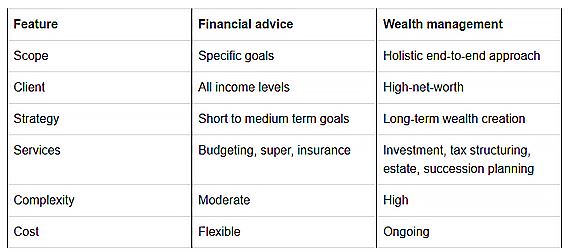
The key differences: Wealth management vs financial advice
Here’s a snapshot of the differences between the two. It’s important to note that wealth management services incorporate elements of financial advice to provide a holistic approach.
How to choose the right wealth management adviser
To ensure you’re getting access to the right wealth management experts, it’s important to check qualifications and compliance with the National Treasury and ASIC standards. Ensure you also ask about their fee structure and whether they have experience with similar clients to yourself.
In terms of the approach, it’s crucial to have an adviser with holistic wealth creation strategies that are proactive but also reactive to evolving needs.


