

Home equity can be utilised to help clients combat the rising cost of living and improve their retirement outcomes.
It’s been a challenging time for Australia’s retirees. The Covid-19 pandemic threatened their health and caused many to be isolated from family, friends and community. Covid remains a risk, particularly to older Australians…and then on top of that is the spectre of rampant inflation.
While no one expects Australia’s inflationary experience to mimic the 1970s, that will be top of mind for many retirees. This fear will be stoked by news from the International Monetary Fund (IMF), which has significantly lowered its forecast for the world’s economy for a second time in three months as inflation stymies activity. Australia’s inflation number at 30 June 2022 represented the fastest rise in inflation since the introduction of GST in July 2000.
Although inflation is pushing up rates – a good thing for those retirees with money in term deposits – those rates on offer are not keeping pace with inflation. This means each dollar of retirement income buys less; and when you’re living on a fixed income, that scenario is especially confronting.
The comfortable retirement
The ASFA Retirement Standard has long been the benchmark for a ‘comfortable’ retirement. While it also measures requirements for a ‘modest’ retirement, that’s not a financial goal many older Australians would strive for – although unfortunately, it’s what many achieve.
The March quarter 2022 figures indicated that retirees aged 65-85 living a comfortable retirement need to spend an extra one percent (couples) and 1.2 percent (singles) than in the previous quarter. This is the largest annual percentage increases in the comfortable budgets since 2010. Over the year to March 2022, prices were up by around 4.2 percent for the comfortable couple budget and by 4.7 percent for the comfortable single budget.
Over this period, the Age Pension increased by 3.7 percent and there was a reduction in the minimum drawdown factor for retirees drawing income from a superannuation account. While this reduction is welcomed by those retirees who don’t wish to draw on income producing assets during periods of market volatility, some may need to draw down more than the minimum to meet rising living costs.
For those retirees aged 85 plus, the budget for a comfortable retirement increased by 1.2 percent from the previous quarter. This cohort is regarded as particularly susceptible to rising costs in food, utilities and health care.
Retiree households will be especially impacted by rising energy prices (particularly home utilities), food and increasing health costs. ABS figures show that food prices rose across the ‘grocery basket’, increasing 5.9 percent year-on-year at 30 June 2022, the highest increase since the September quarter in 2011. Health costs, a significant expense for retired Australians, rose 2.4 percent over the same time period[1].
Increases in private health insurance premiums are a major contributor to increased costs, while out of pocket expenses and gap payments continue to be significant for a range of items including dental treatments and hospital procedures.
Sequencing risk could impact retirement savings
At the same time inflation is running amok, returns from investment markets are expected to be lower this year than historical averages. This will most likely leave self-funded and partly self-funded retirees with less income to combat rising prices.
Most retirees would be advised not to draw on invested capital at times of market volatility because of sequencing risk. This is the risk that the order and timing of a client’s investments is unfavourable. Volatility in markets and the order in which investment returns occur can make a big difference to the capital base once investors begin to draw on their retirement savings.
If investors experience positive investment returns in the first few years of retirement, they will be better placed to ride out market downturns. However, if returns early in retirement are negative, then proportionately more capital is required to fund ongoing living expenses. Drawing income from an already diminished capital base can significantly reduce the possibility of being able to recoup losses over time and increases the risk of depleting savings.
The mathematical relationship between losses and gains in an investment portfolio is a reciprocal one. A 50 percent gain does not allow a portfolio to recover from a 50 percent loss; rather, a 100 percent gain is required to restore a 50 percent loss (figure one).
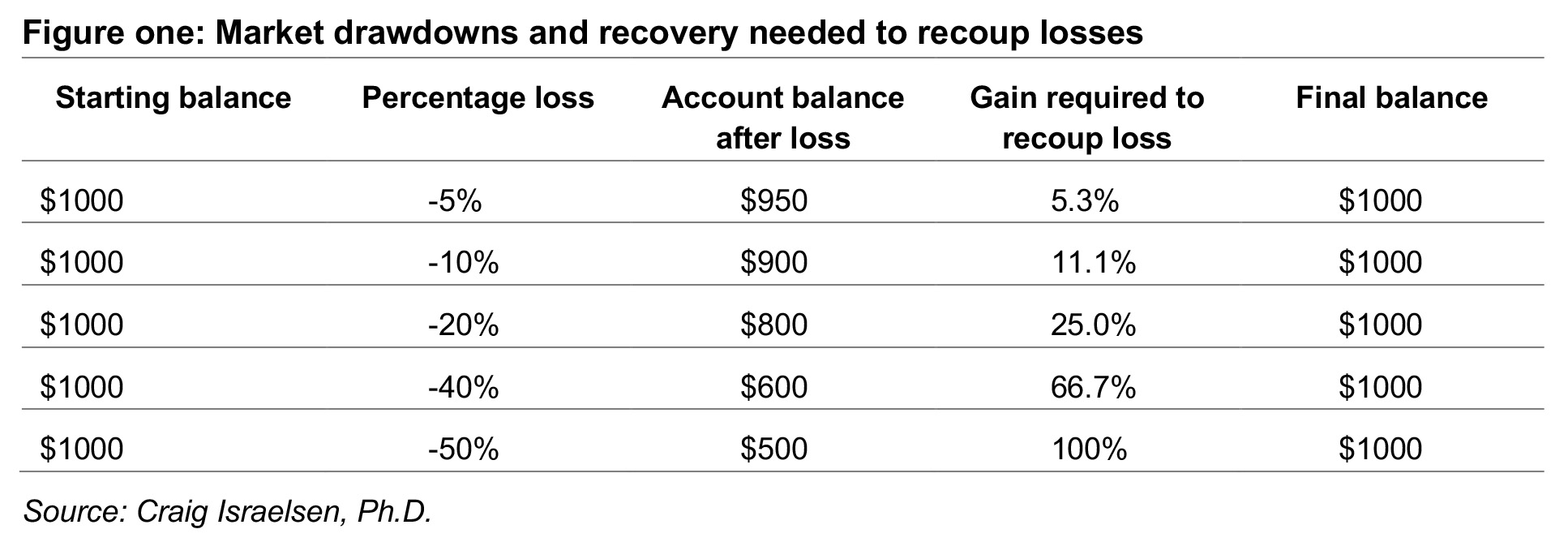

While in an ideal world investors wouldn’t draw on invested assets during volatile markets, many retirees may not have the luxury of limiting such drawdowns, particularly in an environment when spiralling inflation is pushing up costs and purchasing power is consistently eroded.
Carrying debt into retirement can also put a strain on finances, particularly as interest rate rise and increase the cost of borrowing. The proportion of mortgage holders aged 55 to 64 more than doubled between 2001 and 2021, rising from 15.5 percent to 35.9 percent. The number of people with a mortgage at retirement has risen from 3.2 percent to 9.6 percent[2]. Most forms of debt require monthly repayment, which can really diminish already stretched retirement income streams.
So, how can retirees minimise the drawdowns on invested capital, discharge any debt and keep up with the cost of living?
Home equity – drawing on a significant pool of untapped savings
For most Australians, the majority of wealth is tied up in their family home. Around 80 percent of retirees own their home and, despite the recent downturn in property values, home equity held by Australian retirees is valued at well over one trillion dollars. Median household superannuation savings at retirement are $200,000, while median home equity at retirement is over $800,000. This means home equity is worth 3-4 times superannuation savings for the median retiree.
However, this wealth is locked away and has been largely inaccessible to fund retirement needs. Given that most retirees wish to stay in their own home as they age, this untapped savings is a valuable resource that can provide both housing and funding and provide for that comfortable retirement.
The potential of home equity to fund retirement has not gone unnoticed by the federal government. In the Retirement Income Review (2020), home equity was cited as a key part of the third pillar of retirement funding, sitting alongside superannuation and the Age Pension. Facilitating access to home equity to fund long-term retirement needs represents an opportunity to meet a major unmet community need and provide a sustainable fiscal stimulus to enhance economic growth.
Home equity can meet the needs of an increasing number of older Australians, many of whom wish to remain in their home, renovating or modifying it to meet their needs now and in the future. Others wish to discharge mortgages and other debt, so increasing repayments aren’t a continued drag on their retirement income.
Many retirees draw an additional income stream to complement pensions from their super fund and/or the government – this way they can maintain a comfortable retirement without having to stress about rising costs. Health care, in-home care, aged care – all can be funded by home equity – providing retirees with confidence today and when they look toward their future.
Case study one: Retirement with an existing mortgage
The increased number of Australians taking a mortgage into retirement presents a major challenge; rising interest rates and increases in the cost of living will eat into retirement income, which in turn can create financial stress. Those retirees with capital may be tempted to draw on it to ease their current stress, but this can mean pain in the longer term, as their income producing assets are diminished. For those who can’t meet mortgage repayments, there’s the added risk of foreclosure.
John (71) and Jan (69) live in Palm Beach Queensland, in a home worth $2.5 million. The couple has $250,000 in superannuation and recently sold a business for $350,000. The sale of the business, in which they both worked, meant they could retire.
However, John and Jan had a mortgage of $550,000, with a monthly principal and interest repayment of $1,700. The couple knew that with rising interest rates their monthly repayment would increase and take more from their retirement income. They did not want to drawdown on their investible assets (super + proceeds of business sale) as this would deplete their long term retirement income and leave them largely dependent on the Age Pension.
Based on Jan’s age – as the youngest borrower – the couple could access 24 percent of their home’s value, which equates to $600,000. Reverse mortgages do not require regular repayments, although most recent structures allow for repayments at any time without penalty.
John and Jan used $550,000 of their available home equity to discharge their mortgage in full, leaving their capital to generate retirement income today and into the future.
Based on conservative estimates, the profile of John and Jan’s borrowings over time are illustrated in figure two.


Case study two: Want to retire but can’t qualify for the Age Pension
Some clients may hold assets that prevent them from accessing the Age Pension, but which don’t generate income – this can mean they may not be in a position to retire when they want to. In this case study, Freda (70) and Simon (81) found themselves in exactly this situation.
The couple lives on Sydney’s north shore in a home worth $2.4 million. They love their home and don’t want to downsize. They also have a 50 percent share in an investment property, worth $1 million, which was bequeathed to Simon and his brother. Simon’s brother – who owns the other 50 percent – has a lifetime tenancy of the property. As such, the investment property provides no income and cannot be sold while Simon’s brother remains in the home.
The part ownership of the property means the couple fails Centrelink’s assets test and do not qualify for the Age Pension, despite the fact it generates no income. Consequently, Freda has had to continue working well into her retirement years. She badly wanted to retire so she could spend more time with her husband. However, the couple still had a small mortgage of $13,500 to service and with interest rates and the cost of living both going up, she was finding retirement increasingly unlikely.
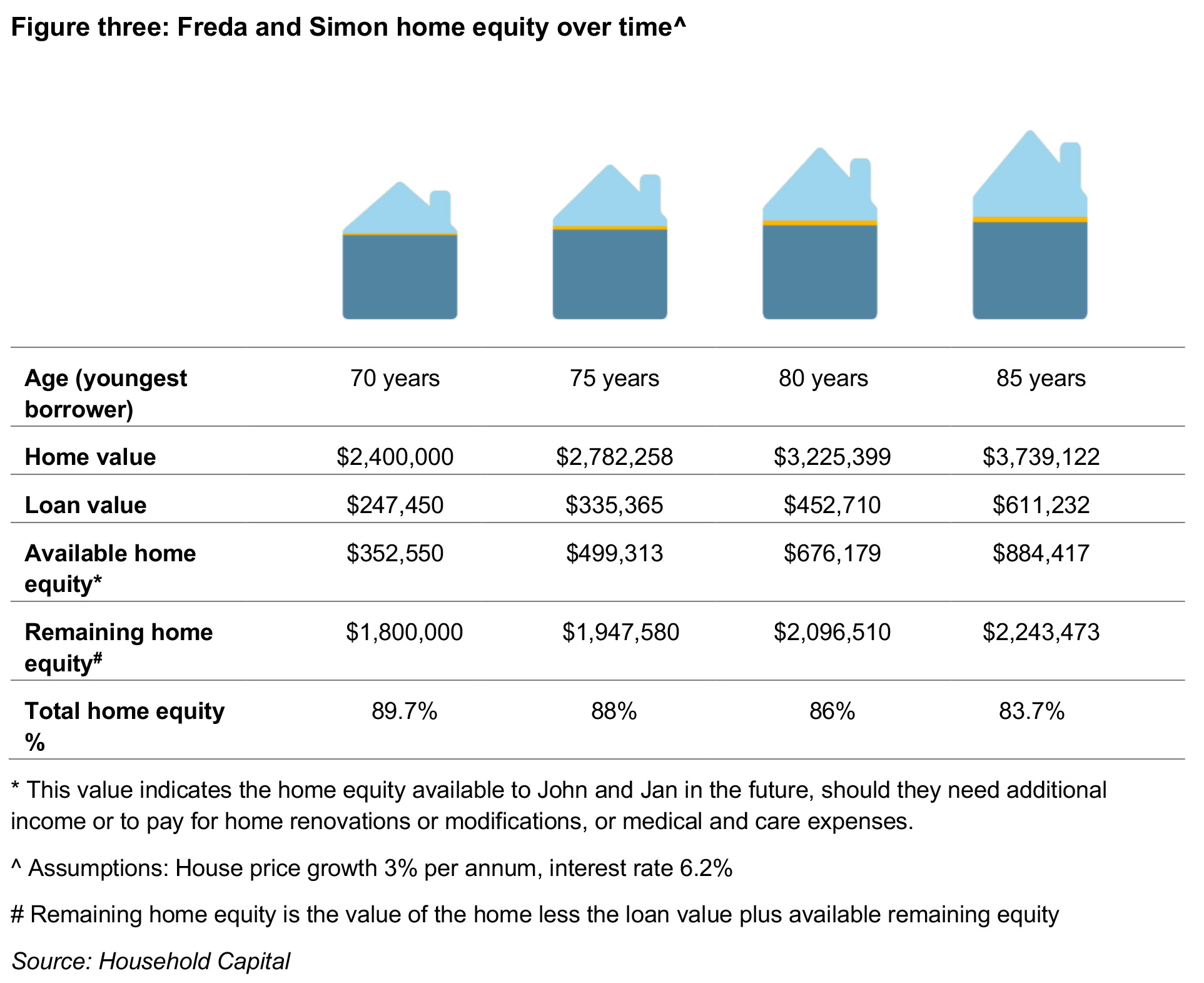
Based on the age of the youngest borrower (Freda aged 70), they were able to access 24 percent of the value of their property – or $600,000. Because they did not need that amount, Freda and Simon borrowed $247,450. This was made up of:
- $13,500 to refinance their existing mortgage and do away with regular repayments and improve their cash flow
- $25,000 to replace an old, unreliable vehicle
- $208,000 to be drawn as a regular income stream of $3,500 per month for the next five years.
After that, they expect to be able to sell the investment property and repay the loan. However, if that’s not the case, they have additional remaining equity to continue drawing an income stream into the future.

Increasing longevity, alongside a period that will be characterised by spiralling cost, indicates that it is now an optimal time to include home equity as a part of retirement planning. It’s also a strategy that allows the preservation of income producing assets during periods of volatility in financial markets.
By drawing on multiple sources of income, Australian retirees can achieve funding adequacy throughout the full course of 25+ years of retirement. However, to achieve this, retirees must be able to responsibly and cost-effectively access home equity savings to generate retirement income, provide access to capital and support a comfortable retirement irrespective of the client’s level of super.
Australian retirees are the wealthiest in the world – working together we can deliver that wealth back to our seniors, make retirement a fantastic phase of life, and lead the world in meeting the challenges of an ageing population.
———-