

Trustees must consider life insurance as part of the investment strategy.
The surging popularity of ‘do it yourself investing’ since the start of 2020 is now well documented.
Attracting less attention, but equally seismic in nature, is the mirroring of this DIY trend in the superannuation sector, with the last 2 years marked by significant growth in the ranks of Self-Managed Superannuation Funds (SMSFs).
In FY21, more than 21,000 new SMSFs were established, taking the total of established funds to just over 600,000[1]. These funds represent more than 1.1m members and around $822 billion in assets[2]. For perspective, this is around one quarter of all superannuation assets in Australia and means more is invested in SMSFs than in retail funds or public sector funds. As such, it is one the most significant parts of the superannuation landscape and one which all financial advisers should be equipped to understand.
One of the major motivators for people to establish an SMSF is to have more control over the way that fund is invested, and certainly much of the focus in the SMSF narrative is about investing. But equally important is the topic of life insurance, especially since much of the recent growth in SMSFs has come from the 35-44 age group (which made up one third of all new establishments in the 20/21 financial year[3]).
To the extent that SMSFs are regulated by the ATO – and not APRA – there are some key characteristics that make the topic of life insurance in SMSFs inherently complex. These complexities include, but are not limited to, the following considerations:
- allowable insurance types
- what premium types are deductible
- the claim implications of claiming tax deductions for premiums
- maintaining cover in existing retail or group funds
- trustee obligations
- beneficiary rules.
In this article, we will take an introductory look at the topic of life insurance in SMSFs, with the intention of giving advisers a working knowledge of some of the issues to be aware of, and traps to avoid, when working with Millennial and Gen X SMSF trustees and members in particular.
Trustees must consider life insurance as part of the investment strategy
Under the Superannuation Industry (Supervision) – SIS – Act 1993, SMSFs are required ‘to formulate, review regularly and give effect to an investment strategy’.
In August 2012, following a federal government review, the SIS Regulations pertaining to investment strategies were amended to include reference to life insurance. Specifically, trustees are now required by law:
- to consider whether insurance cover should be held by the fund on the lives of the members, and
- to review that decision as SMSF trustees regularly as part of the review the investment strategy of the fund.
Note that this does not mean that SMSFs must take out life insurance cover, just that they need to have considered it. However, most experts still recommend that this decision and the reasons behind it are supported by appropriate documentation. And by definition, just as it is mandatory to periodically review a fund’s investment strategy, so too the life insurance approach of the fund should also be similarly reviewed.
What does appropriate consideration look like?
For the purpose of the annual SMSF audit, it is necessary to prove that the trustees have considered the issue of life insurance. An example of appropriate documentation might include trustee prepared minutes/resolutions which:
- acknowledge that the trustees are aware of the obligation to consider insurance cover
- show that the trustees have considered the need for insurance cover for each of the members of the fund
- document that they have implemented cover where possible to meet those needs of the individual members and of the fund itself, and
- acknowledge that the trustees have determined that insurance is or is not required for a particular member(s)
In order to ensure this process is as robust as possible and can stand up to any potential family/beneficiary disputes down the line, trustees might consider asking each member individually whether they wish to have cover and keeping appropriate records of that process and each member’s decision.
Determining the need for cover for SMSF members
On one level, the process of determining the cover needs for SMSF members is the same as for other clients in retail or public sector funds. A comprehensive analysis of their situation, including debts, assets, budget, and any existing coverage would be central to that process.
An extra consideration that can arise specifically for SMSF members relates to Limited Recourse Borrowing Arrangements (LRBAs).
LRBA’s and life insurance for SMSFs
Data shows the SMSF sector represents over $30 billion in limited recourse borrowing arrangements4, many of which are entered into to buy property (which is then held on trust by the fund).
The SMSF has beneficial ownership of that property until the loan is paid off, after which time it attains legal ownership. If the SMSF defaults on the loan repayments, the lender may repossess or dispose of the asset in order to settle that debt.
For this reason (and because the death of a member may trigger the repayment or refinancing of the loan) it is not uncommon for lenders to make it mandatory for an SMSF to have life insurance in place for its members.
In these circumstances, the structure of the life insurance arrangements – in terms of claims payments – can be just as important as the cover itself. If there are issues with a trustee gaining access to an insurance payout – because of who they are paid to and in what form – this could lead to major liquidity challenges for the fund and an inability to pay off any LRBA, ultimately seeing the fund lose that property or asset.
One example of where this challenge could arise is if trustees – due to the absence of valid superannuation dependents – were required to pay the entire balance of a member’s account and insurance to that member’s estate, thus creating a potential liquidity problem for the fund if it doesn’t have all the funds to pay that balance.
Structuring is thus crucial.
Permissible types of cover through SMSFs
The rules around allowable covers within SMSFs are largely the same as for APRA regulated funds, although a degree of grandfathering means that cover types generally not permitted in modern funds can sometimes be found within existing SMSFs.
SMSFs – like other super funds – are allowed to provide any type of insurance cover that meets any of the following superannuation conditions of release:
- death (life insurance)
- permanent incapacity which causes the fund member to be unlikely to engage in gainful employment for which the member is reasonably qualified by education, training or experience (total and permanent disability insurance or TPD)
- temporary incapacity which causes the fund member to temporarily cease working (income protection insurance), and
- the diagnosis of a terminal medical condition (by two medical professionals) that is likely to result in the member’s death within two years.
While the terminal medical condition meaning under the Superannuation Industry (Supervision) Regulations denotes a period of 24 months, some life insurance policies may have a different duration for early access to the life insurance benefits via a separate ‘terminal illness’ duration (e.g., 12 months). As a result, some super fund members may be restricted to accessing just the accumulated capital value of their super fund, and not the life insurance benefit.
As per superannuation generally, the only definitions of TPD that satisfy the legislation are ‘any occupation’, and the stricter ‘Activities of Daily Living’. ‘Own Occupation’ TPD does not satisfy permissible conditions of release, and thus is no longer offered.
Similarly, trauma cover does not satisfy the above conditions of release and thus cannot be offered by super funds.
That said, there are circumstances where trauma/and or own occupation TPD can still be found within an existing SMSFs. Those circumstances involve the cover already being in place prior to 1 July 2014[5] (or earlier, depending on when the respective product provider chose to go live with the changes in legislation).
This ‘grandfathering’ means any covers already in place for members before this date can be maintained, although as discussed below, there are limits on the extent to what premiums are tax deductible to the fund.
Note that whilst this grandfathering is not strictly limited to SMSFs, many regulated and group funds took the decision to cease supporting these cover types, even for members who were eligible, hence this scenario is more likely to be encountered in SMSFs than in APRA regulated funds.
Tax deductibility of premiums
When it comes to the tax deductibility of life insurance premiums held within super (and thus owned by the fund trustees), there are two major considerations. One is strategic – whether or not to claim deductions, even where allowed, the other is one of detail: what type of premiums are deductible to the fund?
Dealing with the last point first, the ATO permits life insurance premiums held within super to be deductible to the extent that they relate to benefits which satisfy the SIS conditions of release. This means premiums that relate to death, any occupation TPD, salary continuance and terminal illness should generally be 100% deductible to the SMSF.
For grandfathered covers, that portion of premium which relates to benefits not satisfying the conditions of release will not be deductible. In the case of trauma covers, this is the entire premium, meaning no deduction is allowable. In the case of TPD, standard proportions apply. The following table from the ATO explains these standard permissible proportions. (Note that funds wishing to claim a non-standard proportion must provide an actuarial certificate when lodging their fund return.)
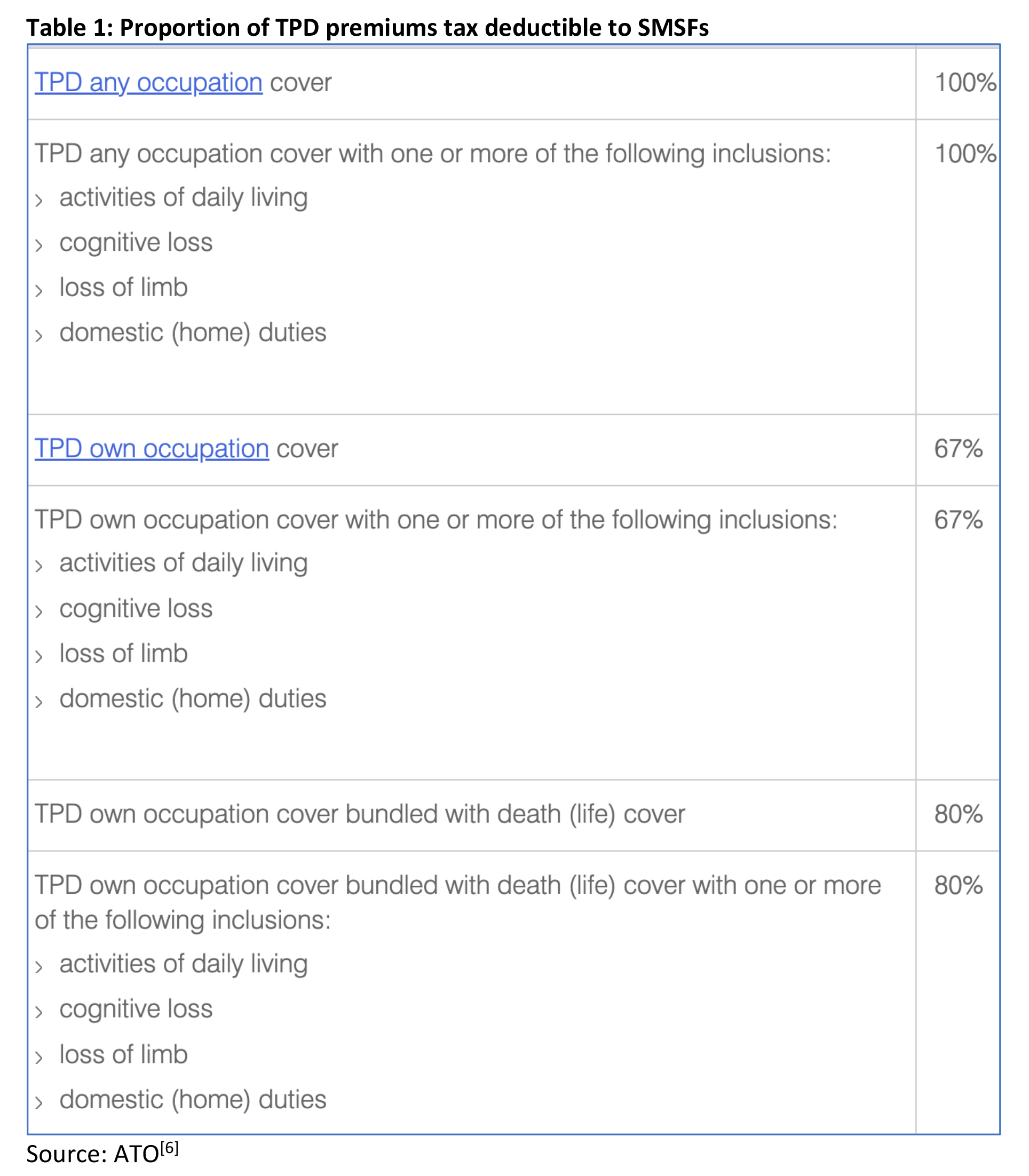

The major strategic consideration with regards to deductible premiums, is where to pay the premiums from, and whether to deduct them at all (even if permitted). What at first may seem to be obviously advantageous (funding life cover from super contributions rather than out of pocket from after-tax dollars) can be actually be fraught with complexities and traps.
The main consideration relates to the likely recipients of any payout.
Where claim proceeds are paid as a lump sum to a “tax dependant” (such as a spouse or a child under 18), the whole amount of the death benefit payment – including the life insurance – will be tax free. However, where the beneficiary is a non-dependant, the tax implications can be significant.
This is because life insurance claim amounts paid into a super accumulation account form part of the taxable component of the fund. If the premiums have been claimed as a deduction by the fund, then it is necessary to calculate an “untaxed element”. Importantly, this untaxed element will apply not just to the life insurance claim amount but is calculated on the entire taxable component in the member’s account.
As this can literally mean many thousands of dollars in tax, it becomes crucially important to consider who the end recipient of any insurance proceeds will be before deciding to claim a deduction for premiums.
In terms of where premiums are paid from, the introduction of the Transfer Balance Cap a few years ago adds complexity if the member has both a pension and an accumulation account. This is because when life insurance claim proceeds are received, they are allocated to the account from where they have been paid.
Whilst at first glance, paying premiums from an accumulation account may seem a smart strategy, there may be an impact on the Transfer Balance cap for the beneficiary, meaning the excess needs to be withdrawn into a less tax effective environment.
If, on the other hand, the beneficiary is a dependant with a reversionary nomination in place, paying the premiums from a pension account instead of the accumulation account could potentially be a better option as the insurance proceeds won’t be considered when assessing the Transfer Balance Cap.
Again, this is a complex area where the optimal structure will vary with individual circumstances.
Maintaining life insurance outside the SMSF
The cash flow benefits of structuring life insurance within super can be compelling, especially for older members facing steep premium increases each year. And whilst there can be reasons for holding cover outside super – including minimising the erosion of retirement balances – holding life cover within super, sometimes in conjunction with ‘linked’ trauma and Own Occ TPD cover outside super, remains a commonly recommended strategy.
In the context of SMSF members however, that doesn’t have to mean the cover should always sit within the SMSF itself. Indeed, there can be a variety of reasons why maintaining existing coverage within the member’s other – already existing – super funds can be the best approach.
These reasons can include:
- continuing access to cheaper group rates (although recent price increase in group cover have changed the differential somewhat), and
- avoiding the need to be individually underwritten (either because they have health issues which would attract loadings and/or exclusions, or just for convenience reasons).
For these reasons, and others, a common approach has been to leave the existing super fund with the insurance open, with the insurance premiums paid from the existing balance, which would obviously ‘run down’ over time.
As sensible as such a strategy may have once been, it is one that now carries inherent risks and the potential for unintended consequences, courtesy of the Protecting Your Super legislation.
Under the PYS legislation, funds with balances below $6,000 and not receiving new contributions for a continuous period of 16 months are deemed to be inactive (however, some policies may have adopted a shorter period of inactivity for members). Unless you have specifically contacted your fund to say you want to keep the fund and insurance in place – and in some cases even if you have – inactive funds will be automatically swept to the ATO (held on the member’s behalf), and any life insurance arrangements lost.
Suffice to say, when advising SMSF members on life insurance, it is absolutely critical to conduct a full review of what life insurances they already have in place, and what – if any – special restrictions might exist on those covers, even if they are allowed to be kept in place.
Examples of such restrictions might include:
- automatic loss of income protection cover after a certain elapsed period
- restrictions around maximum cover limits and waiting periods
- insurance in an employer sponsored plan ceasing if employer contributions stop
- minimum balance requirements
- automatic loss of insurance in a public sector fund if member leaves the public sector
- restrictions around terminal illness payouts
- special rules if the member is unemployed for a period of time.
Naturally, the normal comparison between group and individually underwritten retail cover should also be done.
Other life insurance considerations unique to SMSFs
Not all the processes applicable to regulated funds automatically apply to SMSFs. One example of this point relates to binding death benefit nominations.
An advantage of an SMSF is the flexibility for members to have binding death benefit nominations which do not expire or lapse, and which are not subject to the prescriptiveness of Regulation 6.17a of the SIS Act in relation to signatures and witnessing[7].
A recent court case provided clarity around this and is highly relevant to SMSFs and financial advisers.
In Hill v Zuda [2022], the High Court dismissed an appeal by the daughter of an SMSF trustee, who had earlier tried to stop a death benefit being paid to that trustee’s widowed de facto partner, on the basis that the Binding Death Benefit Nomination didn’t comply with regulation 6.17a and was therefore of no effect[8].
In dismissing this appeal, the High Court reinforced that regulation 6.17a does not ordinarily apply to SMSFs. It should be noted, however, that the regulation does apply to an SMSF where its trust deed specifically refers to or imports the application of the regulation.
Summary
Whilst the popularity of SMSFs continues to grow, the average age of those establishing new funds continues to drop, making it almost inevitable that advisers will encounter clients who need SMSF specific life insurance advice. Whilst many of the rules and considerations applying to life insurance within regulated super funds are equally applicable to SMSFs, there are a number of critical differences which can create headaches and traps for the unwary, and which therefore demand a differentiated approach, employing highly specialised strategies.

