

Robert Baharian
Investment manager Ekam Capital expects weakness in house prices to emerge in the second half of 2024, especially in Sydney and Melbourne, and the Reserve Bank of Australia (RBA) could keep interest rates on hold until the year’s end given the stickiness of inflation.
Ekam Capital co-founder and director Robert Baharian expects the RBA to keep rates where they are given for now, and the housing market to slow down, especially in the eastern states of Australia as credit costs continue to mount and the average mortgage size in NSW reaches $744,000, well above that in Victoria at $590,500, and compared to an Australian average of $608,000 in March 2024.
“We think interest rates could remain on hold this year given that inflation in Australia remains sticky, especially services inflation, as the RBA pointed out this week. Unemployment remains very low and that is keeping Australians spending. The relatively high level of interest rates could cap growth in house prices, especially in NSW and Victoria.
“With share market gains slowing in recent weeks, this also suggests that property prices may have peaked in the short-term, and we expect house price growth to slow.”
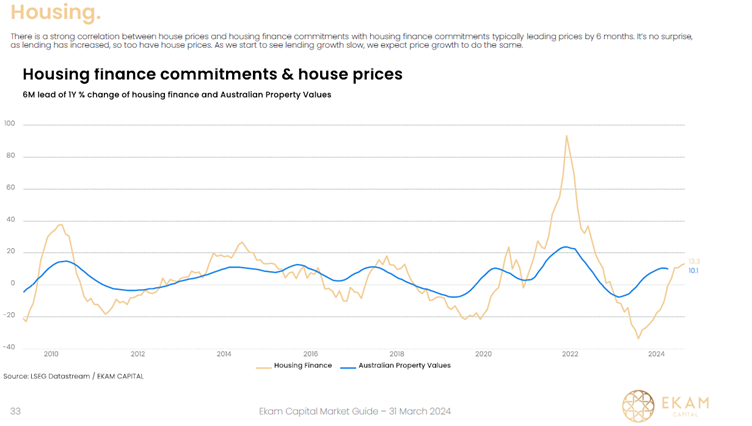
According to Mr Baharian, there is also a strong correlation between house prices and housing finance commitments. “Housing finance typically leads house prices by about six months. Home lending growth has slowed and we expect house price growth to do the same. With inflation where it is today, and interest rates at current levels, it could put a lid on how much people can borrow and therefore pull down mortgage growth” he said. The chart below reveals the recent slowdown in mortgages growth and the impact this may be having on house prices.

Rates on hold as inflation to float above RBA’s target band
“It’s hard to see the Reserve Bank of Australia cutting interest rates this year, especially with unemployment so low and services inflation remaining high. People are still spending, so inflation could remain above the reserve banks 2% to 3% target band for the remainder of the year,” said Mr Baharian.
“Australians are funding their consumption out of their wages and also household savings, and this is pushing up the cost of services such as travel, leisure activities and eating out. I expect services inflation to stubbornly remain above the central bank’s target band,” he said.
“While both the unemployment and underemployment rate have been rising slowly, it continues to remain historically low which may keep inflation stickier for longer.”