

Michael Browne
As AI transforms industries, its massive energy appetite is straining existing infrastructure. Innovative solutions are needed to meet growing demands, driving investments in new energy sources and intelligent grid systems according to Franklin Templeton Institute.
“It is increasingly apparent that the artificial intelligence (AI) boom is anything but artificial. AI is real and it is infusing its applications across industries, enabling advancements in health care, finance, transportation, manufacturing and business services. The proliferation of AI across the world’s economy will, however, require massive investments,” notes Michael Browne, Global Investment Strategist at the Franklin Templeton Institute.
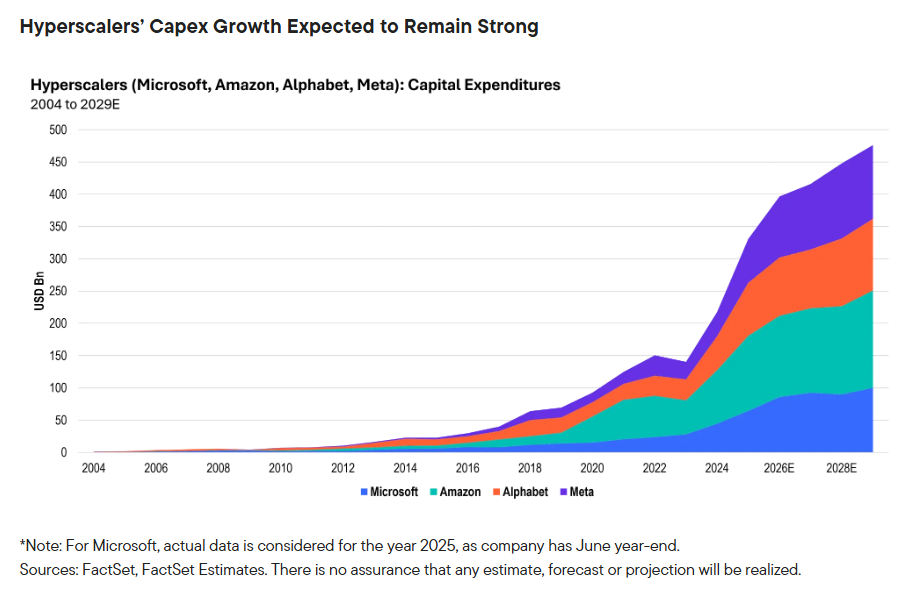
In the United States, the “Big Four” (Microsoft, Amazon, Alphabet and Meta) are forecast to have spent more than US$3 trillion on AI by the end of the decade.[1] Much will be in developing and securely transmitting the power that hungry banks of AI processors require. AI has a massive appetite for electricity, creating both challenges and opportunities for investors. Accordingly, AI will also foster significant innovation and investment in the efficiency of production, distribution and storage of electricity.

As AI models become larger and more complex, their demand for energy inputs is rapidly growing. Presently, AI usages absorb about 4.5% of total US electricity production, equivalent to or that of roughly 20 million American homes or Spain’s current total electricity consumption. By 2035, AI may account for 5% of all energy usage around the world.
Browne adds, “Those trends will place enormous pressures on existing energy infrastructure and will require significant investments in energy supply and in electricity transmission, security and resilience. Over the next five years, the energy infrastructure needed to support AI growth will occur in three areas: data centre expansion and optimisation, power generation and grid modernisation.”
At the heart of AI’s energy demands are data centres, which are the physical hubs where AI is trained, deployed and run. As models grow more complex, with trillions of parameters and real-time inference requirements, the computing power required is increasing exponentially. Given the strong commercial interest in AI applications across all sectors of the economy, data centre capacity is expected to double by 2030, and AI could account for up to 20% of total data centre power consumption.
It appears increasingly likely that AI’s massive energy needs cannot be met solely by boosting energy production and distribution, as necessary as those developments are. Innovations in efficiency and alternative sources of energy will also be required.
AI hardware such as TPUs (tensor processing units) and GPUs (graphics processing units) require calibrated cooling systems and associated energy management software. Innovations like immersion cooling or waste heat reuse can reduce energy usage per computation and will become more important as energy demand rises. Indeed, without energy optimisation advancements, AI-driven data centre power consumption could reach unsustainable financial and environmental levels within a decade.
To support the expanding energy needs of AI, the global energy generation mix must shift toward scalable and sustainable sources. Currently, many data centres are powered by fossil fuels, which not only contribute to carbon emissions, but are also vulnerable to price volatility and supply disruptions.
Over the next five years, AI-related energy needs will increasingly be met by renewable sources such as solar, wind and hydropower. In some novel cases, small-scale nuclear reactors are being purpose-built to power AI infrastructure. Hyperscale data center operators are already investing in private power purchase agreements (PPAs) with renewable energy providers, aiming to secure long-term, carbon-free electricity. However, renewables pose challenges due to their intermittent nature.
“To mitigate those challenges and to enhance energy security, energy storage technologies, particularly utility-scale batteries, will be essential. These systems can store excess power generated during peak renewable production periods and release it during demand spikes. AI can assist by optimising energy forecasting, grid balancing and demand response through real-time analytics,” Browne noted.
With regards to energy transmission needs, traditional centralised grids are incompatible with the decentralised demands of AI infrastructure. More modernised, i.e., “smart” grids, will become necessary. Their development will involve upgrading transmission lines, deploying real-time monitoring and control systems, and integrating local sources of power, including wind, solar, nuclear and battery supplies.
For example, smart grids allow power to be continuously and instantaneously allocated as needs arise, helping to meet demand surges caused by AI needs. AI centres can also enhance grid resilience through load forecasting and adaptive energy routing.
“For investors, we believe the next five years represent an opportunity to capitalise on this shift. The energy sector in all its dimensions must support a vast increase in computational power while simultaneously transitioning toward sustainable production and distribution. It must also enhance resilience and security. All these needs will require significant investment in new sources of energy, power generation, distribution and intelligent, flexible grid systems.
“In our opinion, it is a once-in-a-generation opportunity.”
——–