

What are the diversification benefits offered by private credit, and why is diversification within and between different private credit funds important?
Private credit has rapidly evolved from a specialist asset class into a core component of many Australian investors’ portfolios. As traditional fixed income markets continue to react to a challenging economic and trade environment, investors are increasingly drawn to the promise of enhanced yields and diversification through private lending opportunities.
However, the rapid expansion of the sector has brought uneven standards in origination, underwriting and risk management. The label private credit now covers a broader spectrum of investment opportunities, from conservative, asset-backed corporate loans to speculative, highly leveraged strategies. For advisers and investors alike, distinguishing between these approaches is essential to assessing true risk-adjusted returns and funds that best meet investor objectives.
It is essential that advisers have a deeper understanding of manager capability, portfolio transparency and credit discipline. The opportunities in private credit are real, but so too are the risks for those who don’t look closely enough beneath the surface.
Growing demand for private credit among Australian investors
Although it seemingly emerged overnight, private credit has been an investment opportunity accessible to – and highly sought after by – institutional investors since its swift rise post the GFC. The size of the private credit sector at the start of 2025 was estimated at US$3 trillion, compared to about US$2 trillion in 2020. It is projected to reach US$5 trillion by 2029[1].
The accessibility of private credit by non-institutional investors is a more recent phenomenon. Industry research[2] published this month by the Alternative Credit Council (ACC), the private credit affiliate of the Alternative Investment Management Association (AIMA), and global law firm Dechert LLP, noted the growth in participation of retail clients; over 50 percent of managers currently serve high-net-worth or other retail clients, and two-thirds are targeting retail capital for new funds.
Several structural and cyclical forces have fuelled the growth of private credit in Australia (and globally). On the supply side, regulatory constraints have led banks to retreat from certain segments of corporate and property lending, creating a funding gap that non-bank lenders have been quick to fill. On the demand side, borrowers are increasingly drawn to the flexibility, speed and tailored structuring that private lenders can provide. For mid-market corporates, property developers and other non-investment grade borrowers, private credit offers access to capital that traditional lenders (i.e. banks) may no longer provide.
At the same time, demand for private market investment increased, with superannuation funds, insurers and family offices seeking investments with alternative income streams that can offer both diversification and illiquidity premiums.
For investors, the attraction lies in the potential for more stable returns compared with public markets, as well as lower correlation to listed equities and bonds. This is as attractive to retail investors as it is to their institutional counterparts.
Private credit and diversification
Private credit funds provide meaningful diversification benefits to investor portfolios in two ways.
Firstly, within the asset class itself, because each private credit fund offers access to a broad spectrum of debt instruments and borrowers, ranging from senior secured loans to mezzanine financing and specialty lending (figure one). By spreading investments across different borrowers, industries and loan structures, investors reduce the reliance on the performance of any single issuer or sector.


Secondly, as an asset class, private credit provides diversification from traditional assets. Private credit often exhibits a low correlation with asset classes, such as listed equities or bonds, which can be highly sensitive to macroeconomic cycles, market and investor sentiment, as well as interest rate movements. The relative independence private credit enjoys from broader market fluctuations can help reduce portfolio volatility, particularly during periods of equity market stress or bond market dislocation.
The diversification benefits provided by an exposure to private credit extends to risk-adjusted returns because private credit can generate consistent income streams while buffering against the volatility of more traditional asset classes.
So, private credit not only broadens the range of exposures within a client’s portfolio but also provides a strategic complement to holdings of more traditional asset classes, which can enhance a portfolio’s resilience and long-term performance potential.
Australian investors and equities
Australians love their shares – almost as much as they love property! The last Australian Investor Study took place in 2023[3]. A key finding was that 51 percent of Australians (10.2 million people) hold investments in addition to their home and their super fund, and, of those, 58 percent hold Australian shares and 20 percent hold ETFs.
With that backdrop, investors and their advisers will be closely watching Australian and US equity markets, which have risen to all-time highs in 2025 (figure two) despite ongoing global economic, trade and geopolitical uncertainty. However, many market commentators note that this strength has been accompanied by a growing disconnect between valuations and underlying company fundamentals.
The concept of stretched valuations – where asset prices are significantly higher than fundamental value – has become a growing concern for investors globally. In the current market environment, listed equities are increasingly coming under scrutiny for being potentially overvalued. This raises important questions about portfolio risk and the sustainability of returns over the long term.
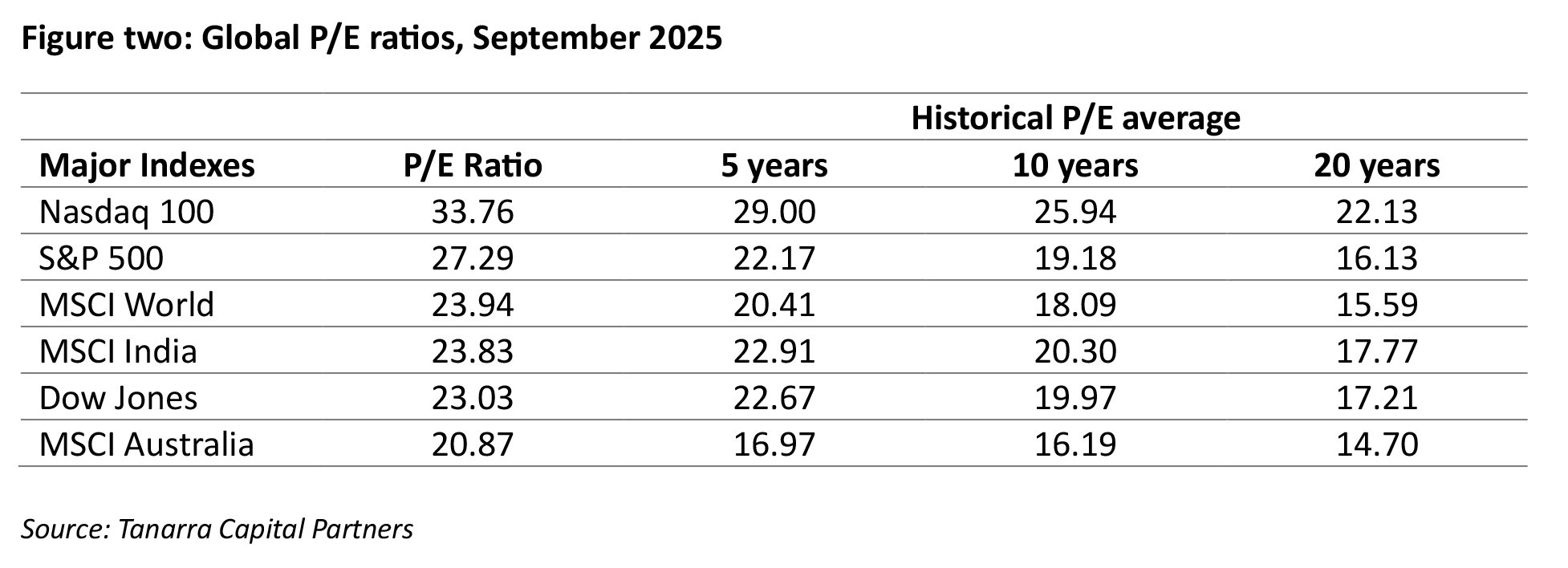

In Australia, the ASX-200 closed at consecutive all-time highs in recent months and surpassed 9,000 index points for the first time. At the same time, the ASX-200 index has a trailing P/E ratio of ~20.9x compared to its rolling five-year average of ~17x. This rally has not been driven by earnings growth, with the median ASX 200 consensus earnings per share steadily declining, and FY25 consensus earnings growth forecast standing at -1.7%.
Instead, growth in the market appears to be driven by a mix of optimism around further interest rate cuts increasing the attractiveness of equities, and international investors looking to decrease their US market exposure. While the concerns around stretched valuations for each of the US and Australian markets are driven by different factors, investors with an overweight allocation to listed equities may find themselves vulnerable to several risks. These include:
- Limited return upside: When investors buy into listed equities at stretched valuations, future returns are typically lower. If there is a correction on the factors driving these valuations (for example, the tech bubble “bursting” or interest rates remaining higher-for-longer compared to before the COVID pandemic), investors risk paying too much upfront for growth that may not eventuate.
- Volatility risk: As experienced throughout 2025, large volatility spikes can force a rapid repricing of risk assets, eroding capital in those portfolios that are overweight to certain sectors, and markets and lack adequate diversification.
- Correlation risk: During economic downturns, listed equities that are typically considered diversified (for example, an ETF that tracks the S&P 500 index) can exhibit high levels of correlation if confidence in the broader market diminishes and there is a mass sell off.
The sell off following the US tariff announcements in April 2025 was a recent example, falling just short of the top ten worst three-day drawdowns of the S&P 500 since World War II. In comparison, this sell off would have limited impact on private credit returns where value is largely derived from business fundamentals and relatively uncorrelated to public market sentiment.
Diversification within private credit
Diversification within specific private credit funds is also an important consideration for successful portfolio construction. Spreading exposure across industries, borrower types, geographies and assets can mitigate concentration risk and ensure a more stable return. During periods of economic volatility, different sectors and borrowers respond in varied ways. A well-diversified portfolio is better positioned to preserve capital and deliver more resilient, consistent returns throughout the economic cycle.
Just last week a headline in The Australian Financial Review suggested the demand for real estate private credit is likely to ‘quadruple’ in the coming years[4]. Real estate exposure in private credit funds can provide advisers with a conundrum.
Historically, a substantial portion of Australian household wealth has been concentrated in real estate. Property assets, including primary residences and additional real estate, represent nearly 60 percent of total household wealth[5]. There is also significant exposure to direct property, both commercial and residential, in Australia’s retirement savings. Of the $4.3 trillion in superannuation at end June 2025, approximately 25 percent was held in SMSFs. Asset allocation data for the same period shows domestic and overseas property holdings represent an average of 15.5 percent of SMSF portfolios, marginally behind cash and term deposits (16 percent); these sectors are eclipsed only by listed shares, with average holdings at 28 percent of SMSF portfolios[7].
For those investors with significant exposure to the property market, it would be prudent to consider diversifying their portfolios through private credit managers that specialise in corporate investments rather than adding additional real estate exposure. There is also the increased likelihood of impaired real estate loans to consider.
In 2023-24 the Australian construction industry was responsible for the largest number of insolvencies at 26 percent[7]. This trend underscores the ongoing challenges faced by the construction industry in Australia. These include rising material and labour costs, skilled labour shortages, fixed price contracts and project delays, each of which has contributed to a surge in builder bankruptcies and liquidations.
While private credit funds that focus on real estate may offer attractive yields, they come with a set of unique risks compared with other private credit strategies. These loans are typically illiquid, tied to long-term property projects, and may be difficult to exit early. The performance of real estate loans is heavily dependent on the successful completion of projects and the stability of property value; as outlined above, the construction sector faces a number of headwinds.
Collateral and valuation issues may also be more pronounced in real estate private credit. Unlike corporate loans, where company financials and cash flows provide clearer insight into creditworthiness, property valuations can be subjective, slow to update and influenced by local market dynamics. Regulatory and legal risks – such as zoning approvals, environmental requirements or planning disputes – can delay projects and affect repayments. Consequently, the investment manager’s expertise in underwriting, monitoring and structuring loans is particularly critical to mitigate these risks.
Compared with corporate private credit, real estate-focused funds generally carry higher project-specific, illiquidity and valuation risks, while corporate loans tend to benefit from broader diversification and more transparent financials.
By understanding the exposure of private credit funds, advisers can ensure that each of their client portfolios is adequately diversified and not over-exposed to a specific asset class, such as real estate.
Why corporate private credit is uniquely insulated
Mid-market corporate private credit loans typically exhibit characteristics that insulate this sub-sector from the risk of stretched public equities and shields it from the challenges that face real estate debt. That said, it is important to understand how each investment manager approaches investment selection, portfolio management and risk mitigation.
With corporate private credit, value is derived from credit fundamentals rather than market sentiment. For example, Tanarra Capital Partners (TCP) underwrites loans based on financial performance (such as EBITDA and cash generation) and credit worthiness (such as leverage and interest coverage). While future growth is considered, private credit valuation and returns are based on business fundamentals rather than volatile factors such as public trading multiples.
It is important that private credit investment managers include at least one financial covenant, such as a leverage ratio, which measures how much debt a borrower has relative to its earnings or assets. This covenant would provide an early warning sign of underperformance. This can provide the investment manager an opportunity to work with company management and restructure the loan if required. Listed equities provide no similar remedy for investors to preserve value.
Downside protection can be provided through a focus on loans that are senior secured over the cashflow and assets of the company and ideally, supported by a 50%+ equity first-loss position. In such cases, the recovery value on invested capital is primarily tied to the cashflows and assets of the company and overall enterprise value. The value to the client can be demonstrated by reference to TCP’s typical equity first-loss position, which would see a borrower’s enterprise value needing to decline by over 50 percent before TCP’s debt is at risk of impairment. Such an approach provides significant downside protection to investors.
With equity valuations at record highs and market volatility elevated, investors should be cautious about concentrating too heavily in listed equities. Similarly, investors should be wary of over-exposure to property at a time when there are multiple headwinds, particularly for developers. Corporate private credit offers a compelling alternative, providing structural features that can help insulate returns from market swings, particularly when managed by experienced fund managers with strong underwriting discipline and robust downside protections.
While no market is entirely immune to global forces, the Australian corporate private credit sector demonstrates a degree of insulation compared with larger, more volatile markets. By adding private credit to a portfolio, investors gain exposure to a diverse set of borrowers and debt instruments that often have low correlation with traditional equities and bonds, helping to reduce overall portfolio volatility.
Whether or not diversification is driving the boom in private credit investing, in an environment of heightened uncertainty and stretched valuations, incorporating private credit can strengthen portfolio diversification, enhance risk-adjusted returns and provide a steady source of income regardless of prevailing market conditions.
Take the FAAA accredited quiz to earn 0.5 CPD hour:
CPD Quiz
The following CPD quiz is accredited by the FAAA at 0.5 hour.
Legislated CPD Area: Technical Competence (0.5 hrs)
ASIC Knowledge Requirements: Alternative Assets (0.5 hrs)
please log in to start this quiz
———–
Notes:
[1] Understanding Private Credit’s Rapid Growth, Morgan Stanley, October 2025
[2] Trends in Private Credit Fund Structuring 2025, Alternative Credit Council and Dechert LLP, October 2025
[3] ASX Australian Investor Study, Australian Securities Exchange, June 2023
[4] https://www.afr.com/property/commercial/surging-demand-will-quadruple-real-estate-private-credit-in-5-years-20251006-p5n0fz
[5] 2022 Household, Income and Labour Dynamics in Australia (HILDA) Survey, December 2023
[6] ATO, SMSF Quarterly Statistical Report, June 2025
[7] https://gerard-de-valence.blogspot.com/2024/09/entry-exit-and-insolvencies-in.html
The information included in this article is provided for informational purposes only and is general advice only. It does not take into account an investor’s own objectives. The information contained in this article reflects, as of the date of publication, the current opinion of Tanarra Credit Partners and is subject to change without notice. Sources for the material contained in this article are deemed reliable but cannot be guaranteed. We do not represent that this information is accurate and complete, and it should not be relied upon as such. Any opinions expressed in this material reflect our judgment at this date, are subject to change and should not be relied upon as the basis of your investment decisions. All reasonable care has been taken in producing the information set out in this article however subsequent changes in circumstances may occur at any time and may impact on the accuracy of the information. Neither Tanarra Credit Partners, GSFM Pty Ltd, their related bodies nor associates gives any warranty nor makes any representation nor accepts responsibility for the accuracy or completeness of the information contained in this article.
CPD Quiz
The following CPD quiz is accredited by the FAAA at 0.5 hour.
Legislated CPD Area: Technical Competence (0.5 hrs)
ASIC Knowledge Requirements: Alternative Assets (0.5 hrs)
please log in to start this quiz