
CPD: Designing retirement income streams

Clients and advisers need to understand the importance of balancing growth, income and flexibility when designing sustainable retirement income streams.
Since 1 July 2022, superannuation trustees have been required to formulate, regularly review and give effect to a retirement income strategy under the Retirement Income Covenant (the Covenant). It requires superannuation trustees to formulate a strategy that helps members achieve and balance three things:
- Maximise expected retirement income over the course of retirement
- Manage expected risks to the stability and sustainability of that income (such as longevity, inflation and market/sequencing risks)
- Have flexible access to expected funds and capital during retirement (such as for unexpected health costs or major purchases).
The significance of the Covenant goes beyond the compliance obligation it places on trustees. It is a formal acknowledgment that the job of superannuation doesn’t end once a member stops working and starts drawing down their balance. Accumulation has always had a well understood goal: build the largest sustainable balance possible by retirement. Decumulation is a different problem entirely, one the industry has historically given far less structured attention.
The Covenant is the regulator’s answer to a question that individual retirees have been left to work out for themselves: how do you turn a lump sum into an income that lasts as long as you do, without either running out of money or leaving a comfortable retirement on the table out of excess caution?
For advisers, the Covenant’s three objectives translate into the work of constructing an individual client’s retirement income strategy. Trustees are solving this problem at a member cohort level. You solve it one client at a time, with the added detail of a client’s specific assets, health, family circumstances, risk tolerance and objectives. The underlying challenge is the same: income, risk and flexibility need to be balanced.
Income – the right frame for retirement
How much super is enough? It’s a frequent headline, clickbait for those close to retirement, often citing a supersized balance we all need to have to enjoy a decent lifestyle in retirement. This is most likely a fallout from the fact that for most of superannuation’s history, success has been measured in terms of the total balance. Statements, projections and even client conversations have tended to centre on a single number: how much has been saved, and whether that number is big enough. It’s an easy metric to communicate but is it the only one to consider?
A large balance says nothing on its own about whether a client’s income will last as long as they do, whether it will keep pace with rising costs, or whether a market downturn in the first few years of retirement will permanently reduce their standard of living. These are the risks the Covenant explicitly cites, and each can affect how any retirement income strategy should be constructed.
- Longevity risk is the risk of a client outliving their savings. Life expectancy is a median and a meaningful proportion of retirees will live beyond it. A strategy built around an assumed end date can leave that client exposed if they live longer than planned.
- Investment and sequencing risk relates to the timing of market returns rather than their average over time. A downturn early in retirement, when a balance is at its largest and a client has started drawing down, can permanently impair how long that balance lasts, even if markets recover later. Two clients with identical average returns over twenty years can end up in very different positions depending purely on the order of those returns.
- Inflation risk is the gradual erosion of purchasing power, particularly front of mind in the current environment. An income that looks adequate at the point of retirement can look considerably less so a decade later if it isn’t structured to keep pace with the rising cost of living.
There’s also a behavioural dimension worth noting. Retirees without a clear income framework often respond to these risks by underspending because they experience FORO – the fear of running out. This happens even when their balance would comfortably support a better lifestyle. Others may remain more heavily exposed to market risk than is appropriate for their stage of life, simply because no alternative structure has been put in place. A defined income strategy addresses both tendencies by giving clients clarity on what they can safely spend and confidence that the risks they can’t control have been actively managed.
The Age Pension – a critical safety net
Any discussion of retirement income needs to start with the Age Pension. It forms the base layer that other income sources sit on top of (assuming eligibility). It’s also the piece most likely to be misunderstood by clients as more substantial than it actually is.
Following the most recent indexation (20 September) the maximum Age Pension is currently $1,237.70 per fortnight for a single person, or $32,180 a year. It is $1,866 per fortnight combined for a couple, or $48,516 a year. These rates are indexed twice yearly.
For clients without significant other assets, this indexation provides an ongoing measure of protection against inflation; however, given the prevailing ‘sticky’ inflation impacting services such as health, an increase of ~$30 twice a year won’t make a significant difference to the retirement budget.
Eligibility is means tested against both an income test and an assets test, with Services Australia applying whichever produces the lower entitlement. As of 1 July 2026, a single homeowner can hold up to $333,000 in assessable assets before the pension begins to taper; assets must stay under $733,500 to receive any payment at all. A homeowner couple can generally hold up to $1,121,000 in combined assessable assets before their pension payments stop completely.
Superannuation becomes an assessable asset once a client reaches Age Pension age, which means the two systems interact rather than operate independently. This interaction is often central to how a retirement income strategy is structured for clients near the relevant thresholds.
The Age Pension does what it says on the tin – it provides a durable, indexed, means tested safety net for older Australians. What it was never designed to do is function as a retirement strategy in its own right. It has no mechanism for scaling with a client’s actual lifestyle expectations and has no flexibility to be adjusted around a client’s specific asset base beyond the means test. Importantly, it has no capacity to bridge the gap between a basic standard of living and a comfortable one. Clients who arrive at retirement assuming the pension will fill whatever gap remains after their other savings are exhausted are, in effect, treating a safety net as a strategy.
ASFA Retirement Standard – benchmarking adequacy
The Age Pension establishes a floor, but it doesn’t tell you or your client whether that floor is anywhere near adequate for the lifestyle the client actually wants. This is where the ASFA Retirement Standard becomes a useful reference point as a way of grounding client conversations with a concrete, recognised benchmark rather than an abstract sense of ‘enough’.
ASFA has tracked the cost of retirement for two decades, publishing quarterly figures for two benchmark lifestyles: modest and comfortable. While the original benchmarks assume the retiree owns their home outright, a benchmark for renters has now been included for the ‘modest’ lifestyle. These benchmarks are based on a single person or couple aged 65-84, with the underlying budgets covering everything from groceries and utilities to health, transport and leisure. The numbers are laid out in figure one.
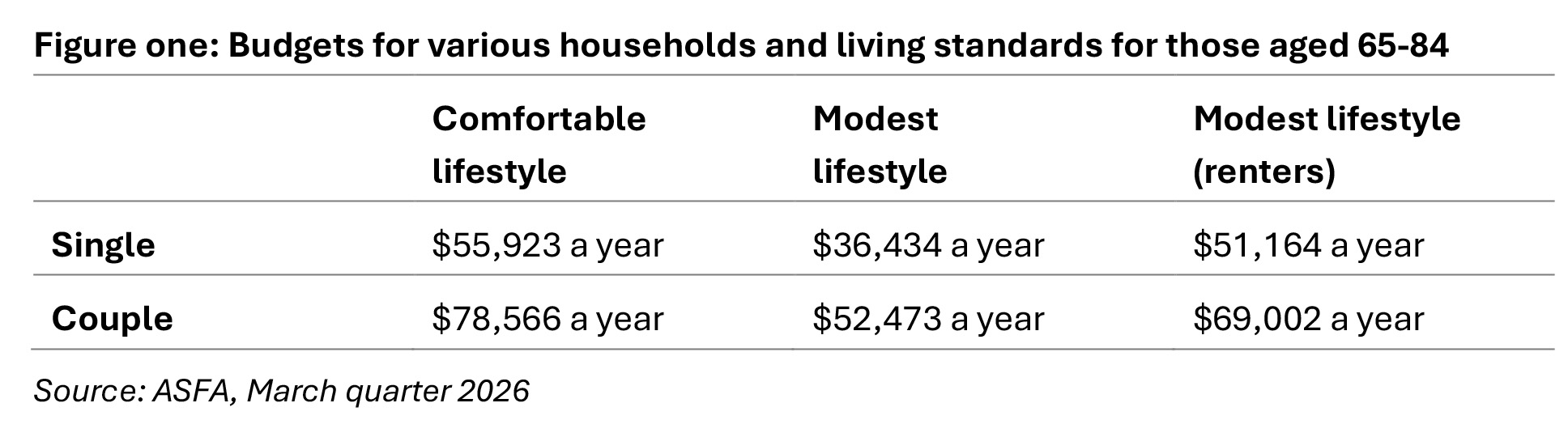
ASFA describes a modest lifestyle as one that covers the basics: budget groceries, limited leisure activities and reliance on public transport rather than a well-maintained car. A comfortable lifestyle includes private health insurance, a reliable car, regular social and leisure activities, as well as the ability to take domestic and occasional international trips.
Set against the full Age Pension, the gap is substantial.
A single retiree on the maximum pension of $32,180 sits roughly $4,250 short of a modest lifestyle and around $23,700 short of a comfortable one. A couple on the maximum combined pension of $48,516 is short by around $3,960 for a modest lifestyle and approximately $30,050 for a comfortable one.
For advisers, these figures serve a purpose beyond illustrating a shortfall. They give clients a tangible target to plan towards, rather than a vague aspiration to ‘be comfortable’ or have an ‘enjoyable lifestyle’. A client’s own view of what they need in retirement should always take precedence over a generic benchmark, but the ASFA standard provides a starting point for that conversation. It is also a useful checkpoint for testing whether a proposed strategy is actually likely to deliver the lifestyle a client expects.
Account based pensions – flexibility, but with risk
For most clients drawing an income from superannuation, the account based pension (ABP) is the default vehicle – and for good reason. It offers a level of flexibility and control that no other retirement income product matches, which makes it a natural fit for the ‘flexible access to funds’ objective set out in the Covenant.
An ABP allows a client to draw an income from their superannuation balance while the remaining funds stay invested. Clients can adjust their drawdown amount within regulatory minimums, respond to changing circumstances and retain access to the underlying capital if they need a lump sum for an unexpected expense. On death, any remaining balance can generally be passed on to a beneficiary. These features make ABPs well suited to estate planning objectives that alternatives often can’t match.
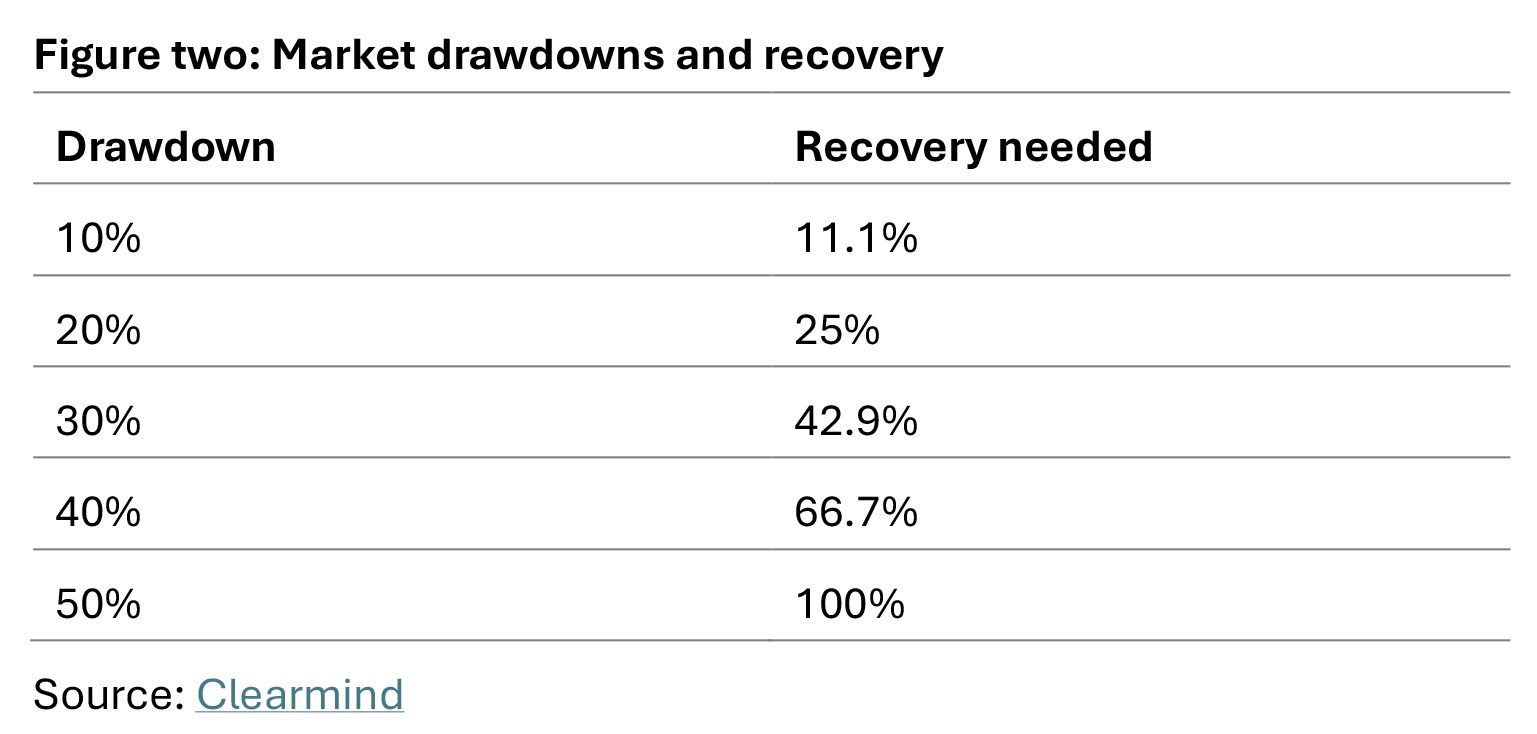
The trade-off is that an ABP doesn’t resolve the risks identified by the Covenant. Instead, this structure shifts them onto the client. The underlying balance remains market-linked, so the client continues to carry investment risk – and, more specifically, sequencing risk. A downturn in the early years of retirement, when the balance is at its largest and withdrawals have begun, can permanently reduce how long that balance lasts, even if markets subsequently recover. A market drawdown requires an asymmetric, increasingly larger percentage gain to return to breakeven because the recovery gains are calculated on a smaller remaining capital base, as illustrated in figure two.
There is also no inherent longevity protection. An ABP has no mechanism to guarantee income for life. If a client draws down too quickly, lives longer than expected or experiences a period of poor returns at the wrong time, the balance can be exhausted before the end of their life.
There’s also a behavioural risk here. Because an ABP gives clients discretion over how much to draw, that flexibility can work against them without a clear framework in place. Some clients draw down too conservatively, at only the minimum required rate, and end up with a far more restricted lifestyle than their balance would actually support. Others draw down too aggressively without fully appreciating the impact of sequencing risk on how long their balance will last.
None of this makes the ABP a poor tool. It remains the right vehicle for the portion of a client’s retirement income that needs to stay flexible and responsive to changing needs. The point for advisers is that it should be understood as addressing one of the Covenant’s three objectives well, flexible access to funds. However, it leaves the other two objectives, maximising income and managing risk, largely unaddressed. This is why the ABP is rarely sufficient as the sole component of a retirement income strategy.
Annuities and lifetime income products – transferring risk to the provider
Where an ABP leaves investment, sequencing and longevity risk with the client, annuities work on the opposite principle. A client exchanges a portion of their capital for a guaranteed income stream, and the provider takes on the risk of funding that income for as long as it’s contracted to run.
Annuities in the Australian market generally fall into two broad categories.
- Term annuities provide a guaranteed income for a fixed period, commonly anywhere from one to twenty years, after which the arrangement ends, sometimes with a residual capital value returned to the client depending on the terms selected.
- Lifetime annuities provide an income for as long as the client lives, regardless of how long that turns out to be, which directly addresses longevity risk in a way no market-linked product can.
This structure maps closely to two of the covenant’s three objectives. Longevity risk and investment risk are both transferred away from the client, and the income itself is generally stable and predictable, which supports the ‘maximising expected income’ objective in the sense that a client isn’t left second-guessing what they can safely spend.
What annuities generally don’t offer is the third objective – flexible access to funds. Once capital is committed to an annuity, it’s typically no longer accessible as a lump sum. If early withdrawal is permitted at all, it often comes at a significant cost. This is the central trade-off advisers need to work through with clients – certainty of income in exchange for a meaningful reduction in liquidity.
There’s also a means-tested benefit. Eligible lifetime income streams can receive concessional treatment under the Age Pension assets test compared to holding the equivalent capital in a standard ABP, which in some circumstances can improve a client’s pension entitlement. The specific discount and eligibility criteria depend on the product’s structure and the Services Australia rules in place at the time.
Annuities can be a useful tool for the portion of a client’s retirement income that needs to be genuinely guaranteed, typically the amount required to cover essential, non-negotiable living costs. Used this way, they complement rather than compete with an ABP. The annuity covers the base level of income a client cannot afford to be without, while the ABP retains flexibility for everything above that base.
Newer generation retirement income products – growth, flexibility and guarantees
Between the flexibility of an ABP and the certainty of a traditional annuity, a broader category of retirement income products has developed over recent years, designed specifically to address a gap that neither of the other structures fully closes when used in isolation. These products generally combine market-linked growth potential with some form of guaranteed income floor or guaranteed minimum withdrawal amount.
The client’s capital typically remains invested, giving them exposure to potential market gains, while the guarantee ensures that regardless of how markets perform, the income received won’t fall below a set level. Many of these products also provide flexibility by allowing access to the underlying capital. This sets them apart from a traditional lifetime annuity where capital is generally inaccessible.
The new generation of lifetime income products typically meet all three of the Covenant’s objectives, rather than requiring a trade-off between them. The growth component supports the objective of maximising expected income over time, since the client retains some exposure to market performance rather than accepting a fixed, guaranteed rate alone. The income floor addresses the objective of managing investment and longevity risk, as the client knows the minimum income they’ll receive, regardless of market conditions. Finally, continued access to capital, where the product allows it, goes some way to preserving flexibility.
As with any financial product, there are trade-offs. The guarantee has to be paid for somehow, typically through fees, a cap on potential upside (or both) and the specific mechanics vary significantly from one product to the next. Some structure the guarantee around a minimum income for a fixed period, while others extend it for life. Some allow full capital access at any time, while others impose conditions or reduce the guarantee if capital is withdrawn early.
However, for advisers building a layered retirement income strategy, this category is worth considering for clients who want a stronger guarantee than an ABP alone can offer, but who aren’t ready to give up market exposure or capital access entirely in the way a traditional annuity requires. It sits deliberately in the middle ground, and for the right client, that middle ground can be exactly where a well-balanced strategy needs to live.
The Covenant formalised something good retirement advice has always required – balancing income, risk and flexibility, rather than optimising for any one of them in isolation. For trustees, that balance is struck at a member cohort level. For advisers, it’s struck one client at a time, using the full range of tools available. The Age Pension provides a durable but limited safety net, ABPs provide flexibility, annuities for guaranteed protection against longevity and investment risk – and a new generation of lifetime income products for clients who want elements of both.
The right combination will never be the same for two clients. It depends on their asset base, their health and life expectancy, their family circumstances and ultimately, how much of their income needs to be guaranteed versus how much can afford to stay flexible. Your role is to weigh these factors against the Covenant’s own framework and construct a strategy that goes well beyond the Age Pension alone, using the available tools to deliver a retirement income that’s adequate, durable and suited to each of your clients.
Take the FAAA accredited quiz to earn 0.5 CPD hour:
CPD Quiz
The following CPD quiz is accredited by the FAAA at 0.5 hour.
Legislated CPD Area: Technical Competence (0.5 hrs)
ASIC Knowledge Requirements: Retirement (0.5 hrs)
please log in to start this quiz

CPD Quiz
The following CPD quiz is accredited by the FAAA at 0.5 hour.
Legislated CPD Area: Technical Competence (0.5 hrs)
ASIC Knowledge Requirements: Retirement (0.5 hrs)
please log in to start this quiz


Have feedback on this article? Contact Us
Earn CPD Points
 CPD: US middle market private credit – the investment case
In today’s rapidly shifting investment landscape, traditional sources of fixed income are struggling to meet the yield and diversification needs of investors. They are also becoming more closely correlated with [...]
 CPD: A new global order and implications for investors
The new global order differs from its predecessor in four ways, as outlined in the following article from GSFM’s investment partner TD Epoch. For decades, the US has been unrivalled [...]
 CPD: Is your approach to client risk profiling putting you at risk?
Introduction The shockwaves that followed the announcement of ‘Liberation Day’ tariffs by Donald Trump brought an abrupt and unsettling end to a three-year bull market. Major global indices plummeted by [...]
 CPD: Ethics and the advice practice
When last published, the FAAA’s Value of Advice Index[1] saw trust in financial advice at an all-time high, which reinforces the importance of ethical practice. This article, proudly sponsored by [...]
 CPD: Retirement income strategy choices
There’s a wide variety of income strategies used across the market, with an equally wide variety of labels attached to these strategies. Each varies in complexity, its ability to mitigate [...]