SQM Research has released its latest data on residential property vacancy rates.
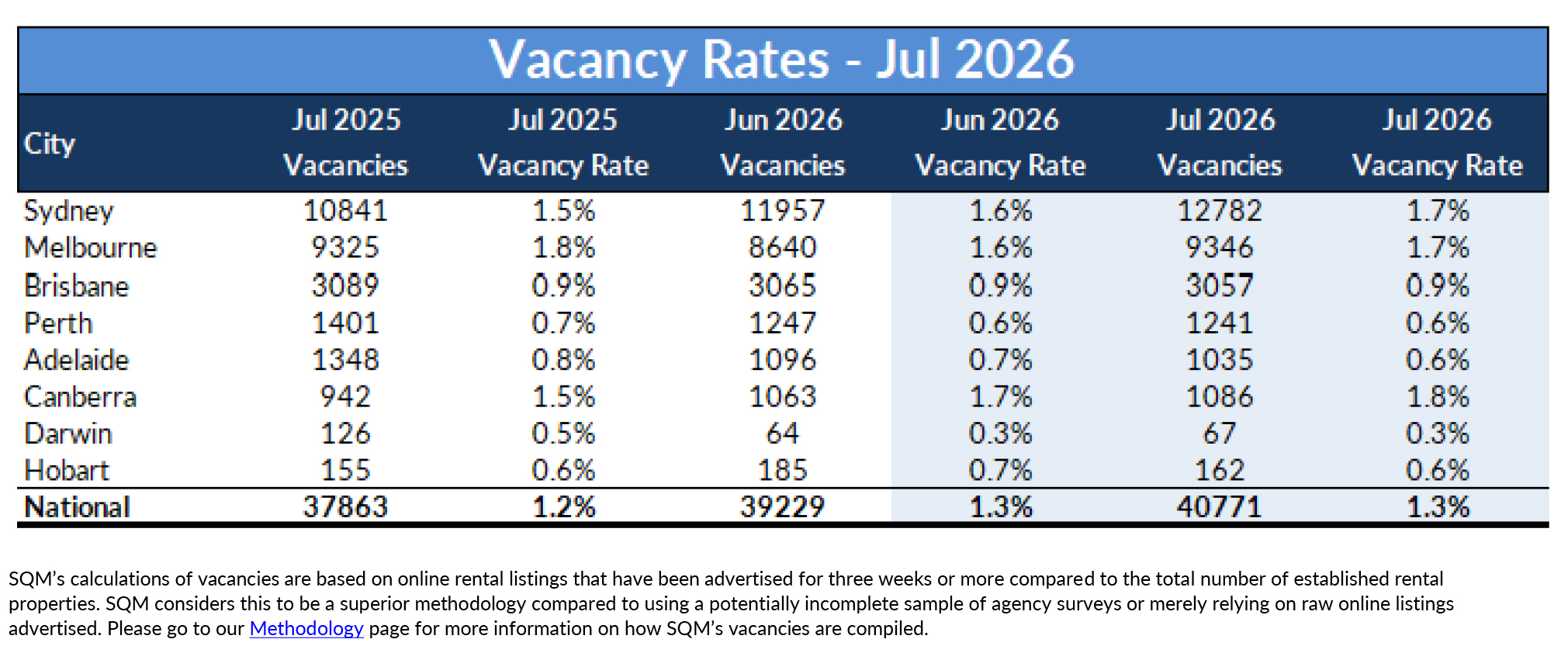
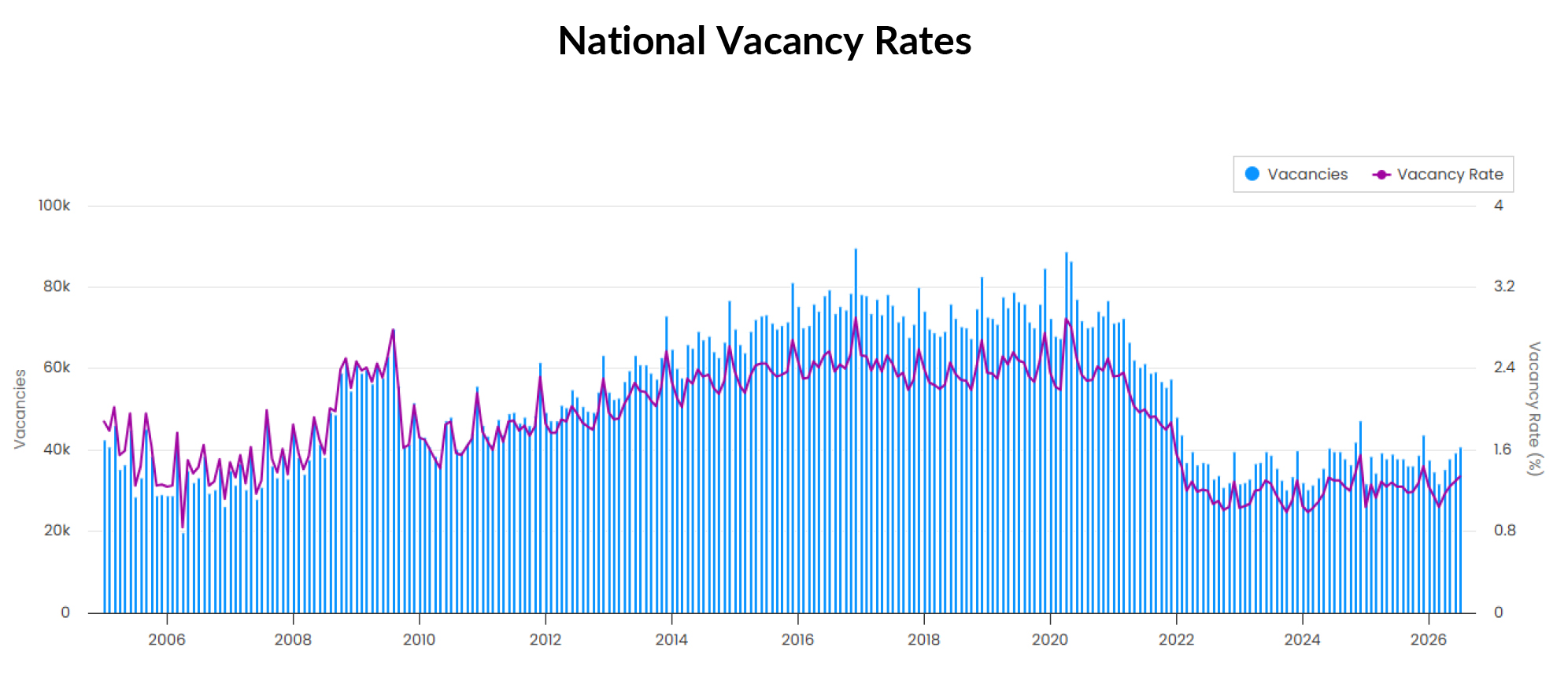
Australia’s national residential vacancy rate remained steady at 1.3% in July 2026, unchanged from June. The total number of residential vacancies increased to 40,771 dwellings, up from 39,229 in June, indicating a modest increase in available rental stock despite the unchanged headline vacancy rate.
Compared with July 2025, when the national vacancy rate stood at 1.2% with 37,863 vacancies, rental availability has increased slightly. Nevertheless, conditions remain tight across most capital cities, with Brisbane, Perth, Adelaide, Darwin and Hobart all recording vacancy rates below 1%.


SQM’s calculations of vacancies are based on online rental listings that have been advertised for three weeks or more compared to the total number of established rental properties. SQM considers this to be a superior methodology compared to using a potentially incomplete sample of agency surveys or merely relying on raw online listings advertised. Please go to our Methodology page for more information on how SQM’s vacancies are compiled.
Capital city highlights
Sydney: Vacancy rates increased to 1.7%, up from 1.6% in June, with 12,782 dwellings available. This compares with a vacancy rate of 1.5% in July 2025, indicating some easing in rental availability over the past year.
Melbourne: Vacancy rates rose to 1.7%, from 1.6%, with 9,346 vacancies recorded. Melbourne’s vacancy rate remains slightly below the 1.8% recorded at the same time last year.
Brisbane: Vacancy rates remained unchanged at 0.9%, with 3,057 dwellings available. Brisbane continues to record tight rental conditions, with the vacancy rate unchanged from July 2025.
Perth: Vacancy rates held steady at 0.6%, with 1,241 vacancies. Despite remaining one of the tightest rental markets nationally, conditions have eased slightly compared with the 0.7% vacancy rate recorded a year ago.
Adelaide: Vacancy rates declined to 0.6%, down from 0.7% in June, with 1,035 dwellings available. This is also below the 0.8% vacancy rate recorded in July 2025, highlighting continued tight rental supply.
Canberra: Vacancy rates increased to 1.8%, from 1.7%, with 1,086 dwellings available. Canberra recorded the highest vacancy rate among the capitals in July and is above the 1.5% recorded a year earlier.
Darwin: Vacancy rates remained unchanged at just 0.3%, with only 67 dwellings available. Darwin continues to record the lowest vacancy rate of all capital cities, down from 0.5% in July 2025.
Hobart: Vacancy rates declined to 0.6%, from 0.7%, with 162 dwellings available. The vacancy rate is now in line with the 0.6% recorded in July last year.
Advertised rents analysis
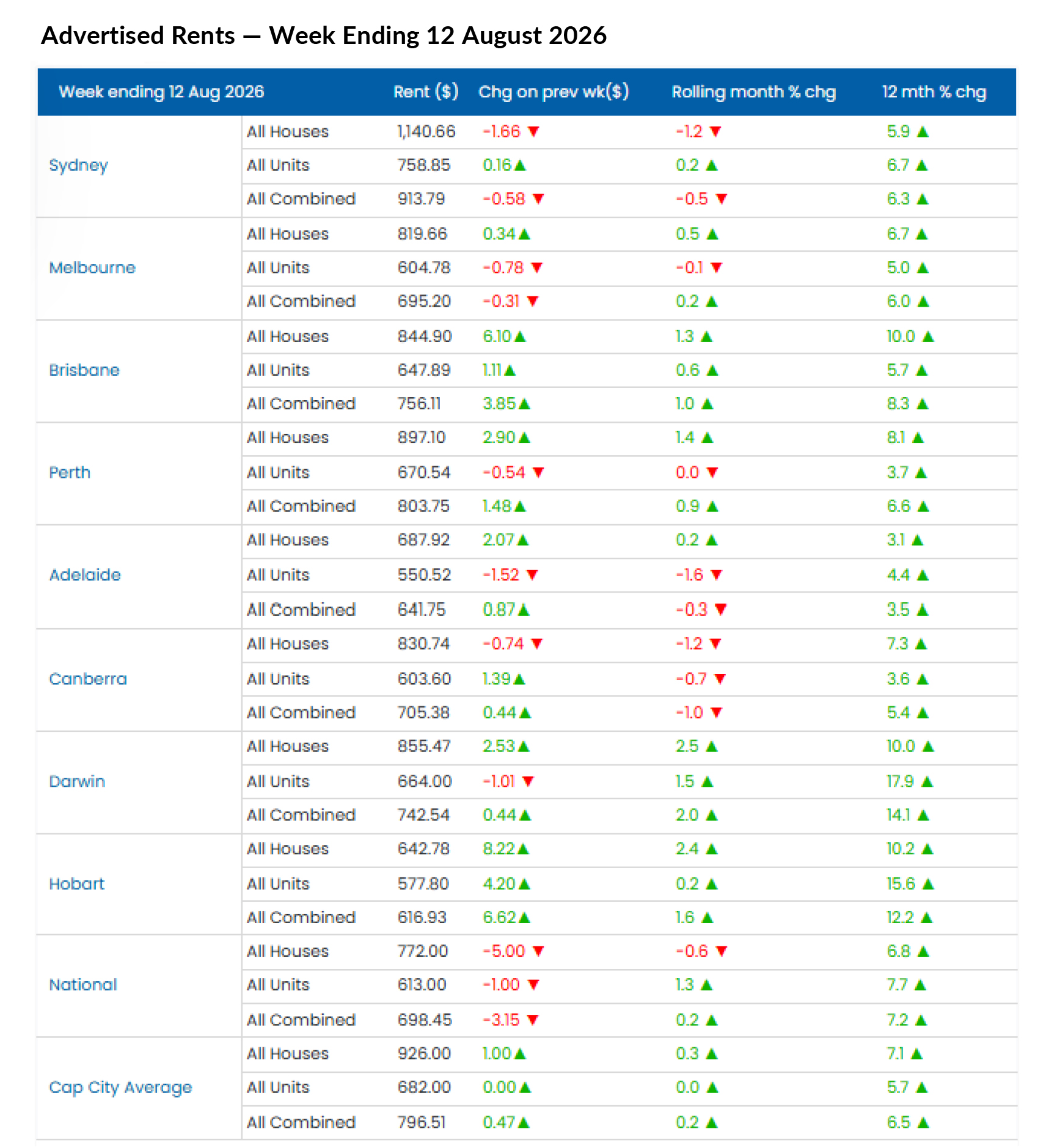
National advertised rents remained elevated through August, with combined rents increasing 0.2% over the past 30 days and 7.2% higher year-on-year. Monthly rental growth has slowed, however this might be a normal seasonal occurrence due to the typical winter month lull in rental activity.
The national combined rent average now stands at $698.45 per week, while the capital city average sits at $796.51 per week.
Nationally, house rents declined 0.6% over the month but remain 6.8% higher over the year, while unit rents increased 1.3% monthly and 7.7% annually, with unit rental growth currently outpacing houses.
Sydney: Combined rents declined 0.5% for the month but remain 6.3% higher year-on-year, with combined advertised rents averaging $913.79 per week.
Melbourne: Combined rents increased 0.2% monthly and are 6.0% higher annually, with combined rents reaching $695.20 per week.
Brisbane: Combined rents rose 1.0% over the month and 8.3% year-on-year, with advertised rents averaging $756.11 per week.
Perth: Combined rents increased 0.9% for the month and 6.6% annually, with the combined advertised rent reaching $803.75 per week.
Adelaide: Combined rents declined 0.3% over the month but remain 3.5% higher year-on-year, with combined rents averaging $641.75 per week.
Canberra: Combined rents fell 1.0% over the month but remain 5.4% higher annually, with advertised rents averaging $705.38 per week.
Darwin: Combined rents increased 2.0% for the month and 14.1% year-on-year, recording the strongest annual combined rental growth of all capital cities.
Hobart: Combined rents rose 1.6% over the month and 12.2% annually, continuing to record double-digit annual rental growth amid tight vacancy levels.

Louis Christopher, Managing Director of SQM Research, commented: “The national vacancy rate holding at 1.3% in July suggests there has been some stabilisation in rental availability, although the underlying market remains tight. Total vacancies have increased compared with this time last year, particularly in Sydney and Canberra, but five capital cities are still recording vacancy rates below one per cent.
“The rental data continues to show significant pressure on tenants. National asking rents are now 7.2% higher than a year ago, and we are seeing particularly strong annual increases in Darwin and Hobart, where vacancy rates remain very low.
“There are some signs of moderation in markets such as Sydney, where asking rents have eased over the month, but this is not yet a broad-based easing in rental conditions. Brisbane, Perth and several of the smaller capitals continue to record very limited rental availability.
“Overall, the rental market remains undersupplied. Until we see a more sustained increase in available rental stock, we expect affordability pressures to remain elevated.”