

Shane Oliver
Key points
- Bond yields are being pushed higher by concerns about inflation, high public debt, rising corporate borrowing, rising Japanese bond yields and increasing economic uncertainty.
- This is part of a super cycle rise in bond yields that started in 2020, partly reversing the super cycle from the 1980s.
- The rising trend in bond yields could dampen other asset classes as it leads to a higher yield structure in the economy. This includes residential property.
Introduction
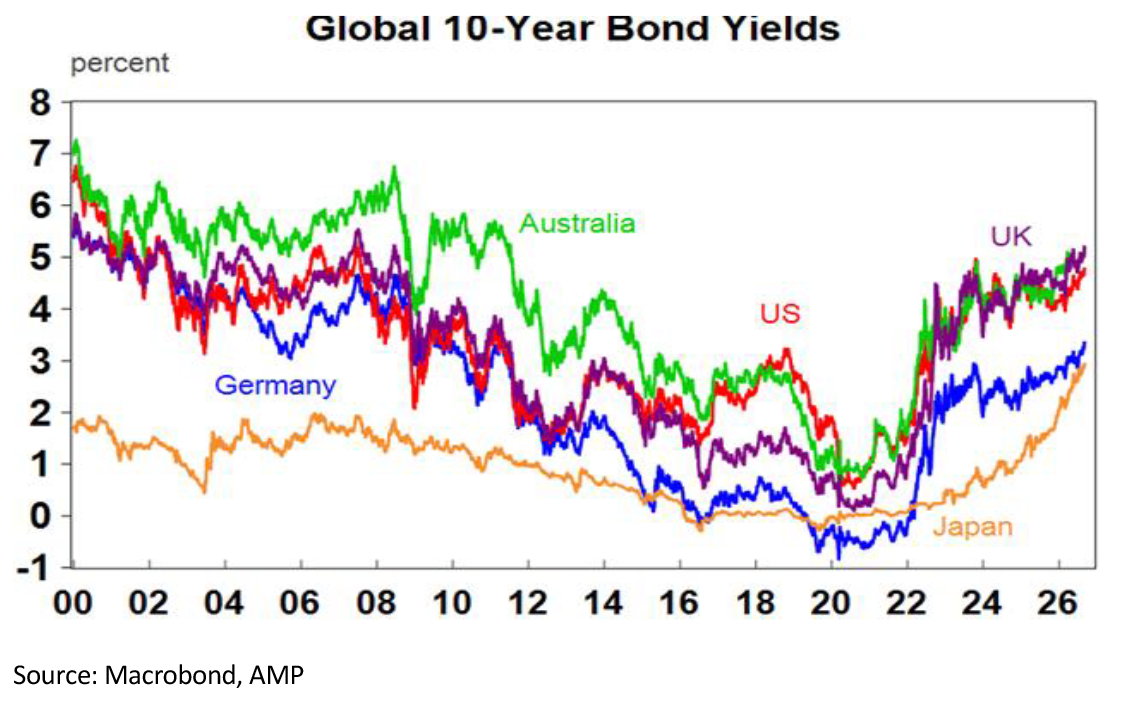
This year has seen a rising trend in bond yields with the US 30-year treasury bond yield reaching its highest in around two decades and the Australian Government’s 10-year bond yield rising to its highest since 2011. This is causing some consternation in terms of its impact on borrowing costs, public finances and what it means for shares and other assets. This note looks at why bond yields are likely now in a super cycle rising trend and what the implications are.

Bonds 101 – how bonds work
But first a quick refresher on how bonds work. Governments issue bonds to finance their budget deficits and companies issue bonds as a way to borrow to finance investment (as an alternative to borrowing from a bank). Since discussion of bond yields usually refers to government bonds we will focus on them, but the principles regarding their pricing and yields are the same. This can be a bit confusing, but my high school economics teacher belaboured the point that yields move inversely to price and so it’s always stuck with me. If the government issues a bond (which is basically a fixed amount of debt with a fixed interest payment) for $100 and agrees to pay $5 a year in interest, this means an initial yield of 5%. The higher the yield the better in term of the return that an investor will get. But in the short term the value of the bond will move inversely to the yield. If growth and/or inflation slows and the central bank cuts interest rates, investors might snap up the bonds paying $5 till the yield is pushed down to say 4%. In the process, the value of the bond goes up giving a capital gain which adds to the yield to give a strong return from bonds. But if growth or inflation pick up and bond yields rise, investors suffer a capital loss and whether the bond makes a return or not depends on whether the capital loss is greater than the yield on the bond. This is what’s essentially happened since 2020. For example, Australian bonds returned just 0.6% over the last year and lost 0.1% pa over the last five years and for global bonds it’s been 1.8% and -0.4% pa respectively. Of course, if you buy a 10-year bond yielding 16%, a level it reached in the 1980s, and hold it till it matures (10 years) the return will be 16%pa. But if the starting yield is say, 5.2% that’s all you will get for 10 years. And that 5.2%, which is the current Australian 10-year bond yield, is the rate of interest the government pays to borrow for 10 years.
Bond yield components
A bond yield reflects investors’ expectations for short term interest rates over the term of the bond plus compensation for locking their money away, called the term premium. So, a bond yield compromises:
- Investors’ expectations for inflation over the term of the bond for which they will want compensation. Central banks inflation targets of 2-2.5% are a good guide but with inflation running above target over the last five years or so, this may be seen as a less useful guide.
- A real rate of return. A key driver is expected real economic growth.
- And a term premium. This can be influenced by things like uncertainty about economic policy, budget deficits and public debt and how valuable bonds are as a diversifier to investors in their portfolios.
So: if inflation expectations rise; expected real economic growth picks up; and economic uncertainty increases, the government runs a bigger deficit and demand for bonds in portfolios falls investors will want a higher yield.
Super cycles in bond yields
It’s useful to see the recent back up in bond yields in their longer-term context. Over the last 80 years there’s been two big secular or long term moves in bond yields – up for around 40 years and then down.
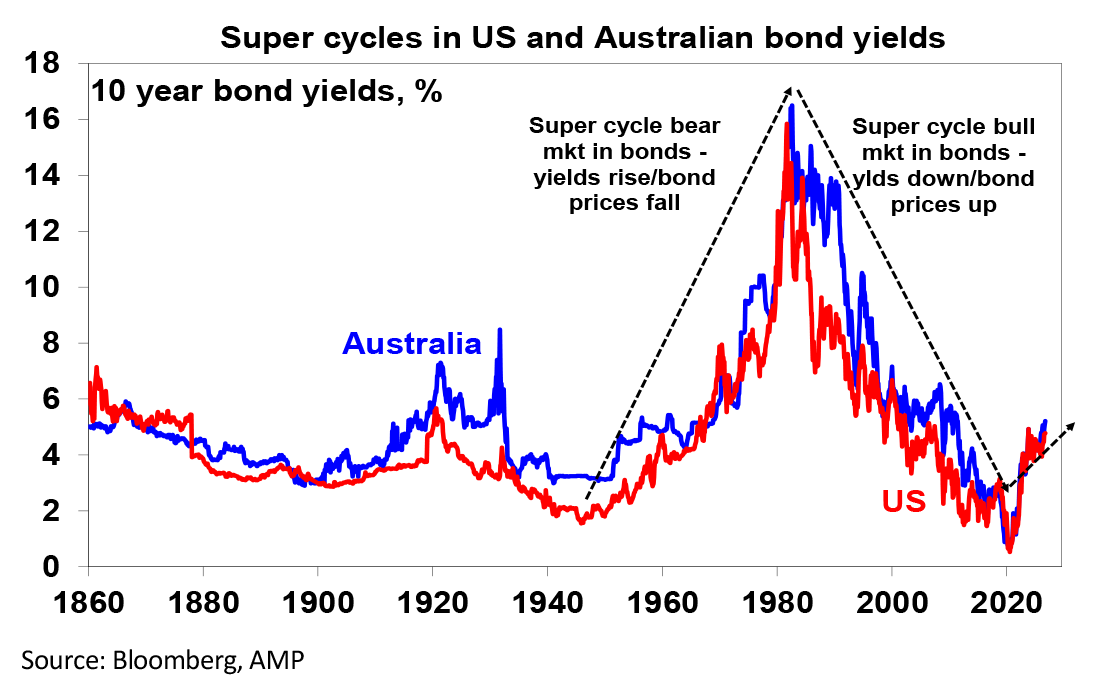

- The near 40-year super cycle bear market in bonds that saw a rise in yields into the early 1980s was driven by rising inflation on the back of expansionist fiscal and monetary policies after the Great Depression and WW2, monetary financing of the Vietnam War, rising commodity prices, protectionism and slowing productivity along with rising economic uncertainty resulting in higher real yields, inflation expectations and the term premium. This saw 10-year bond yields in the US and Australia rise from 2-4% in the 1940s to around 16%.
- Then from the early 1980s a near 40-year super cycle decline in bond yields set in. This was driven by inflation targeting central banks, supply side reforms, globalisation, lower costs and rising competition flowing from digitalisation, rising inequality depressing spending, spare capacity and reduced worker bargaining power with worries about deflation post the GFC, rising demand for safe income yielding assets, strong demand for bonds as a portfolio diversifier, excess global savings & central bank bond buying post GFC. This saw a sharp downtrend in 10-year bond yields to around 0.5% or less in 2020.
A new super cycle bear market in bonds
However, starting in 2021 the long-term downtrend in bond yields started to reverse. There are several key drivers and my colleague Diana Mousina looked at some of these here in more detail:
- Higher inflation expectations – central bank inflation targets are starting to lose credibility. While inflation is down from its 2022-23 high, in many key countries it’s still above target including the US not helped by Trump’s tariffs and oil price spike in the last 18 months. And in Australia if this year is included it’s been above target for five of the last six years. Bigger government, the reversal of globalisation, increasing defence spending and less workers/more consumers with aging populations are making the world more inflation prone. By boosting productivity AI can act as an offset but for now the data centre boom is pushing up construction and computer chip costs.
- Higher expectations for central bank interest rates – sticky inflation is leading to expectations of higher rates higher for longer.
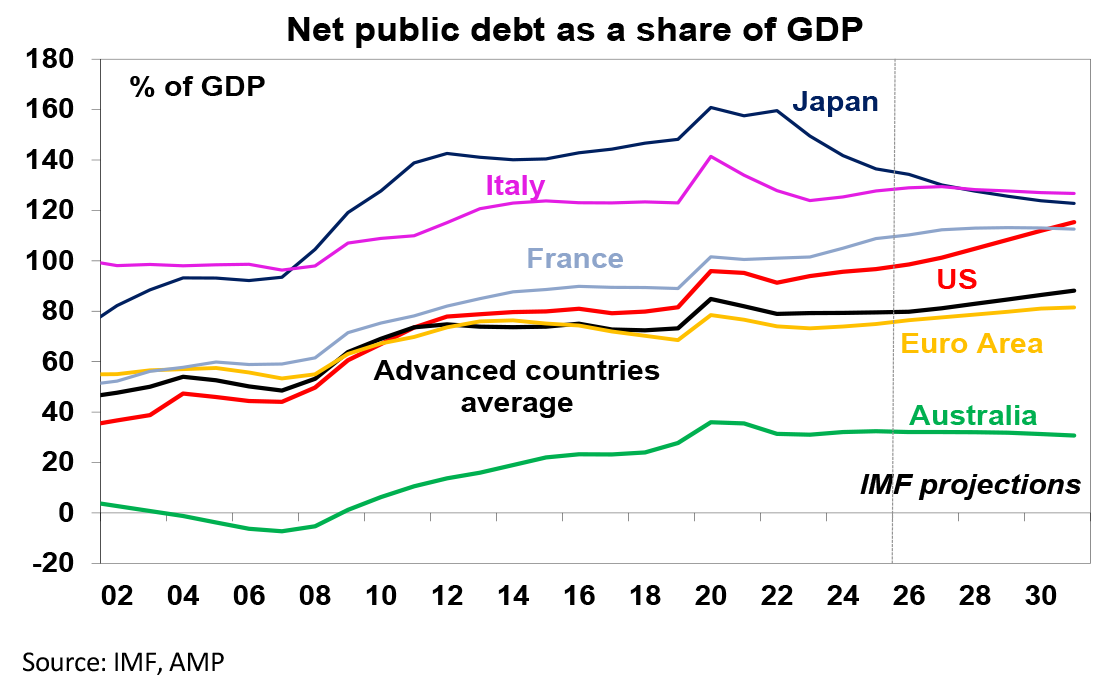
- Ongoing high budget deficits and public debt – e.g., the US budget deficit is around 6.5% of GDP and it’s hard to see much improvement in France with an election next year and the populist National Rally being the front runner. At least Australia is at the low end here.

- Surging corporate borrowing to fund data centre investment – this competes with public borrowing and combines to push yields up.
- Rising Japanese bond yields – this is reversing the “carry trade” where investors borrow cheaply in Japan and invest in say US bonds.
- Various factors are pushing up the term premium on bonds including: Trump’s erratic policies; US Treasury Secretary Bessent’s silly intervention in the bond market which revived concerns the US might monetise its debt (ie print money); and the correlation between bond and share returns has increased reducing investor demand for bonds.
- AI’s role is ambiguous. Over the long term, it may pull down inflation by boosting productivity but it could also boost real economic growth and hence real bond yields & in the short term it’s adding to inflation.
After years of being in abeyance it seems the “bond vigilantes” – investors who sell their bonds when they fear excessive public debt or inflation – may be back. At least they are a brake on silly populist policies. Since US bond yields are the base for global yields their rise has boosted Australian yields with the add on of higher expectations for the RBA’s cash rate. The risk is high that yields will rise further as it’s hard to see the drivers reversing soon. While the super cycle bear market in bonds – or rising trend in yields – likely has further to go with spikes and setbacks along the way the rise in yields is likely to be limited to well below 1980’s highs as central banks are still committed to their inflation targets. That said, the temptation of governments to monetise their debt is a tail risk supporting the case to have small exposures to gold and maybe Bitcoin as a hedge.
Implications of the super cycle rise in bond yields
The rise in bond yields has a number of implications for investors.
First, it means higher borrowing costs for governments. Public debt interest is the fastest growing major spending item in the Federal Budget currently accounting for around 5% of tax revenue. The more bond yields rise the faster this will rise and the more tax revenue it will take leaving less for welfare payments and other services. This means greater pressure for fiscal austerity. Which of course is what “bond vigilantes” want.
Second, it means higher corporate borrowing costs which can act as a dampener on company profit growth.
Third, it means banks are likely to raise their fixed mortgage rates which will reduce the attractiveness of fixed rate mortgages as an alternative to variable rate mortgages when the latter are likely to rise further. We expect the RBA to hike again soon, with a high risk of a second hike.
Fourth, it means bond returns are likely to stay mediocre. While starting points yields are up from 2020 which is good for returns this will likely be partly offset by the capital loss from rising yields over time.
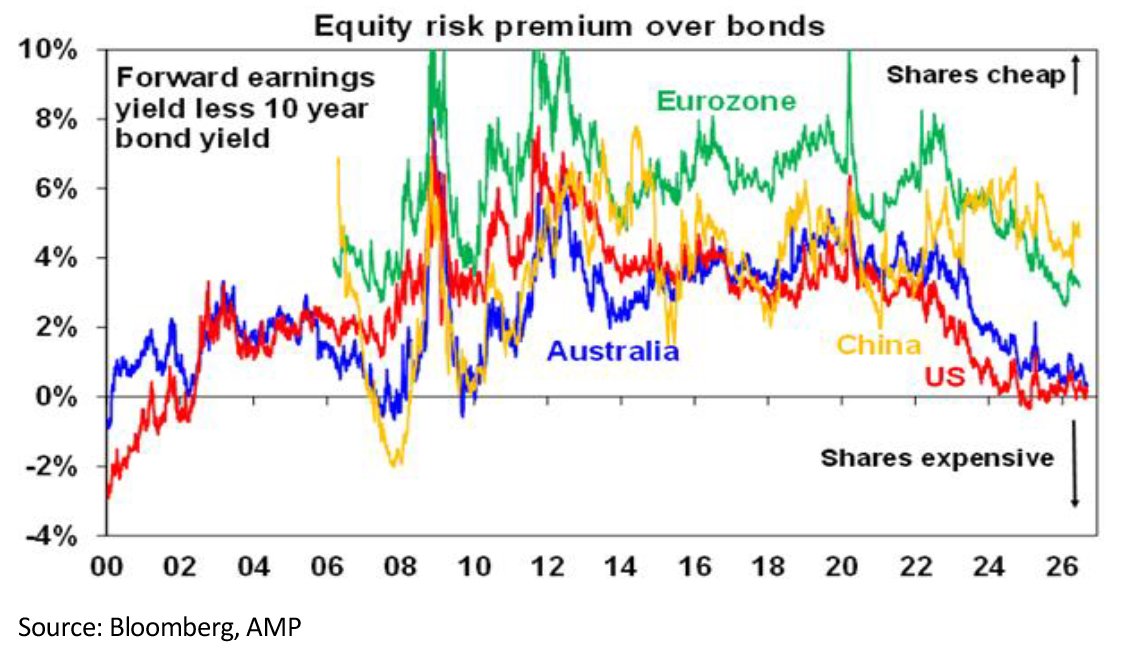
Fifth, higher bond yields could pose a problem for shares as they already offer a very low risk premium over bonds, so a further rise in yields will reduce the relative attractiveness of shares. Right now, strong profit growth is providing an offset, but it could be an issue if profits weaken.

Finally, for all assets the rising trend in bond yields is reversing the tailwind they saw over the 1980s to 2020 whereby the fall in bond yields led to a “search for yield” which led to lower yields/higher prices for most assets – shares (with higher PEs), commercial property, infrastructure and housing. In terms of housing, it’s part of the reason why the super cycle surge in Australian home prices over the last 30 years may be over.
By Dr Shane Oliver, Head of Investment Strategy and Chief Economist, AMP