
High yield sheds its ‘junk bond’ past as credit quality reaches historic highs

Shannon Ward
The global high-yield bond market is undergoing a fundamental shift in credit quality that has left its former “junk bond” reputation increasingly disconnected from reality, according to Capital Group fixed income portfolio manager Shannon Ward.
Ms Ward, who has invested in high-yield markets for three decades, said the quality of the market was the highest she had seen, with around 55% of the high-yield universe now rated BB – the highest sub-investment-grade rating – and only around 10% sitting in the lowest CCC category.
“In all my time investing in high yield, I have never seen this market with a higher quality than it has today,” she said.
“Most of the market is now double-B rated and almost investment grade, while there is very little exposure to triple-C.”
This shift is challenging traditional perceptions of high-yield investing at a time when investors can earn yields of around 7–8% from selected issuers.
Ms Ward said the improvement in credit quality partly reflected a change in how lower-quality corporate borrowers finance themselves. More highly leveraged borrowers that historically would have issued high-yield bonds have increasingly turned to leveraged loans and private credit markets.
At the same time, corporate risk appetite has become more conservative, with many companies using strong free cash flow to reduce debt rather than increase leverage.
While high-yield credit spreads remain below long-term averages, Ms Ward said the strength of corporate fundamentals and the absolute yields available to investors continued to make the asset class attractive.
Recent corporate earnings, revenues and cash flows remained solid, while the refinancing market remained open to companies across the credit-quality spectrum, keeping the pool of potential defaults relatively low.
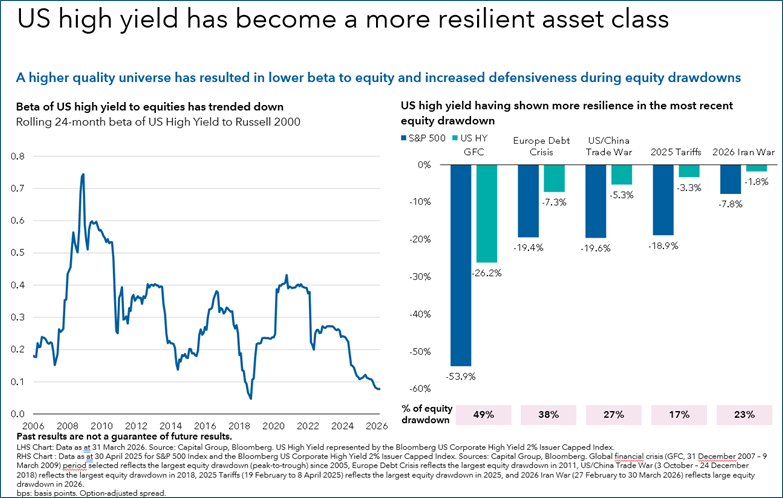
Capital Group Fixed Income Investment Director Haran Karunakaran said the upshot for investors is that high yield has become a much more resilient asset class.
“Most strikingly, high-yield’s beta to equities has fallen from historical levels of 0.3-0.4 (non-crisis periods) to currently under 0.1 (see chart below). And this is while delivering almost 10% p.a. over the last 3 years.”
“The combination of these structural changes in high-yield markets, solid corporate fundamentals and high all-in yields, countering historically tight credit spreads, leaves us moderately constructive on the sector. It’s certainly not the time to go “all in” on high-yield risk, but equally staying out of the market could be costly in terms of foregone returns,” he said.
Ms Ward continued: “The macro backdrop looks very solid and risk-taking attitudes just haven’t been there.
“You have companies that are using their free cash flow to pay down debt.”
The high-yield market has also become shorter duration as companies have increasingly issued five-year rather than eight or 10-year debt, reducing investors’ exposure to movements in government bond yields.
Ward said tight spreads meant investors should retain capacity to increase exposure when periods of market volatility created better entry points, rather than necessarily maintaining maximum allocations.
For financial advisers, Ms Ward said one of the most important implications was to reconsider the traditional perception of high yield as simply the “junk bond” end of fixed income.
The combination of improved credit quality, shorter duration, strong corporate fundamentals and yields of around 7–8% meant high yield could play a role between traditional defensive fixed income and more return-seeking assets.
“The high-yield market should not be thought of as junk bonds. It’s a really well-functioning, diverse way that good-quality companies finance themselves. Many have no aspiration to be investment grade. This means that for investors, it’s a liquid, transparent way to earn returns of around 7% – 8% right now.


