

Dynamic retirement spending strategies allow retirees to adjust withdrawals as market conditions change, balancing income flexibility with financial security and long-term portfolio sustainability.
Retirement planning tends to concentrate on the income side of the ledger: how much a client needs, where it will come from, and how sustainable it is. A resilient income stream can help mitigate both longevity and market risk, and advisers have an extensive toolkit to build this resilience, including product selection and portfolio construction.
But sustainability depends just as much on the spending side of the ledger.
Without a strategic approach to spending – that responds to changing market conditions – retirees may find themselves spending less over the course of retirement and depleting their capital faster.
Dynamic spending can provide the foundation of such a strategic approach. Rather than assuming the same CPI-adjusted income amount is taken each year – regardless of what happens to the portfolio supporting it – dynamic spending adjusts the flexible part of retiree spending within upper and lower limits. This is sometimes called a floor and ceiling, or guardrails, approach, and there are a handful of different methodologies used across the market. While each is unique, they all work to deliver the same outcome – creating the potential for higher spending while maintaining an agreed probability of portfolio survival.
In this article we examine the risks of a fixed spending approach, the evidence that supports the value of a dynamic spending strategy, and practical ways for advisers to help clients put a dynamic approach into practice. Equipped with these tools, the adviser’s task is then to decide which of a client’s spending can flex, and how to make that flexibility workable for the client in practice.
The retirement spending hierarchy
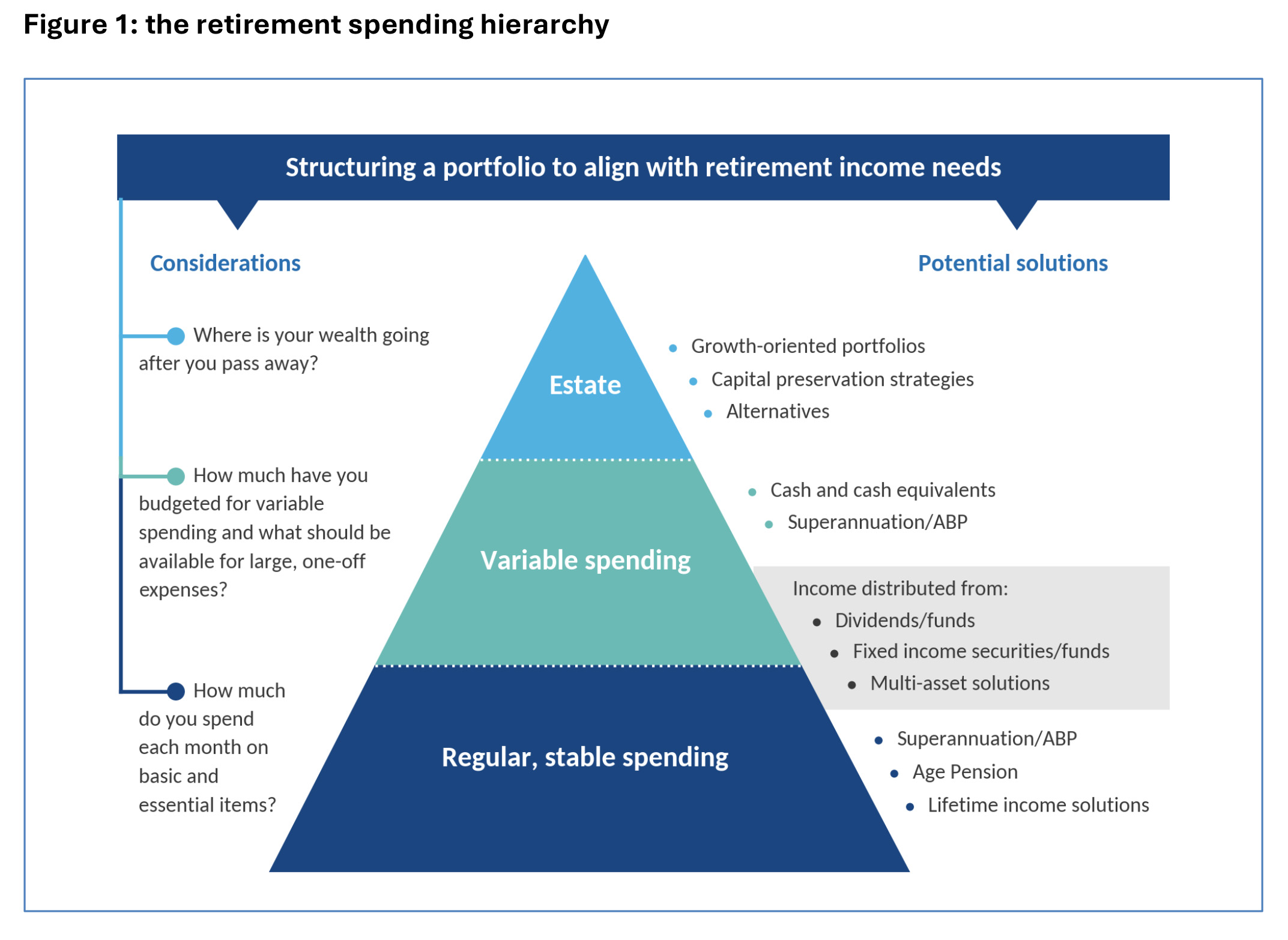
Work by Allianz Retire+ on retirement spending1 illustrated the hierarchy of retirement spending through the pyramid device shown in Figure 1. The base of the pyramid comprises expenditure on necessities, including housing, food and healthcare. This essential spending has the greatest need for income certainty, and the least scope for flexibility. Securing this base is critical for retiree confidence.
The middle of the pyramid is where the discretionary dimensions of retirement spending are found, including those lifestyle items such as travel and leisure, and this is where the most opportunity for flexibility lies.
To see how this works in practice, take a hypothetical retired couple – John and Sylvana – spending $70,000 a year. Housing costs, food, utilities, health expenses, insurance and the running costs of the car come to $42,000, which an adviser would place at the base of the pyramid. Travel, dining out, gifts for the family, hobbies and home improvements make up the remaining $28,000, which sits in the middle, variable, layer.
Of course, the sorting is rarely this tidy. A car is a necessity, but when it is replaced can often be timed to suit. If the replacement car is an upgrade, there may be a strong discretionary element to the purchase. Some travel, such as visiting grandchildren, may be central to the retirement the client wants and therefore regarded as essential. Where each item sits is a judgement the client should make, and recording it is the first step towards an agreed spending range.

The risks of the ‘magic number’ approach to retirement spending
Traditional approaches to retirement planning in Australia have typically centred on calculating an annual income level that is sustainable and can support a retiree’s desired lifestyle. Conventional wisdom dictates that – once calculated – this ‘magic number’ should be indexed each year for inflation, to avoid any erosion of spending power.
The ubiquity of this approach can be seen in everything from conventional projection methods to retirement income product design, to the widely publicised ASFA Retirement Standard.
The rigidity of this approach is part of its appeal. It’s easy to model and retirees know with certainty what will go in their bank account each month.
But this predictability becomes a risk following a market fall. Consider a client withdrawing 4% from a $1.2m portfolio. That produces an annual withdrawal of $48,000 before CPI. But if the market falls and the portfolio value drops to $850,000, the effective withdrawal rate rises to 5.6%.
The client is now removing a larger proportion of the remaining capital at a time when asset values are depressed. This means more assets may need to be sold, leaving less capital invested to participate in any subsequent market recovery. Continuing to increase the withdrawal amount in line with inflation adds further pressure.
Fixed real withdrawals can also constrain spending unnecessarily after sustained strong investment performance. A client may continue following a conservative spending path even though the portfolio could support a higher amount. This can contribute to the underspending seen among some retirees, who preserve more capital than they need while forgoing the lifestyle they could have afforded.
For clients, the choice is between predictable income and a stronger chance that the portfolio lasts. A fixed amount tells the client what next year’s income will be, and it carries on regardless of what the portfolio behind it is doing. An adjustable amount gives up some of that predictability so that spending can respond when markets fall, which improves the odds that their portfolio lasts. Advisers can put that choice to clients in plain terms before any methodology is selected.
Dynamic spending methods
A dynamic approach allows the flexible – ‘mid-pyramid’ – component of spending to respond to weaker investment outcomes. But this is more than just ‘turning off CPI’ or telling your clients to forgo a holiday. Dynamic spending methodologies are rules-based, involving quantitative trigger points and adjustment limits to determine whether withdrawals should rise or fall.
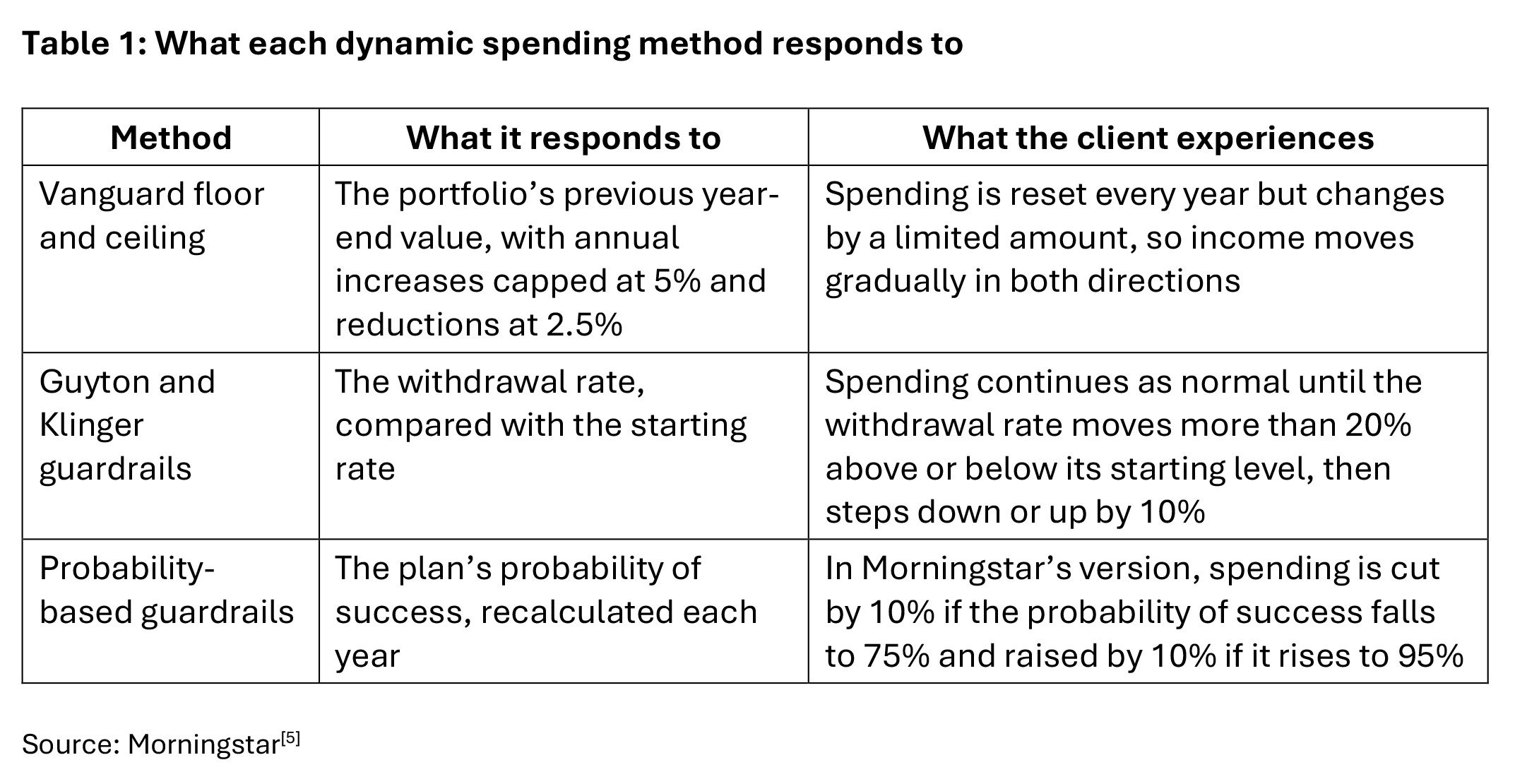
Under Vanguard’s floor and ceiling approach2, for example, annual spending is calculated with reference to the portfolio’s previous year-end value. Increases are limited to 5% and reductions to 2.5% of the previous year’s inflation-adjusted spending, helping to prevent abrupt changes in income.
Guardrail approaches adjust spending when an agreed measure moves outside set boundaries. Guyton and Klinger3 use changes in the portfolio withdrawal rate, while the probability-based method4 recalibrates spending annually to an amount that keeps the portfolio survival probability within upper and lower bounds.
There are other methods too, all differing in their calculations and the size of the permitted adjustments.
Table 1 compares what each of these methods responds to and what the client is likely to experience when its rule takes effect.

Whichever method is used, the client should see in advance what a trigger would mean in dollars a year.
Does dynamic spending deliver better outcomes?
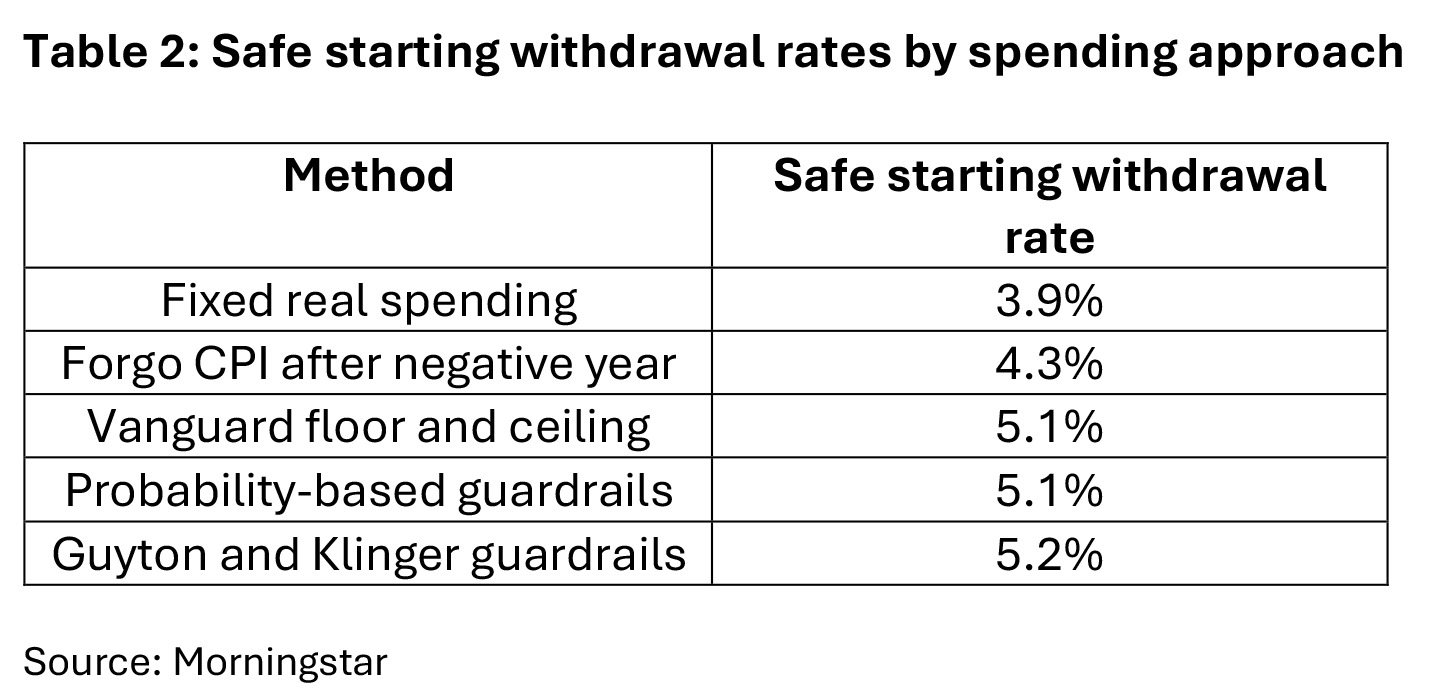
Morningstar compared several dynamic spending methodologies against a fixed real spending baseline6. It also tested the simpler step of forgoing an inflation adjustment after a negative return year.
Using 1,000 simulated return sequences, they calculated the starting withdrawal rate each method could support over 30 years with a 90% probability of retaining a positive portfolio balance (also referred to as ‘portfolio success’). A higher starting rate indicated that the method supported more initial spending at the same probability of success.
While even forgoing an inflation increase after a negative year improved the sustainable starting withdrawal rate, the more adaptive methodologies supported considerably higher ‘safe’ withdrawal rates.

The effect also extended to total spending over retirement. Morningstar found that probability-based guardrails produced almost one-third (32%) more median lifetime withdrawals than the fixed real spending strategy under its modelled assumptions7. Vanguard’s historical modelling8 reached a similar conclusion, finding that its floor and ceiling approach produced higher cumulative spending than the traditional ‘4% rule’ across the periods tested.
When presenting these results to clients, it helps to describe them as modelled outcomes under the stated assumptions. The higher spending potential comes with more variation in annual spending. Morningstar found that the most responsive methods produced the largest year-to-year changes in cash flow, while simpler approaches offered more stability9.
Lifetime income solutions: certainty allows flexibility
The potential for higher lifetime spending is not without cost, that cost being greater variability in income from year to year, which brings the Allianz spending pyramid back into focus. Just as all income is not the same, nor is all spending the same, and it is critical to align the characteristics of income with the nature of the spending being funded.
Essential spending – the base of the pyramid – is non-negotiable and is effectively a floor that must be secured. Paying for food, petrol, clothing, electricity and healthcare is something that should be stress-free and not dependent on a variable income source. This part of the pyramid demands predictable and dependable income to give retirees certainty.
A lifetime income solution, such as those offered by Allianz Retire+ and others, can help support that dependable income layer, giving retirees the certainty and confidence that comes with having guaranteed income payments for life, however long that may be.
Securing the base also creates scope for a more dynamic approach to mid-pyramid expenses, because a fall in the flexible layer no longer affects essential spending. The higher modelled spending shown above comes from the withdrawal methods themselves. The dependable layer plays a different role, which is to determine how comfortable the client is when flexible spending moves.
This makes the size of the dependable layer a decision for each client. Advisers can help clients calibrate how much of their income they choose to guarantee, starting with how much of their essential spending dependable income should cover. A lifetime income allocation is just one layer within a broader strategy, and the flexible part of the portfolio still needs a documented withdrawal range, agreed triggers and regular review, as set out below.
Practical takeaways for advisers
A dynamic spending strategy requires more than selecting a withdrawal methodology. Advisers should:
- Separate essential expenditure from lifestyle spending that the client could adjust
- Assess how much of the essential spending floor is supported by dependable income
- Agree on a normal level of portfolio withdrawals and the upper and lower limits the client could accept
- Document the triggers that would lead to an adjustment and how often the strategy will be reviewed
- Identify the expenses that would change if withdrawals were reduced, so the flexibility is realistic rather than theoretical
Dynamic spending in action
Return to our hypothetical couple, John and Sylvana, who spend $70,000 a year. Assume dependable income such as the Age Pension and a lifetime income stream covers their $42,000 of essential spending, and their $28,000 of flexible spending is funded from a $700,000 portfolio – effectively a 4% withdrawal rate.
The adviser first asks which parts of the $28,000 John and Sylvana would change if they had to, and in what order. They would travel overseas every second year and put off replacing the car for two years before cutting gifts to family or their hobbies, and they confirm this would release at least $4,000 a year. The adviser records the choices so each adjustment can later be shown in dollars.
They agree to use Vanguard’s floor and ceiling method10 for the portfolio withdrawals. Each year the starting point for spending is 4% of the portfolio’s value at the previous year end. The ceiling and floor are then calculated. Last year’s actual spending is indexed for inflation, assumed here to be 2.5%, and the ceiling is set 5% above that amount and the floor 2.5% below it. If 4% of the portfolio falls outside that band, the couple spend the ceiling or the floor instead.
In an up year: assume the portfolio rises from $700,000 to $760,000. Four per cent of that is $30,400, but the ceiling is $30,135 (last year’s actual spend of $28,000 indexed to $28,700, plus 5%). The couple spend the ceiling amount of $30,135, rather than the $30,400.
In a down year: assume the portfolio falls from $700,000 to $640,000. Four per cent of that is $25,600, but the floor is $27,983 (the same $28,700 shown above, less 2.5%). Because 4% of the portfolio is below the floor, the couple spend the floor amount of $27,983. As the portfolio is smaller, the effective withdrawal rate becomes 4.4%.
If markets stay weak, the floor can apply year after year, so spending edges down a little each year once inflation is allowed for. John and Sylvana’s list of potential changes (above) shows where savings could come from, and the $4,000 they identified would cover several years at the floor. If markets fall far enough, spending may need to move beyond the floor, which is why the adviser reviews the position each year. Had some essential spending not been covered by dependable income, the shortfall would also come from the portfolio, leaving less room to flex, and the adviser would need to revisit how much dependable income the couple hold.
Conclusion
A retirement income plan holds up best when both sides of the ledger are managed. Fixed real spending is simple to plan around, but it carries on regardless of what the portfolio is doing. Dynamic spending replaces it with rules that let the flexible part of spending move within limits. The modelling suggests this can support higher spending at the same probability of portfolio survival, in return for less predictable income from year to year.
The practical work for advisers is deciding which spending can flex, agreeing the limits and triggers with the client, and making sure dependable income covers the essentials so the flexible layer can do its job. Income layering sets where income comes from, and dynamic spending sets how withdrawals from the flexible layer respond. The right combination is the one that fits the client’s spending needs and their tolerance for variation.
Take the FAAA accredited quiz to earn 0.5 CPD hour:
CPD Quiz
The following CPD quiz is accredited by the FAAA at 0.5 hour.
Legislated CPD Area: Technical Competence (0.5 hrs)
ASIC Knowledge Requirements: Retirement (0.5 hrs)
please log in to start this quiz
———–
References:
[1] https://www.allianzretireplus.com.au/news-and-insights/insights/not-all-income-is-created-equal.html
[2] https://advisors.vanguard.com/content/dam/fas/pdfs/FAJAMEAG.pdf
[3] https://www.financialplanningassociation.org/sites/default/files/2021-11/2006%20-%20Guyton%20and%20Klinger%20-%20Decision%20Rules%20and%20SWR%20%281%29.PDF
[4] https://assets.contentstack.io/v3/assets/blt9415ea4cc4157833/bltb73b87c5d0c70ead/The_State_of_Retirement_Income_2025.pdf
[5] Ibid.
[6] Ibid.
[7] Ibid.
[8] https://advisors.vanguard.com/content/dam/fas/pdfs/FAJAMEAG.pdf
[9] https://assets.contentstack.io/v3/assets/blt9415ea4cc4157833/bltb73b87c5d0c70ead/The_State_of_Retirement_Income_2025.pdf
[10] https://advisors.vanguard.com/content/dam/fas/pdfs/FAJAMEAG.pdf
This material is issued by Allianz Australia Life Insurance Limited, ABN 27 076 033 782, AFSL 296559 (Allianz Retire+). Allianz Retire+ is a registered business name of Allianz Australia Life Insurance Limited. This information is current as at November 2026 unless otherwise specified and is for general information purposes only. It is not comprehensive or intended to give financial product advice. Any advice provided in this material does not take into account your objectives, financial situation or needs. Before acting on anything contained in this material, you should speak to your financial adviser and consider the appropriateness of the information received, having regard to your objectives, financial situation, and needs. No person should rely on the content of this material or act on the basis of anything stated in this material. Allianz Retire+ and its related entities, agents or employees do not accept any liability for any loss arising whether directly or indirectly from any use of this material.
CPD Quiz
The following CPD quiz is accredited by the FAAA at 0.5 hour.
Legislated CPD Area: Technical Competence (0.5 hrs)
ASIC Knowledge Requirements: Retirement (0.5 hrs)
please log in to start this quiz