
CPD: Ethics and recommending listed investments

Understand your ethical obligations when recommending listed securities to their clients.
The ASX Australian Investor Study 2026[1] shows that direct shares and other listed securities remain the most widely held asset class among Australian investors. This article, proudly sponsored by GSFM, examines some of the ethical obligations advisers face when recommending listed securities.
Since the inaugural Australian Investor Study in 1986, the number of Australians investing in listed securities has steadily grown. An estimated 11.5 million Australians now invest beyond their superannuation and primary home, with 8.3 million holding on-exchange investments. This figure represents an increase of 2.5 million since 2020. In 1986, just 1.01 million Australians owned shares.
This year’s study uncovers two major trends. Firstly, the ongoing growth in the number of self-managed superannuation funds, and secondly, exchange-traded funds rivalling shares as the first investment choice for younger investors. Since the first exchange traded product (ETP) was listed on the ASX in 2001, the market cap of this growing sector reached $377.08 billion[2], with 471 products listed and an average of 89,656 transactions per day in September 2026.
This growth in interest in listed securities – as well as the number and range of listed securities available – has presented advisers with an increased opportunity set for diversification into asset classes or thematics.
Upcoming Delivering Better Financial Outcomes (DBFO) reforms are likely to present a shift in how advisers will need to approach compliance and ethics when building investment portfolios, a change that may influence how listed securities are used in an advice practice.
While it was expected that the safe harbour steps would be abolished in the second tranche of DBFO reforms, in August 2026 the government adjusted its stance. Rather than completely abolishing the safe harbour framework as originally proposed in the Quality of Advice Review, the core safe harbour steps are slated to remain, albeit in a different form.
The updated framework intends to keep the prescriptive steps largely intact but will narrow or remove the final ‘catch-all’ step (Section 961B(2)(g) of the Corporations Act). This has been described as a rigid, ‘tick-a-box’ compliance structure that forced advisers into defensive, paperwork-heavy processes. This change intends to enable advisers to confidently recommend listed securities to meet specific needs – such as establishing a core equities sleeve – without having to undertake an exhaustive review of a client’s entire, unrelated financial footprint.
The shift away from a mandated holistic financial footprint review towards contractually scoped, episodic advice is anchored in the Australian Government Treasury’s policy paper[3], which establishes the blueprint for the second tranche of DBFO legislative reforms.
Because tranche two legislation is still being adjusted and finalised following public consultation, financial advisers must continue to follow the existing seven-step safe harbour process to demonstrate compliance with the best interests duty.
Once implemented, it is important that advisers do not mistake any statutory eforing as an ethical shield. While the law may no longer demand a bureaucratic paper trail to prove you took ‘any other step’ to serve a client, the Financial Planners and Advisers Code of Ethics (Code of Ethics) remains entirely (for the moment) untouched.
In other words, the ethical catch-all still firmly stands. Under standards two and five, you maintain an obligation to ensure that any recommended product – listed or unlisted – genuinely prioritises your client’s wellbeing and is in their best interests.
Ethics and listed securities
Financial advisers are guided by several frameworks when making financial product recommendations. This includes recommending listed securities. These are the law, the Code of Ethics, as well as other obligations from licensees.
An adviser with membership of the Stockbrokers and Investment Advisers Association (SIAA) must also abide by its Code of Ethical Conduct, most recently updated in February 2023. As with the Code of Ethics, the SIAA Code of Ethical Conduct has a series of standards that advisers and stockbrokers are expected to meet.
As highlighted above, all investment recommendations – whether for listed or unlisted investments – must be in each client’s best interests. Not only does this underpin quality advice, but it is also essential to meeting the requirements set down by the Corporations Act 2001 and both Codes of Ethics.
Acting in a client’s best interests requires you to know and understand the intricacies of each financial product you recommend to a client. This includes the product’s suitability for the client and whether the client understands the intricacies of the product, including the associated risks and product costs. During volatile market conditions the conversation pertaining to risk is more likely to be scrutinised.
The rapid evolution in the availability of listed securities, in the number and variety of products available, has undoubtedly increased demand for listed investments. Consequently, the demand for financial advice in relation to listed securities has also increased.
The SIAA Code of Ethical Conduct
As noted, advisers who belong to the SIAA must follow the principles and standards set out in its Code of Ethical Conduct. The Code is enforceable and governs the ethical conduct of both Practitioner Members (individuals) and Principal Members (organisations) of the Stockbrokers and Investment Advisers Association.
The objective of the SIAA’s Code of Ethical Conduct is to: “Maintain and improve ethical behaviour in the stockbroking and investment advice profession and the conduct of members of the profession with the consumers of their services.”
The SIAA Code of Ethical Conduct is comprised of several principles that identify enforceable rules and provide guidance about ethical conduct, much like the adviser Code of Ethics. Figure one provides a summary of the SIAA Code of Ethical Conduct and outlines both ethical principles and industry specific issues.
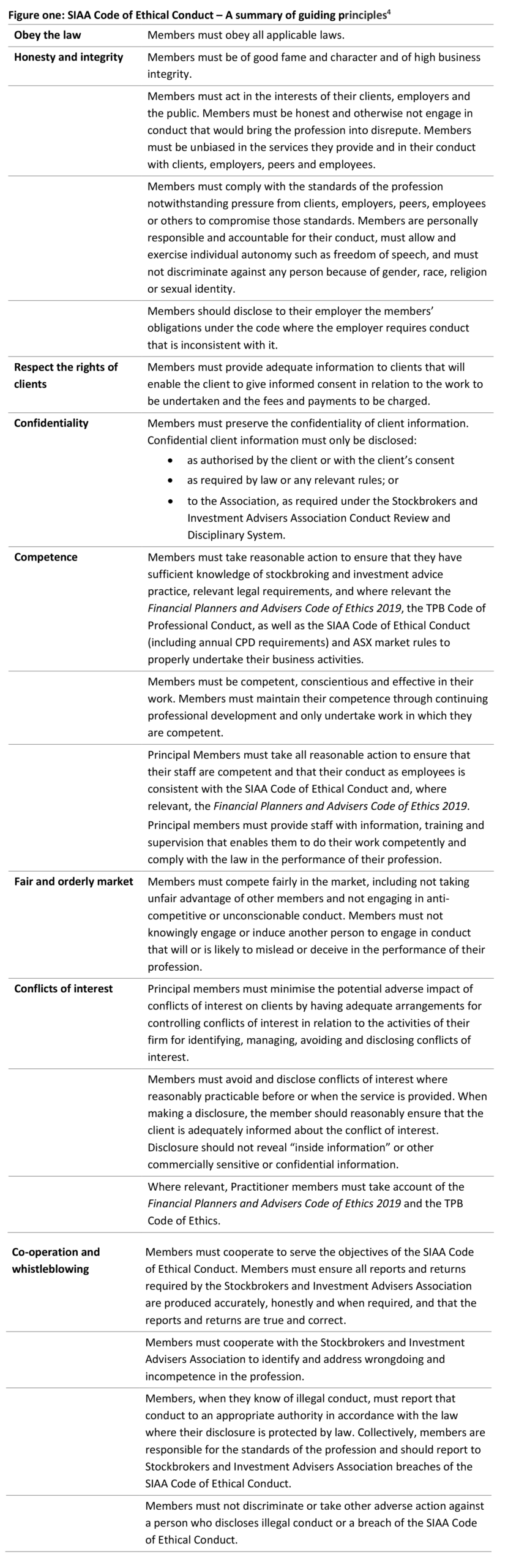
Members of the SIAA are also subject to other codes, such as the Financial Planners and Advisers Code of Ethics. As such, they must read and apply those codes together with the SIAA Code of Ethical Conduct. The SIAA may also take a breach of another code into account when assessing whether a member has met their obligations under its own code. In practice, a breach of the Financial Planners and Advisers Code of Ethics could be treated as a breach of the SIAA Code of Ethical Conduct.
The Financial Planners and Advisers Code of Ethics
Introduced in 2019, the Code of Ethics is designed to encourage higher standards of behaviour and professionalism across the financial advice industry. As a legislative instrument, it must be complied with under section 921E of the Corporations Act 2001. Its broader purpose is to lift professionalism and ensure that advice providers uphold and promote these standards.
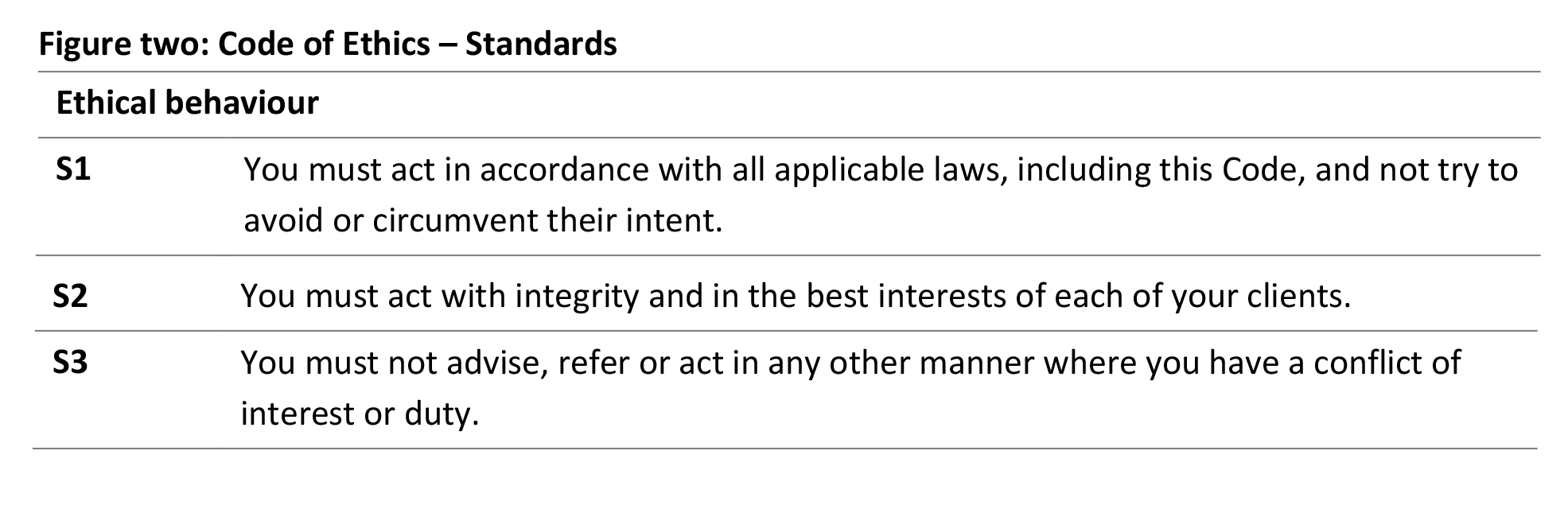
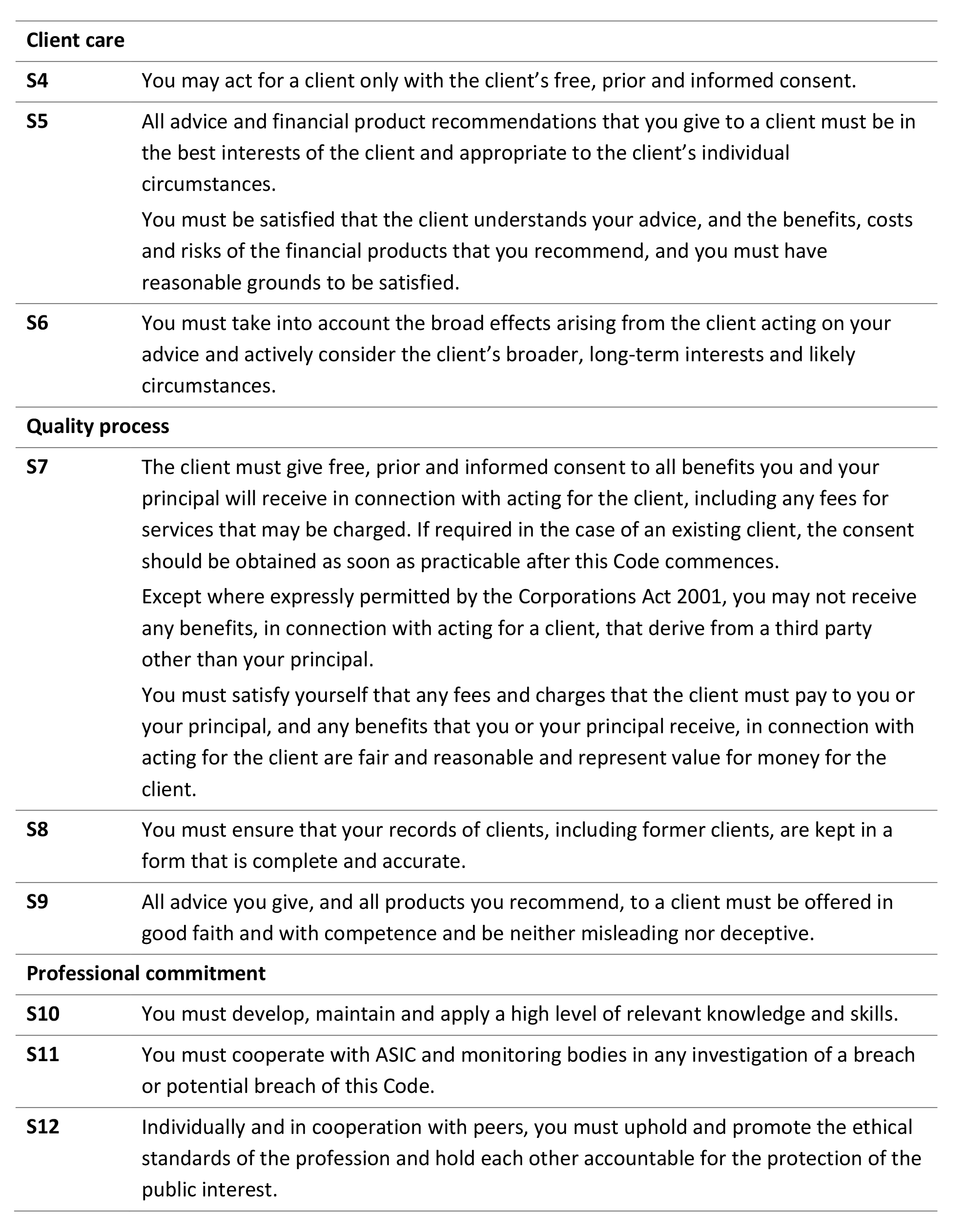
The Code is built around five core values: trust, competence, honesty, fairness and diligence. These values are paramount, and every other provision of the Code must be read and applied in a way that promotes them. Twelve ethical standards put these values into practice, and they fall into four themes: ethical behaviour (standards one to three), client care (four to six), quality process (seven to nine) and professional commitment (ten to twelve).
Advisers must act at all times and in all cases in a manner that is demonstrably consistent with these standards, which are summarised in figure two. Among other things, they require advisers to act in the best interests of clients, avoid conflicts of interest, ensure clients give informed consent and understand the advice they receive, confirm that clients clearly agree to the fees they will pay and maintain a high level of knowledge and skills.
Where the two codes converge
This section reviews some of the key principles in the SIAA Code of Ethical Conduct and shows how they relate to the standards in the adviser Code of Ethics. It concentrates on the topics most relevant to financial advisers who recommend or transact in listed securities.
Obey the law
Both codes begin with the same principle: comply with the laws that govern the industry. This covers legislation, statutory rules and both regulatory and self-regulatory requirements. Because these laws change often, you need to keep your knowledge current. Your licensee also has a responsibility to make sure that you and your colleagues in the practice do the same.
Honesty and integrity
That SIAA members must act with honesty and integrity, and in the best interests of their clients, is consistent with standards two and five of the Code of Ethics. Honesty and integrity also underpin most standards and principles across both codes. The requirement to not bring the profession into disrepute aligns with standard twelve.
Respect the rights of clients
This requirement focuses on the notion of ‘informed consent’, particularly in relation to recommendations made (consistent with standard four) and fees charged (consistent with standard seven).
Competence
Continual innovation has led to significant growth in the number and types of listed securities available to Australian investors. This has increased the need for advisers to keep their knowledge current and to educate their clients about the sector more broadly. To recommend listed investments competently, advisers need to understand the detail of each potential investment. This includes the underlying assets, the investment approach where the investment is a listed fund and the risk and return profile.
Recommending listed investments also calls for additional knowledge. Advisers need relevant market and product knowledge and, importantly, must understand and abide by market rules. All relevant information must be communicated clearly to clients.
The SIAA code requires members to take reasonable steps to ensure they have sufficient knowledge of stockbroking and investment advice practice, the relevant legal requirements and, where relevant, the adviser Code of Ethics. Members are also expected to maintain this competence through continuing professional development. This is consistent with standard ten, which focuses on developing, maintaining and applying appropriate knowledge and skills.
Principal members of the SIAA must give staff the information, training and supervision they need to work competently and comply with the law. AFSL holders face the same expectation.
Conflicts of interest
The SIAA Code requires members to avoid conflicts of interest and, where reasonably practicable, to disclose them before or when the service is provided. Principal members must also limit the potential adverse impact of conflicts by having adequate arrangements in place to control them.
Standard three of the adviser Code of Ethics covers similar ground but sets a stricter threshold. It states that you must not advise, refer or act in any other manner where you have a conflict of interest or duty. It is concerned with actual conflicts, either between the duties an adviser owes a client and their own personal interest, or between those duties and duties owed to another individual or organisation. Because the standard speaks of conflicts of duty as well as conflicts of interest, an adviser who identifies a conflict cannot simply manage it and carry on. They must take documented action to avoid it.
In practice, an adviser dealing in listed securities who meets the SIAA obligations to disclose and control conflicts will still need to consider whether standard three may prevent them from making and implementing specific recommendations.
Cooperation and whistleblowing
While the requirements for SIAA members are more detailed, they are broadly consistent with standard eleven, which requires advisers to cooperate with any investigation of a breach or potential breach of the Code of Ethics by ASIC or another monitoring body.
Fair and orderly market
SIAA members must compete fairly in the market, including not taking unfair advantage of other members and not engaging in anti-competitive or unconscionable conduct. Importantly, members must not knowingly engage or induce another person to engage in conduct that will or is likely to mislead or deceive in the performance of their profession.
There are several important elements to consider with this standard; advisers working with listed securities need to understand and manage these risks, each of which could see them in breach of the law and, at the very least, standard one in the adviser Code of Ethics.
ASIC’s enduring priorities[5] include misconduct damaging market integrity (insider trading, continuous disclosure breaches and market manipulation), as well as misconduct involving a high risk of significant consumer harm.
Some of the requirements to ensure a fair and orderly market include:
- Best execution
ASIC’s regulatory guide RG-265 provides guidance on market integrity rules for participants of securities markets. In terms of best execution, the regulatory guide states that market participants must take reasonable steps to obtain the best outcome for their clients. For retail clients, it means best total consideration, which market participants may interpret as best price while there are not material differences in transaction costs between licensed markets.
This applies to trades executed via any exchange. There are additional rules applied in the case of trading derivatives. The notion of ‘best total consideration’ means that for buy orders, investors pay as low a price as possible. Conversely, for sell orders, investors should receive the best possible price. Best execution also means paying the lowest possible transaction costs and applies to all listed securities, whether a share, an AREIT or an actively managed ETF.
From the perspective of the Code of Ethics, best execution addresses acting in the clients’ best interests (standards two and five) and competence (standard nine).
- Pump and dump
‘Pump and dump’ is a form of securities fraud. It begins when an individual or group buys shares in a company and then runs an organised campaign to lift (or ‘pump’) the share price. They often use online forums and social media to spread false news about the company’s prospects or to generate hype. Once the price rises, they sell (or ‘dump’) their shares for a profit, and other shareholders suffer losses as the price falls.
The practice is not new, but it has been growing, largely because of social media and the rise of the finfluencer. In recent years, ASIC has paid closer attention to both pump and dump activity and the spread of finfluencers, many of whom are unlicensed.
Engaging in pump and dump activity is clearly unethical. Recognising these schemes draws on knowledge and skills (standard ten) and on always acting in your clients’ best interests (standards two and five).
- Insider trading
Both an ASIC enforcement priority for 2026 and an enduring priority, inside information refers to confidential, non-public knowledge about a company that could influence the value of a listed security.
Examples of inside information may include:
-
- Advance knowledge of unexpected changes in revenue or profit
- Plans for mergers or acquisitions
- Potential legal action involving the company
- Development of new products
- The awarding of major export contracts or key client accounts
Access to inside information can give individuals an unfair advantage in the market. It is illegal to trade based on inside information or to share it with others who are likely to trade on it.
Even where a transaction using inside information is undertaken to benefit clients, using insider knowledge will breach the Corporations Act 2001, section 1043A and is therefore a contravention of the first standard in the Code of Ethics, as well as the first principle of the SIAA code.
Case studies
The following case studies are loosely based on ASIC’s enforcement activities or AFCA cases; however, names and other details have been changed for privacy reasons.
Case study one: Insider trading – size does not matter
Aaron was a corporate adviser who learned confidential information through his role at ACME Company. He received email correspondence about a funding proposal for ACME Minerals, including a multi-million dollar share placement and a restructure of the board, along with a draft ASX announcement.
He spoke to his financial adviser Pete and shared the information. He then asked Pete to acquire ACME Minerals shares while in possession of the inside information. The information became public several weeks later and the share price rose 178 per cent. Aaron instructed Pete to sell the shares two months later, booking a profit of $59,350.
ASIC’s enforcement action targeted both Aaron (as the possessor of the inside information) and Pete for acting on the information, even under instruction.
The Supreme Court of Western Australia sentenced Aaron to two years’ imprisonment, with release after ten months on a twelve-month good behaviour recognisance. He was also automatically disqualified from managing corporations for five years. He had pleaded guilty to one count of applying for shares while in possession of inside information, in breach of section 1043A of the Corporations Act.
For acting on his client’s instructions, Pete received a suspended sentence and was banned from providing financial services, from controlling an entity that carries on a financial services business and from performing any function involved in carrying on such a business for three years.
Although the profit gained from this transaction was relatively small, the penalty indicates that ASIC takes insider trading seriously, regardless of the amount gained.
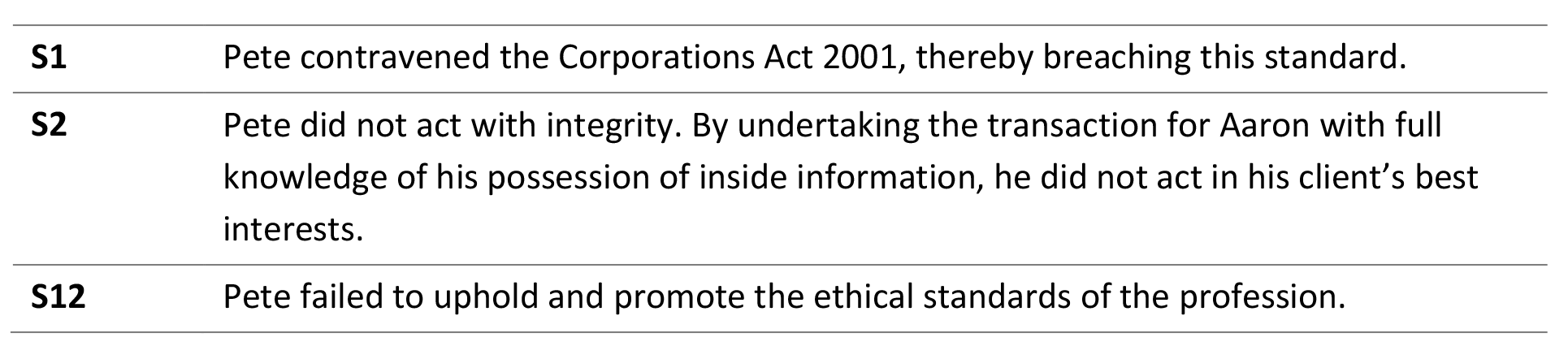
Although Aaron was not subject to the Code of Ethics, Pete was, and likely breached the following standards, which also connect to the SIAA requirement to act with honesty and integrity:
 Case study two: Failure to act in a client’s best interests
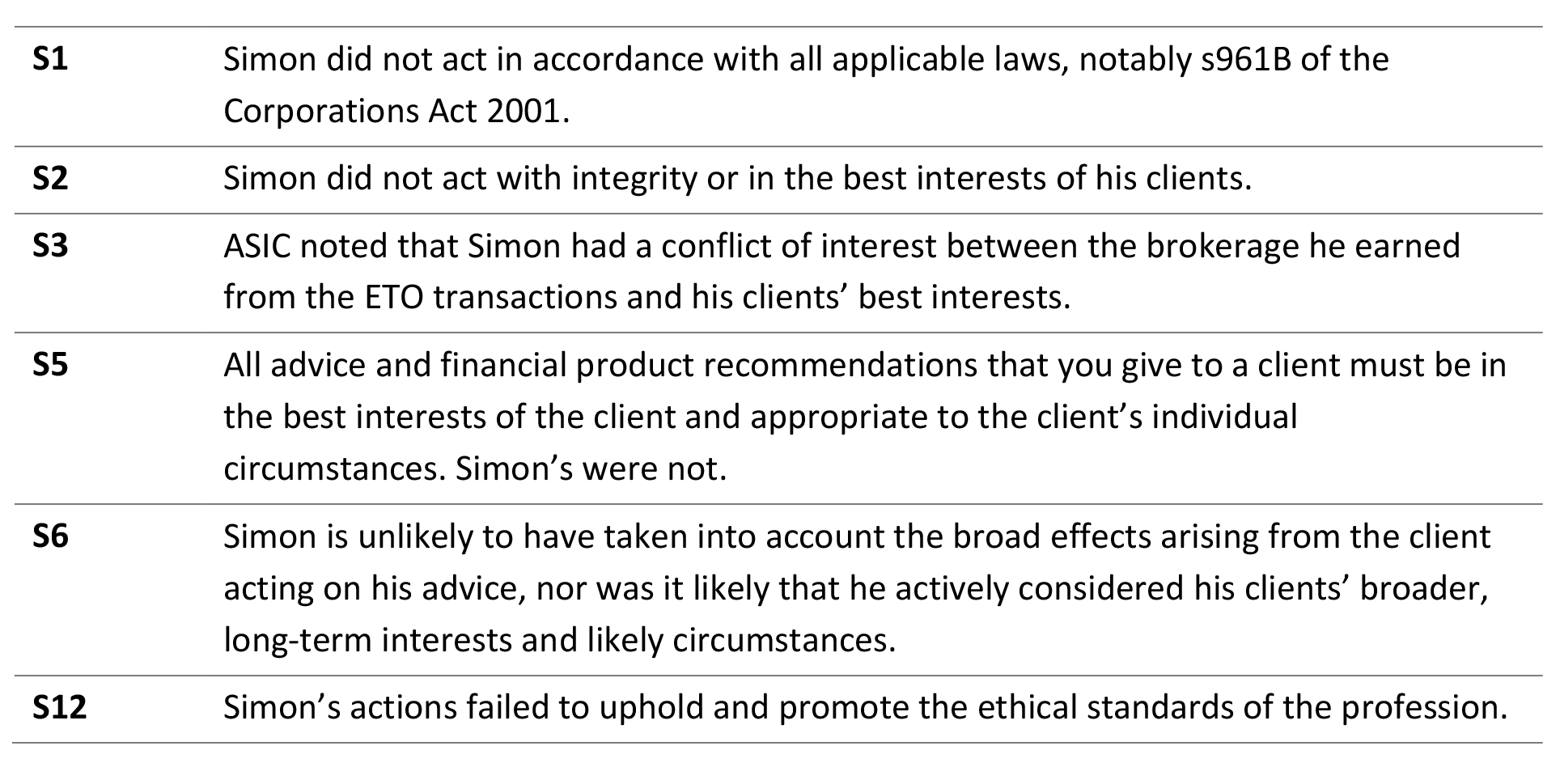
ASIC permanently banned adviser Simon, an adviser at ACME Advice, after finding he failed to act in his clients’ best interests and gave inappropriate advice about exchange traded options.
ASIC found that:
- Simon failed to act in clients’ best interests and gave advice about exchange traded options (ETO) that was inappropriate for their financial circumstances and objectives.
- His conduct left each client’s superannuation account significantly exposed to short ETO cash covered positions, contrary to the risk profile declarations the clients had given. ASIC described selling options to open a position as a highly risky strategy, with unlimited potential loss in the case of a sold call.
- Simon knew, or ought reasonably to have known, that there was a conflict between the brokerage he earned from the many ETO transactions he advised clients to enter and their best interests, and he failed to give priority to their interests.
Consequently, Simon was permanently banned. ASIC stated that Simon’s conduct was not isolated or inadvertent and occurred over a long period, during which clients incurred significant losses. It had reason to believe he was likely to contravene a financial services law in future and was not of good fame or character.
As a result of his actions, Simon likely breached the following standards of the Code.
 Case study three: A ‘finfluencer’s’ pump and dump
ASIC issued warning notices to four ‘finfluencers’ in April 2026 and reviewed licensee supervision of 15 more, following action against 18 in 2025. The following case study is a hypothetical, loosely based on ASIC’s actions in this space.
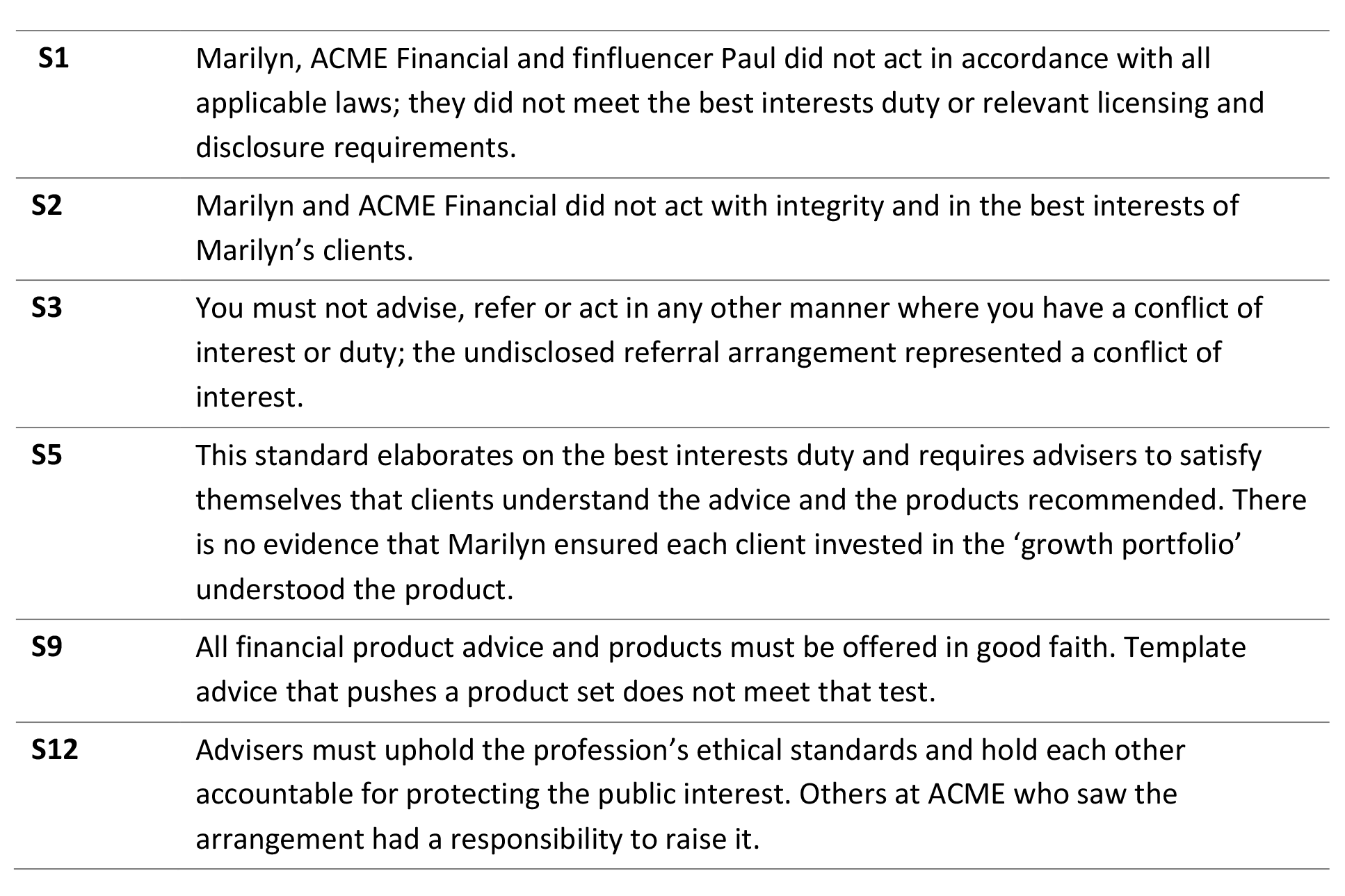
Marilyn is a financial adviser and an authorised representative of ACME Financial, a small licensee. Paul is a finfluencer with a large following on social media, and he describes himself as a ‘markets educator’. He is not licensed and is not an authorised representative of ACME.
ACME agreed to pay Paul a fee for each follower who became one of Marilyn’s clients, plus a share of the ongoing advice fees from those clients. In return, Paul directed followers to a ‘free strategy session’ with Marilyn.
Paul regularly promoted a set of high-risk ASX-listed investments to his followers. These included several small-cap shares and a geared exchange traded product. He described them as a growth portfolio that had beaten the market and told followers that ‘serious investors’ held it. He held positions in some of the shares he promoted and did not say so.
Marilyn then met the followers who booked sessions. The fact-finds were largely completed by Paul’s team using a standard online form. Marilyn spent about 20 minutes with each client and used a template to prepare statements of advice, which recommended allocating between 70% and 100% of the client’s investable funds to the growth portfolio.
One client, Anne, was 61 and planning to retire within five years. Her fact-find showed a balanced risk profile and that she relied on her savings for retirement income. Marilyn recommended that Anne move 85% of her funds into the portfolio. The statement of advice did not mention the referral payments to Paul, and it described the portfolio as suitable for most clients. Within six months, the portfolio fell by around 40%. Anne lodged a complaint with AFCA, and ASIC began a review of ACME’s supervision of Marilyn.
In this instance, Marilyn and ACME Financial potentially breached the following standards:
The ethical dimension of financial advice rests on giving well-founded recommendations that serve the client’s best interests and help them reach their financial and lifestyle goals. It also means making sure clients understand the advice and every investment recommendation, whether it involves listed or unlisted securities.
Upholding ethical standards, demonstrating trustworthiness and acting with integrity are essential to earning consumers’ trust. In turn, this builds confidence in dealing with advisers and with financial services more broadly. Adherence to the adviser Code of Ethics (and, for SIAA members, the Code of Ethical Conduct) plays a central part in building the advice industry’s reputation.
Take the FAAA accredited quiz to earn 0.75 CPD hour:
CPD Quiz
The following CPD quiz is accredited by the FAAA at 0.75 hour.
Legislated CPD Area: Professionalism and Ethics (0.75 hrs)
ASIC Knowledge Requirements: Ethics (0.75 hrs)
please log in to start this quiz

———–
Notes:
[1] Australian Investor Study, ASX, October 2026
[2] ASX Investment Products, ASX, September 2026
[3] Ensuring access to quality and affordable financial advice, Commonwealth of Australia (Treasury), 2024
[4] Stockbrokers and Investment Advisers Association, Code of Ethical Conduct, February 2023
[5] ASIC enforcement priorities, ASIC, November 2025
CPD Quiz
The following CPD quiz is accredited by the FAAA at 0.75 hour.
Legislated CPD Area: Professionalism and Ethics (0.75 hrs)
ASIC Knowledge Requirements: Ethics (0.75 hrs)
please log in to start this quiz
———–
Notes:
[1] Australian Investor Study, ASX, October 2026
[2] ASX Investment Products, ASX, September 2026
[3] Ensuring access to quality and affordable financial advice, Commonwealth of Australia (Treasury), 2024
[4] Stockbrokers and Investment Advisers Association, Code of Ethical Conduct, February 2023
[5] ASIC enforcement priorities, ASIC, November 2025


Have feedback on this article? Contact Us
Earn CPD Points
 CPD: Currency risk – friend or foe?
In today’s interconnected world, global companies play a significant role in our daily lives. However, when Australian investors allocate their capital to global markets, they are exposed not only to [...]
 CPD: Ethics and moral dilemmas
When it comes to financial advice, the numbers may be black and white, but the ethical decisions often aren’t. This article, proudly sponsored by GSFM, examines moral dilemmas and the [...]
 CPD: Jump in my CAR. Client Advice Records – why, what, how
Introduction The forthcoming replacement of Statements of Advice (SOAs) with Client Advice Records (CARs) has once again shone a spotlight on the vexed issue of client communication within financial advice. [...]
 CPD: Investor Behaviour – Retirement
To best understand how and why clients make financial decisions – particularly during retirement – advisers must look beyond technical strategies and consider investor behaviour. Before addressing product selection or [...]
 CPD: A star is (re)born – Investment Bonds are the new headline act of tax-smart investing
Introduction Tax-smart investing is one of the central pillars of quality, effective, financial advice. The capacity for tax to drag on investment returns, stifle compounding, and eat away at gains [...]