Summary
- Ireland has gone from financial market darling to a challenging credit in the space of three years. With a similar concentrated banking system that has a high exposure to the property market, could Australia become another Ireland?
- The rapid rating decline of Ireland has various lessons for investors: not to rely on ratings; and that state support for banks is not necessarily a panacea.
- Sovereign guarantees to banks may defend them to an extent but ultimately it may only transfer the risk from the banking system to the sovereign.
- While Ireland’s problems could be partly mirrored in Australia, various factors should mitigate some of the causes that were central in Ireland.
- Ireland should provide a salutary lesson to Australian investors that relying upon the status quo is unwise.
- Australia did weather the financial crisis effectively due to a variety of factors, but if these factors reverse, Australia’s safe haven status could be dented.
Introduction
Ireland has rapidly deteriorated from financial market darling to a challenging credit needing a bail-out. The extent of the turnaround is such that the factors that caused this need to be considered in regards to other economies. In particular, could this happen in Australia? The Australian economy is considerably more robust and diversified than Ireland’s but the systemic exposure to banking has noticeable parallels, suggesting that complacency about Australia’s economic strength may need to be challenged.
Of the European states that have so far experienced severe challenges and much public consideration, Ireland stands out to Australians because of a greater similarity in banking systems, with both having a small set of major banks which are very focused on the domestic market. It is therefore informative to compare the situations of the two nations and more particularly the banking systems.
To do this, we first examine the events in Ireland and then compare them with Australia so as to determine if there are lessons for Australian investors.
The Irish situation
Ireland has been in the headlines in the last few months for all the wrong reasons. A bail-out by the European Union (EU) and International Monetary Fund (IMF) is now in progress and the creditworthiness of the state is continually deteriorating. Four years ago, it all seemed so different: prior to the GFC, Ireland was a shining star, attracting financial institutions around the world to the new financial hub of Dublin. Low taxation, a knowledge-based culture and a convenient location made Ireland a hive of activity.
What went wrong?
Ireland was badly affected by the financial crisis of 2007 and 2008. Many of the institutions operating there contracted in size and often the Irish operations were scaled back or closed. The Irish economy had transitioned from being primarily an agricultural exporter to being a ’knowledge centre’ but unfortunately this ’knowledge’ was often centred on more innovative products such as Structured Investment Vehicles (SIVs) which were the most vulnerable to the liquidity squeeze caused by the global financial crisis (GFC).
To meet the rapid growth up to 2006, Irish property was in strong demand from genuine and speculative buyers, causing house prices to more than double between 2000 and 2006 (as shown in chart 1). Commercial property was squeezed and developers borrowed heavily to meet the increased demand.
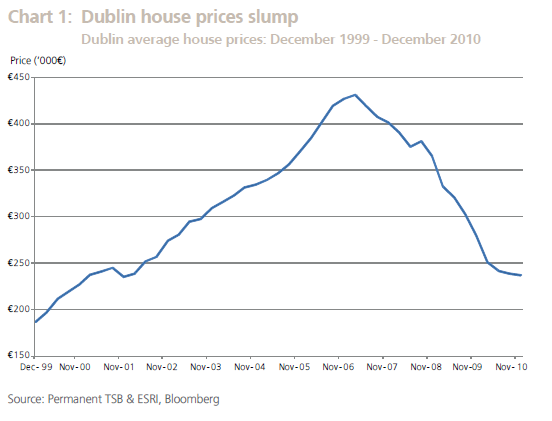
When growth stopped, the banks were left with large books of commercial and residential real estate and extensive loans to developers. Since 2006, house prices have fallen nearly 40%. Commercial property has been performing even worse with Investment Property Databank Ltd. estimating a 60% slump in the values of shops, offices and warehouses in the three years to September 2010.
The Irish banking system
Four main banks operate in the Republic of Ireland: Bank of Ireland, Allied Irish bank, Anglo Irish bank and the Ulster Bank. Ulster Bank is a subsidiary of Royal Bank of Scotland (RBS). On the night of 29-30 September 2008, two weeks after the collapse of Lehman Brothers, the Irish Government issued a guarantee of Allied Irish, Anglo Irish Bank, Bank of Ireland and three building societies. To address European Commission concerns, the guarantee was extended on 9 October 2008 to Ulster Bank and five other institutions which had non-Irish sponsors.
In January 2009, the Irish government nationalised Anglo Irish Bank. At the time of writing, it appears quite likely that Bank of Ireland and Allied Irish will also be nationalised.
Recent developments in Ireland
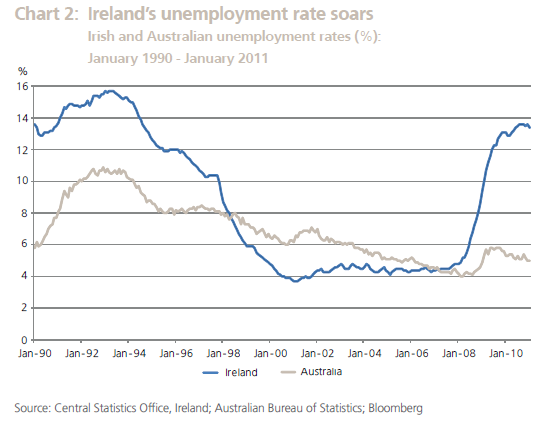
The population of the Republic of Ireland is about 4.5 million people. Unemployment has risen from a low of 4.4% in November 2006 to the current level of 13.6% (as shown in chart 2). With limited prospects of improvement, the size of the bank debt problem has, despite political resistance, forced the EU and IMF to intervene. Effectively an €€85 billion package has been established of which between €€35 and €€50 billion will be used to prop up the banks with the remainder to support the Irish state.
Ratings downgrades
Since the crisis started, the ratings of Ireland have deteriorated rapidly. For over seven years up to March 2009, Ireland was a solid triple-A rated state with ratings as good, or in some cases, better than Australia’s1. Now Moody’s and Fitch have lowered the sovereign into the triple-B rating grade and at A (Negative Watch), S&P is expected to follow shortly.
Bank ratings have been even more adversely impacted. The Irish banks are all rated in the triple-B range or below and subordinated bank debt has now been downgraded into the weaker end of sub-investment grade if not to default.
An Australian perspective
Effect on investments
For Australian investors, Ireland seems a long way away and direct exposure to Irish entities is likely to be limited for most.
The contagion effect to other challenged European sovereigns may possibly increase the significance of Ireland’s problems for investors, and portfolios need to be monitored to control the extent of impact.
Loss of faith in governments and banks
Perhaps the most significant contagion effect is a loss of faith in the creditworthiness of major banks – even when strongly supported by the government. Although the Irish government has indicated that senior bank paper is ‘money good’, some commentators are questioning whether it is possible to achieve this. Certainly, any hope that Tier 2 paper is very resilient has been dimmed, if not extinguished, by the action of Irish authorities on their banks’ subordinated debt as well as by ECB legislation that is intent on clarifying and ensuring the loss protection purpose of all subordinated debt.
The rapid rating decline of Ireland has various lessons for investors. The first of which (if not already learnt) is not to rely on ratings. The next lesson is that state support for banks is not necessarily a panacea. It might appear that the Irish state has been weakened by the explicit guarantees that it gave for the banks, but probably the more pertinent point is that these guarantees were forced upon the Irish government, since without them the collapse of the banking system may well have been much earlier.
Australia was fast to follow Ireland into guaranteeing bank debt. This action was not a casual decision and emphasises the systemic importance of the banks within Australia. The subsequent events in Ireland highlight that sovereign guarantees do not eliminate the risk but instead transfer it from the banking system to the sovereign.
Could it happen here?
This raises the more intriguing question for Australians: could it happen here especially with a similar concentration of key banks, all of which have high exposure to the property market? It should, however, be noted that the four major banks are serving a country with about five times the population of Ireland.
Australia has had a relatively gentle GFC compared with the US and Europe and the banking system has remained largely unscathed especially when considering the major banks. The cost of funds has increased for all banks, but the competitive landscape has eased with many of the smaller competitors being squeezed out. The reduction in competition has allowed the major banks to protect their margins, especially in the mortgage and small and medium enterprise (SME) markets.
This protection of margins has helped maintain the credit quality of the major banks but it has created political problems, as borrowers see their interest rates being increased by more than the official Reserve Bank of Australia rate rises.
The four major banks have increased their balance sheets over the last few years substantially as competing lenders have gone by the wayside – although the growth has not reached the level predicted in early 2009.
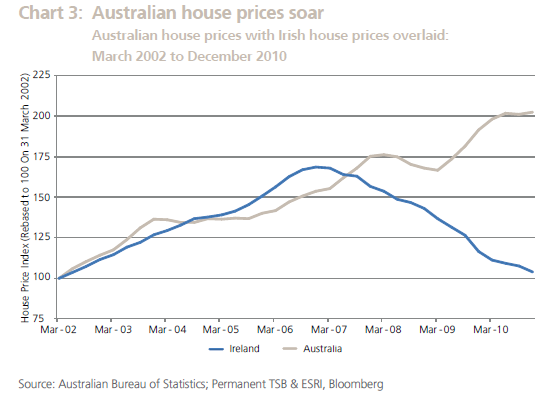
Australian banks have always had a heavy property focus and in the early 1990s some banks nearly collapsed due to their exposures. Since the advent of the GFC, the banks have been steadily managing down the more challenging commercial property exposures and this sector should not impact Australian banks to nearly the same extent as the Irish banks, but residential mortgages remain a key exposure. Although Australian house prices increased slightly slower than Ireland’s before the financial crisis, they have continued to increase and convincing arguments can be made that prices are in a bubble. (Chart 3 emphasises the extent to which the Australian housing market has continued to perform.) Possibly, the biggest risk is if unemployment in Australia rises significantly as it did in the Republic of Ireland.
However, unlike Irish banks, Australian banks have had a broader range of assets with much of corporate Australia traditionally relying on bank loans as their main, and often only borrowing avenue. With the banks’ increased borrowing costs and investment money beginning to build up both domestically and offshore, corporate bond markets are now competing with relatively attractive borrowing rates and issuers are being lured away from the banks.
Caution may be needed if the banks’ exposure to stronger Australian corporates continues to be eroded and the banks’ balance sheets become overwhelmingly focused on just SMEs and mortgages. That being said, there is a long way to go before we reach that situation.
Beyond the banking sector, other factors definitely distinguish the two countries. Unlike Ireland, Australia has its own currency which enables it to use more levers in controlling economic issues. However, the fact that Ireland shares the euro places a strong incentive upon other euro participants to find a solution and hence is not a complete negative.
Finally, the situations of Australia and Ireland are very different: Ireland is an agricultural producer that reinvented itself as a ’knowledge centre’. In Australia, although agriculture is a main export earner, commodities are a dominant earner and with the relative geographic advantage, in terms of proximity to Asia, Australia has been fortunate in continuing to find buyers of its exports, and while trying to become more of a focus in the financial world, it has not relied upon this.
For Ireland, the exposure was to a downturn in demand for ’innovation’ but Australia is much more exposed to a downturn in demand for agriculture and commodities. This important variation means that the causes of any Australian crisis will most likely be quite different from those of the Irish crisis. However, the similarity of banking systems suggests that the banks, as a transmission mechanism for a crisis, may be similar even if the stronger nature of the Australian banks results in the end effects being less dire.
Conclusion
Australia is not Ireland and, as the discussion above suggests, while Ireland’s problems could be partly mirrored in Australia, various factors should mitigate some of the causes that were central in Ireland. However, with the corporate market attracting strong credit names away from their traditional bank markets, the banking system is moving towards the Irish in its concentration on property and this trend should be monitored.
More importantly, however, than any similarities of the two countries, Ireland should provide a salutary lesson to Australian investors that relying upon the status quo is unwise. Australia did weather the financial crisis most effectively due to a variety of factors. But if these factors reverse (e.g. the Chinese market for commodities reduces) then Australia’s safe haven status could be dented. In such a case, the banks and their dominant position in Australia would become a core focus and they may be more vulnerable than currently thought.
Disclaimer
This document was prepared and issued by Tyndall Investment Management Limited
ABN 99 003 376 252 AFSL No: 237563. The Tyndall managed funds are issued by Tasman Asset Management Limited ABN 34 002 542 038 AFSL No: 229664 (“TAML”). The information contained in this document is of a general nature only and is not personal advice. It is for the use of researchers, licensed financial advisers and their authorised representatives. It does not take into account the objectives, financial situation or needs of any individual. Investors should consult a financial adviser before acting on the information contained in this document. Investment decisions should be made on information contained in the current Tyndall Australian Equities or Tyndall Fixed Interest Product Disclosure Statements (“PDS”) and their Supplementary PDSs (“SPDS”) available at www.tyndall.com.au. Applications will only be accepted if made on an application form attached to the current SPDSs. Past performance is no guarantee of future performance. TAML and Tyndall Investment Management Limited are subsidiaries of Nikko Asset Management Co., Limited (Nikko AM). An investment in the Tyndall managed funds are subject to investment risk including possible delays in repayment and loss of income and principal invested.