Lending finance; RBA Board minutes; New Car Sales
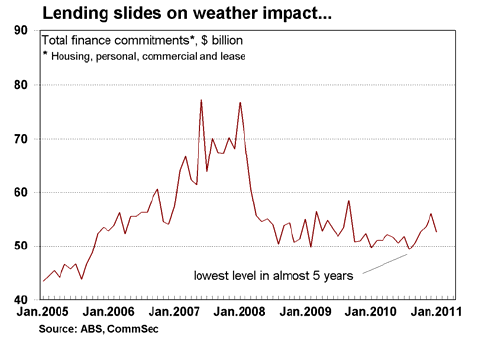
- Lending slumped in January. Total lending finance fell for the first time in the five months – down by 6.0 per cent in January. Lending totalled $52.6 billion in January, up 5.8 per cent over the year. Over the prior four months cumulative monthly gains in lending finance stood at 12.8 per cent.
- RBA Board on interest rate sidelines. The decision to leave interest rates on hold in March was due to an array of factors, however the key driver was the negative impact on the economy from the floods. The subdued level of consumer spending also provided Board members with further reason to hold off on near-term rate hikes.
- Australian new car sales recorded a modest 0.2 per cent rise in February.
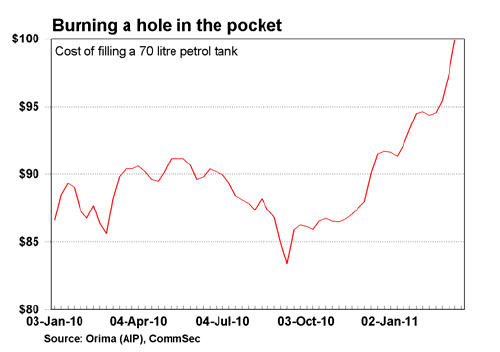
- According to the Australian Institute of Petroleum, the national average Australian price of unleaded petrol rose by 3.5 cents per litre to 142.7 cents a litre in the week to March 13 – a near 29 month high. Over the past month the national average price has lifted by 7.9 cents per litre.
- Brisbane has the highest petrol price across the capital cities, while Canberra is the lowest.
- The futures market has now priced in a 55 per cent chance of a rate cut at the April meeting in light of the Japanese nuclear crisis.
What does it all mean?
- Lending finance is a forward-looking indicator of economic activity – as any rise in borrowings will eventually translate to a pickup in spending and production. The floods are clearly complicating analysis of the lending data, but the continued softness of consumer borrowing remains a concern.
- In late 2010 there were tentative signs of thawing in the conservative attitudes of consumers and businesses. Lending finance had risen for four straight months prior to the sharp 6 per cent fall in January. The key issue going forward is: how long will the weakness last? Notwithstanding the floods, the Reserve Bank would clearly want to see some improvement in lending over February and March.
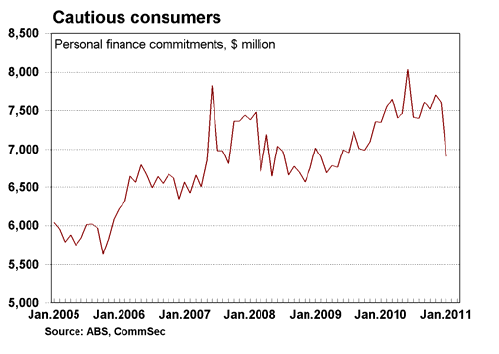
- The weakness in consumer borrowings is a major concern, especially given that personal finance has fallen for five out of the last seven months. CommSec expects the Reserve Bank is likely to stay on the interest rate sidelines – especially given that inflation looks to be well contained at present.
- The latest Reserve Bank Board minutes identified the Queensland floods as a key reason for interest rates remaining on hold in March. And as the Reserve Bank has noted on recent occasions, the lack of consumer activity is not all bad news – ensuring that inflationary pressures are contained in the near term. Even the recent slide in lending is unlikely to surprise the Reserve Bank, especially given that it was expecting growth to be sluggish in the first half of 2011.
- The minutes revealed that Board members were generally optimistic about the outlook, noting strength in business investment plans as well as the sustained improvement in labour market conditions. However given that interest rate were “mildly restrictive” – in other words acting to slow the Australian economy – a rate pause seemed the most logical outcome.
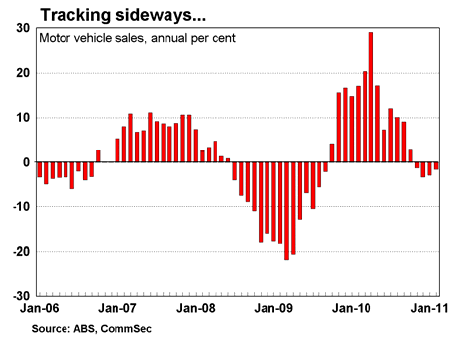
- After a modest pickup in activity in the mid part of 2010, car sales are now effectively going nowhere with more signs of buyer caution once again emerging. In annual terms vehicle sales are down almost 2 per cent on a year ago. The rate hikes of late last year are no doubt resulting in potential car buyers being more circumspect about future purchases. In fact in trend terms car sales have been broadly flat for the last ten months.
- What is required in the near term is for interest rates to remain on hold, allowing consumers and businesses to adjust to the higher interest rates now in place and, in turn, start spending again.
- Brisbane was hit hard by the floods and now it has the highest petrol price of any capital city. The lofty petrol price is clearly an impediment to economic recovery.
What do the figures show?
Lending Finance:
- Total new lending commitments (housing, personal, commercial and lease finance) fell by 6.0 per cent in January after rising 4.3 per cent in December. However over the prior four months lending was up a much healthier 12.8 per cent in cumulative terms. Lending totalled $52.6 billion in January, up 5.8 per cent over the year.
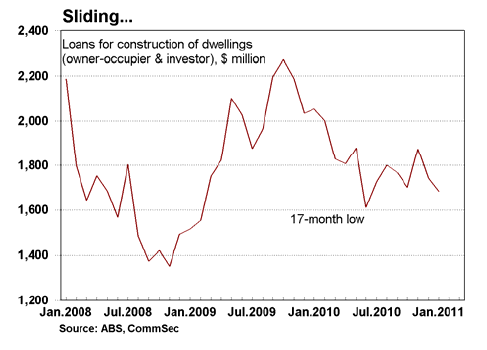
- All housing finance (owner occupier & commercial) fell by 4.8 per cent in January – the first fall in seven months.
- Commercial finance fell by 5.8 per cent in January. Within commercial commitments, fixed lending fell by 4.0 per cent while revolving credit slumped by 9.7 per cent. Commercial loans are up 13.9 per cent on a year ago.
- Personal finance fell by 9.5 per cent in January – marking the fifth fall in the past seven months. Within personal commitments, fixed lending fell by 4.5 per cent while revolving credit fell by 14.5 per cent. Personal loans are down 6.2 cent on a year ago.
- Lease finance fell by 1.3 per cent in January and loans are down 6.2 per cent over the year.
New car sales
- New car sales rose by 0.2 per cent in February after sliding by 2.4 per cent in January. Total car sales are down 1.5 per cent on a year ago.
- Passenger car sales fell by 2.7 per cent in the month, sports utility vehicles rose by 4.1 per cent while “other” vehicles (trucks, utes etc) were 4.2 per cent higher. In annual terms “other” vehicle sales were up 1.4 per cent on a year ago.
- In rolling annual terms, 236,260 SUV’s have been sold in the 12 months to February – the second highest reading on record. Overall SUV sales are up 4.6 per cent on a year ago.
Petrol prices:
- According to the Australian Institute of Petroleum, the national average Australian price of unleaded petrol rose by 3.5 cents a litre to 142.7 cents a litre in the week to March 13. The metropolitan price rose by 3.7 c/l to 142.8 c/l, while the regional average price rose by 3.3 c/l to 142.6 c/l.
- Average petrol prices across states over the past week were: Sydney (up 4.5 cents to 143.2 c/l), Melbourne (up 3.5 cents to 142.2 c/l), Brisbane (up 4.9 cents to 145.6 c/l), Adelaide (up 1.6 cents to 141.1 c/l), Perth (up 2.7 cents to 141.5 c/l), Darwin (up 1.3 cents to 144.4 c/l), Canberra (up 3.3 cents to 137.3 c/l) and Hobart (up 1.4 cents to 145.5 c/l).
Minutes from the March 2011 Reserve Bank Board meeting
Consumer spending
- Retail sales data had shown subdued spending in late 2010, including a small fall in real spending for the December quarter. Liaison with retailers had suggested some improvement in conditions in early 2011, with sales data for January released during the Board meeting showing moderate growth in the month. Consumer confidence had softened in early 2011 to be only modestly above average levels, although it was difficult to determine how much of this decline was due to the floods and the cyclone.
Business conditions
- Most business surveys showed a deterioration in current conditions in January, and there was a substantial reduction in hours worked in Queensland. However, business confidence in late January had bounced back after falling in the previous survey taken in early January.
Employment
- There had been another solid rise in employment in January, with the unemployment rate remaining at 5 per cent. Forward-looking indicators of employment from surveys and liaison pointed to solid employment growth over the coming year. Wage growth had picked up over the second half of 2010, with the quarterly outcomes for the wage price index back at around their average rate for the 2005–2007 period. Wage outcomes had been stronger in the mining sector.
The decision
- Interest rates on loans were slightly above average, a level reached after the monetary policy decision taken in November 2010. Members judged that this mildly restrictive stance of policy continued to be appropriate. The Board therefore decided to leave the cash rate unchanged.
What is the importance of the economic data?
- Lending Finance is released monthly by the Bureau of Statistics and contains figures on new housing, personal, commercial and lease finance commitments. The importance of the data lies in what it reveals about the appropriateness of interest rate settings, confidence and spending levels in the economy.
- The Reserve Bank releases minutes of its monthly Board meeting a fortnight after the event. The minutes give a guide to Reserve Bank thinking on interest rate settings.
- The Australian Bureau of Statistics (ABS) provides monthly estimates of car sales in seasonally adjusted and trend terms after receiving the actual sales data from the car industry. The figures highlight the strength of consumer spending as well as conditions facing auto & components companies.
What are the implications for interest rates and investors?
- Overall the latest Board minutes suggest that the Reserve Bank has a degree of flexibility on the interest rate front. And while the near term domestic data looks patchy the Reserve Bank remains confident about the outlook.
- CommSec doesn’t expect a rate hike until at least May, however the risks are that the Reserve Bank will maintain stable rates for longer.
- Interestingly current futures market pricing indicates a 55 per cent chance of a rate cut at the April meeting in light of the Japanese nuclear crisis.
Produced by Commonwealth Research based on information available at the time of publishing. We believe that the information in this report is correct and any opinions, conclusions or recommendations are reasonably held or made as at the time of its compilation, but no warranty is made as to accuracy, reliability or completeness. To the extent permitted by law, neither Commonwealth Bank of Australia ABN 48 123 123 124 nor any of its subsidiaries accept liability to any person for loss or damage arising from the use of this report.
The report has been prepared without taking account of the objectives, financial situation or needs of any particular individual. For this reason, any individual should, before acting on the information in this report, consider the appropriateness of the information, having regard to the individual’s objectives, financial situation and needs and, if necessary, seek appropriate professional advice. In the case of certain securities Commonwealth Bank of Australia is or may be the only market maker.
This report is approved and distributed in Australia by Commonwealth Securities Limited ABN 60 067 254 399 a wholly owned but not guaranteed subsidiary of Commonwealth Bank of Australia. This report is approved and distributed in the UK by Commonwealth Bank of Australia incorporated in Australia with limited liability. Registered in England No. BR250 and regulated in the UK by the Financial Services Authority (FSA). This report does not purport to be a complete statement or summary. For the purpose of the FSA rules, this report and related services are not intended for private customers and are not available to them.
Commonwealth Bank of Australia and its subsidiaries have effected or may effect transactions for their own account in any investments or related investments referred to in this report.