House Prices; Private Sector Credit
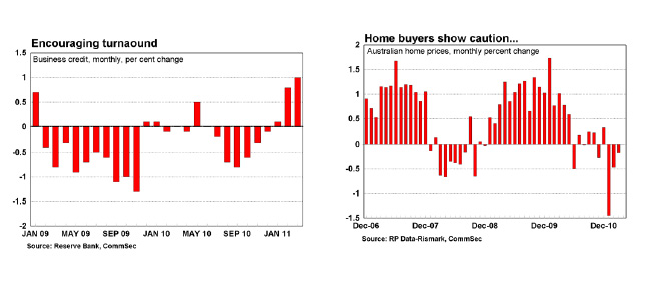
- Capital city home prices fell by 0.2 per cent in seasonally adjusted terms in March after a downwardly revised 0.5 per cent slide in February, according to the RP Data-Rismark Hedonic Australian Home Value Index – the largest property database in Australia. Outside capital cities, prices rose by 0.2 per cent in March.
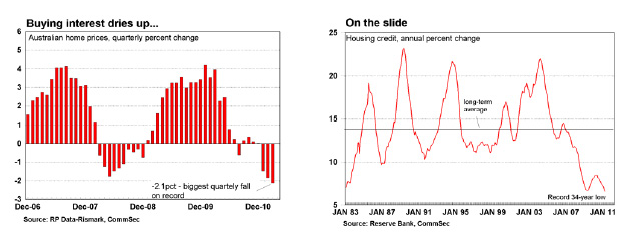
- Capital city home prices fell by 2.1 per cent over the first three months of the year – marking the largest quarterly slide in property prices on record. Prices in the ‘Rest of State’ markets were down 0.5 per cent in annualised terms.
- Prices rose in just two of the seven capital cities in March with Darwin prices up 1.1 per cent, followed by Melbourne up 0.6 per cent. Prices fell most in Perth (down 1.9 per cent), Brisbane (down 1.4 per cent), followed by Adelaide (down 0.7 per cent). Sydney prices were unchanged in March.
- Private sector credit rose by 0.6 per cent in March to stand 3.6 per cent higher than a year ago. Housing credit grew by 6.6 per cent in annual terms marking the weakest annual growth rate in records going back 34 years.
What does it all mean?
- Over the past six months we have made mention of the inevitable consolidation in the housing sector and it certainly seems to be in full swing. In fact over the first three months of 2011 property prices have fallen by 2.1 per cent marking the biggest quarterly slide in records going back seven years. And even in annual terms prices have recorded the first fall in two years. Whichever way you look at it the housing sector is decidedly weak, and more importantly there is no silver lining on the horizon to suggest a turnaround in fortunes is likely anytime soon.
- The sizeable 19 per cent slide in housing finance commitments over the first two months of 2001 clearly highlights the lack of home buyer interest. Added to which the latest private sector credit figures have revealed that housing credit has posted the weakest annual growth in records going back 33 years. The recent slide in property prices and more circumspect home buyers will result in sellers being more realistic about achievable prices in coming months.
- Effectively you can strike another item off the Reserve Bank’s worry list. The rate hikes delivered over 2010 have taken the heat out of the housing market ensuring that the normal supply-demand fundamentals are ruling the roost across capital city housing markets.
- Interestingly there are marked differences in home prices across the nation and it is a similar story when you look at rental yields. States like NSW has seen a significant amount of under building compared to the likes Victoria however the lack of supply – lower vacancy rates – in NSW has resulted in higher rental yields on offer.
- It is important to highlight that while the housing sector is cooling it is not about to collapse in a heap. Overall CommSec expects house prices to consolidate over the next few months, but for the year as a whole we would expect prices to lift by 5 per cent. The Reserve Bank is likely to remain on the interest rate sidelines in the near term, while healthy jobs growth, rising population and sliding rental vacancy rates will support housing activity in the medium term.
- The Australian economy has certainly lost momentum over the last couple of months. However the latest improvement in private sector credit is certainly encouraging especially given that modest increases have taken place over the last few months.
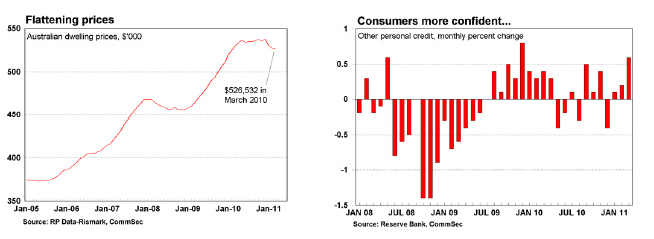
- Admittedly it is too early to claim a full blown turnaround borrowing activity, but it does seem like the lack of rate hikes over the past few months is allowing businesses and consumers to get back to basics. Personal credit recorded its best monthly increase since late 2009, added to which businesses borrowing also recorded its best monthly gain in 2½ years. The pickup in borrowings does have the potential to boost spending levels in coming months. It should be noted that the impact of the natural disasters may have artificially inflated the pickup in borrowings, but there has been signs of a modest improvement nonetheless.

What do the figures show?
House price prices
- The RP Data-Rismark Hedonic Australian Home Value Index fell by 0.2 per cent in March after a downwardly revised 0.5 per cent fall in the previous month.
- House prices fell by 0.2 per cent in the month while apartments fell by 0.3 per cent.
- Capital city home (dwelling) prices are down 0.6 per cent on a year ago – marking the first annual slide in property prices in two years. House prices are down 1.2 per cent and apartment prices are up by 1.4 per cent.
- Prices rose in just two of the seven capital cities in March with Darwin prices up 1.1 per cent, followed by Melbourne (up 0.6 per cent). Across the other cities prices fell most in Perth (down 1.9 per cent), Brisbane (down 1.4 per cent), Adelaide (down 0.7 per cent) and Canberra (down 0.4 per cent). Sydney prices were unchanged in March, while Hobart prices rose by 2.3 per cent in February (March data not yet available).
- Home prices are higher than a year ago in just Sydney (up 2.1 per cent) and Melbourne (up 1.0 per cent). Prices fell the most in Brisbane (down 6.8 per cent), Perth (down 6.4per cent), Darwin (down 1.3 per cent) and Canberra (down 0.5 per cent). Adelaide prices were unchanged on a year ago.
- March home prices aren’t available yet for Hobart. In the year to February, home prices in Hobart were down by 1.3 per cent.
Private sector credit
- Private sector credit (lending) rose by 0.6 per cent in March after rising by 0.5 per cent in February. Credit growth is up 3.6 per cent on a year ago.
- Housing credit grew by 0.4 per cent with lending to owner-occupiers rising by 0.4 per cent and investor housing up 0.2 per cent. Housing credit is up 6.6 per cent on a year ago – the weakest annual growth in records going back 34 years. Owner occupier housing credit is up 6.5 per cent on a year ago – slowest pace in records going back 20 years. Investor housing lending was up 6.7 per cent on a year ago.
- Personal credit remained rose by 0.6 per cent in March after rising by 0.2 per cent in February. Personal credit was up 1.0 per cent over the year – still well below the rate of inflation. Business credit rose by 1.0 per cent in March, however was down 0.6 per cent on a year ago.

What is the importance of the economic data?
- The RP Data-Rismark Hedonic Australian Home Value Index is based on Australia’s biggest property database covering more than 340,000 sales during 2010. Unlike the ABS Index, which excludes terraces, semidetached homes and apartments, the RP Data-Rismark Hedonic Index includes all properties.
- The monthly RP Data-Rismark Hedonic Index compares month-to-month index results. Quarterly results are measured comparing end months rather than averaging each month in the quarter. For example, the first quarter of 2009 index results would compare the end of March index with the end of December index.
- Private sector credit figures are released by the Reserve Bank on the last working day of the month. Credit is separated into three categories – housing, other personal and business. Private sector credit is effectively the amount of loans outstanding in the economy. If growth in lending is strong then it suggests that credit from financial institutions is freely available, underlying demand for assets such as cars and houses is firm and that the price of credit (interest rates) is attractive.
What are the implications for interest rates and investors?
- The rate hikes have certainly taken their toll on the housing sector over the past year and unfortunately for the sector it is unlikely that a turnaround is going to take place anytime soon. Overall CommSec expects house prices to consolidate over the next few months, but for the year as a whole we would expect prices to lift by 5 per cent.
- A softening in home prices combined with the prospect of interest rates remaining unchanged for the next few months is clearly positive for budding home buyers. Less doom and gloom stories about interest rates and unsustainable home prices will be beneficial for consumer sentiment more generally.
- The improvement in consumer and business credit is certainly encouraging, but to claim a sustained improvement the Reserve Bank will need to stay on the interest rate sidelines for another couple of months. More importantly there is nothing in the data to date to force the Reserve Bank to raise interest rate in the near term.

Produced by Commonwealth Research based on information available at the time of publishing. We believe that the information in this report is correct and any opinions, conclusions or recommendations are reasonably held or made as at the time of its compilation, but no warranty is made as to accuracy, reliability or completeness. To the extent permitted by law, neither Commonwealth Bank of Australia ABN 48 123 123 124 nor any of its subsidiaries accept liability to any person for loss or damage arising from the use of this report. The report has been prepared without taking account of the objectives, financial situation or needs of any particular individual. For this reason, any individual should, before acting on the information in this report, consider the appropriateness of the information, having regard to the individual’s objectives, financial situation and needs and, if necessary, seek appropriate professional advice. In the case of certain securities Commonwealth Bank of Australia is or may be the only market maker. This report is approved and distributed in Australia by Commonwealth Securities Limited ABN 60 067 254 399 a wholly owned but not guaranteed subsidiary of Commonwealth Bank of Australia. This report is approved and distributed in the UK by Commonwealth Bank of Australia incorporated in Australia with limited liability. Registered in England No. BR250 and regulated in the UK by the Financial Services Authority (FSA). This report does not purport to be a complete statement or summary. For the purpose of the FSA rules, this report and related services are not intended for private customers and are not available to them. Commonwealth Bank of Australia and its subsidiaries have effected or may effect transactions for their own account in any investments or related investments referred to in this report.