Global economic news over the last couple of months has improved with Europe pulling back from the brink, the US economy seemingly perking up again and China continuing to grow solidly.
However, the news flow in Australia has not been as positive. While the mining boom is as strong as ever, household related demand and the labour market have been weak and the decision by the RBA to leave rates on hold has added to the short term uncertainty.
What does this mean for the economy and Australian assets?
While the RBA chose to wait and see following its latest meeting, it still appears to retain a bias to ease further in describing monetary policy as appropriate for the “moment” and indicating that the inflation outlook provides scope for easier monetary policy. However, its urgency to ease seems to be low and the hurdle to ease higher, with the RBA suggesting it will require a “material” weakening in domestic conditions.
Two thoughts on this though. First, reading too much into RBA statements is dangerous – witness the big U turn on interest rates during the second half of last year – and prone to generate a lot of hot air from economists and other RBA watchers. Second, while we agree with the Reserve that the global backdrop has become less threatening we ultimately think it will have to ease a bit further – largely for domestic reasons.
There are several reasons why.
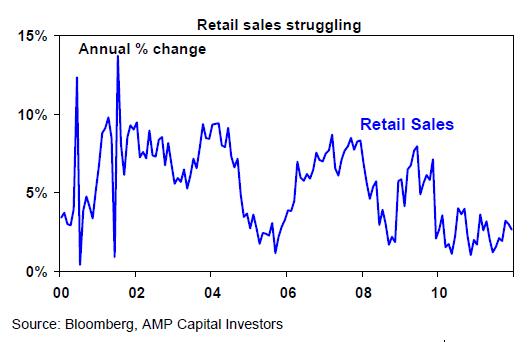
- Retail sales remain very weak. Retail sales were flat over the last three months of 2011 and up just 2.6% over the last year, a range they have hovered around for the last two years, in contrast to past experience where such low growth during cyclical downturns has been limited to a few months. Unfortunately, anecdotal evidence doesn’t suggest any improvement for the start of 2012.
- Retailers are struggling under the weight of consumer caution, a newfound desire to reduce debt levels and save more following the GFC, rising costs for utilities & rents eating into spending power, a rise in online shopping and more Australians shopping overseas on holiday. These trends are unlikely to change any time soon.

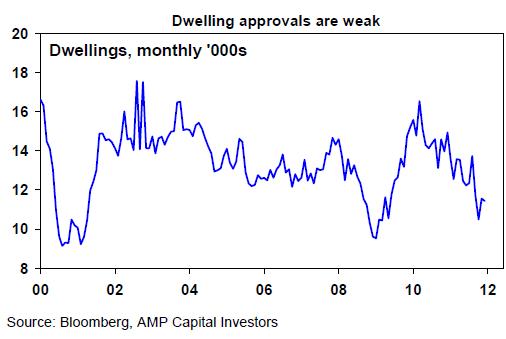
- Housing activity is soft with building approvals remaining in a downtrend.

- Capital city average house prices are down 5.5% from their 2010 high and still appear to be drifting down.
- The pace of job layoffs appears to have picked up again with almost a daily drip feed of anecdotes of job losses in manufacturing or the finance sector, which in the absence of an offset will only weigh on consumer confidence.
- The reluctance of the RBA to ease at a time when the US Federal Reserve is becoming more dovish and the European Central Bank is set to provide another huge cash injection into its economy later this month via its Long Term Refinancing Operation has further reinforced an already strong rebound in the $A. This will put further immense pressure on the already struggling manufacturing, tourism, higher education and retailing industries. Retailing used to be a beneficiary of a strong $A as it meant lower wholesale costs for imported retail goods. It still does, but any benefit is being swamped as the strong $A is reinforcing the trend of more Australians going overseas, realising how cheap things are and shopping online.
- The increase in bank funding costs in the absence of an offsetting fall in the RBA’s cash rate risks prompting a rise in mortgage rates.
- Finally, while mortgage rates may now be characterised as being around their long term average suggesting monetary policy is neutral, this is doubtful. First, while the average standard variable mortgage rate at 7.3% is in line with its average over the last decade, small businesses face borrowing rates well above their decade average. See the next chart.
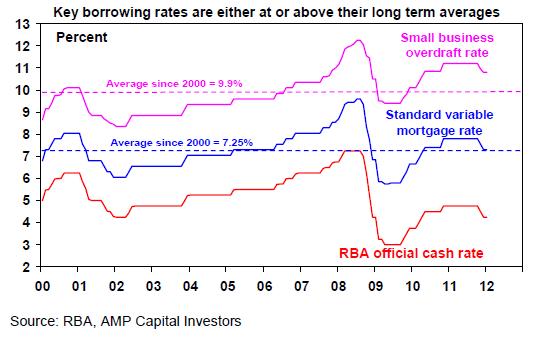

- In the current environment of consumer caution and reluctance to take on debt it’s likely the so called “neutral” level for borrowing rates has fallen below the average of the last decade, perhaps by 0.5%. This would imply a further 0.5% reduction in the cash rate (or more if small business borrowers are allowed for). Third, it ignores the influence of the rising Australian dollar, which amounts to a de facto monetary tightening. All of this suggests monetary conditions are still a long way from neutral.
- While the mining boom is continuing, the key message of the last year is that it is not delivering anything like the trickle down boost to the economy seen through the first mining boom last decade or as was generally expected a year ago. There is no huge revenue windfall for the Federal Government to allow annual tax cuts, wages growth outside mining is soft and the impact on the labour market has been minor.
- None of this is to say the Australian economy is in dire straights. In fact broadly it is in good shape with our export markets holding up reasonably well, an absence of public debt problems, low corporate gearing and a high household savings rate. Rather the key point is that for trend growth of around 3.0 to 3.25% to be achieved over the year ahead, interest rates will need to be lowered further.
Implications for Australian investment markets
- The relatively tougher stance of the Reserve Bank of Australia has a number of implications for Australian investment markets.
- Australian dollar – while the $A is due for a short term pullback having risen 9% since its last decent correction in mid December, further gains look likely as the RBA’s relatively tough stance at a time when the US Fed and ECB are easing has put another rocket under it, adding to the boost from improving global economic confidence. Abstracting from the risk of a short term correction, a retest of the July high of $US1.1081 looks likely in the next few months, if not sooner.
- Australian share market – the relatively tougher stance of the RBA, along with the impact of the strong $A and worries about a Chinese hard landing have been the three main factors leading to the relative underperformance of Australian shares over the last two years. The first two are likely to fade, but it may take a while in the case of the RBA. As a result, the risk is that the Australian share market will continue to underperform in the short term. So while improved confidence in the global growth outlook, coming at a time when shares are cheap and global monetary conditions are easing, has helped underpin a recovery in shares in recent months that is likely to continue, global and emerging markets are likely to continue outperforming Australian shares in the short term.
- The residential property market – while the rate of decline in national average house prices appeared to slow down late last year, further price declines are likely in the short term. A decent recovery will probably require further falls in mortgage rates. In the short term this has probably been set back a bit, to further into the second half of the year.
- Commercial property – after a slump in 2009, commercial property (ie office, retail and industrial) has been a relatively solid and steady performer reflecting yields of around 7%. This is unlikely to change much although tough conditions for retailers and soft office employment will act as a drag.