A decade has now passed since I first wrote a note suggesting that we are coming into an environment of low and volatile investment returns.
At the time I and various investment strategists were concerned the drivers of the super normal returns from most asset classes from the early 1980s had largely run their course and therefore sustainable returns would revert to longer term norms. While a high return world lingered for Australian based investors up until 2007 (thanks to a strong performance by the Australian share market during the first mining boom), low sub-par medium term returns have been a phenomenon for US and European investors for the last decade and longer for Japanese investors. This all begs several questions – if the low return world is more than a decade old is it nearly over? If not, what does it mean for the way we manage money?
The secular ebb and flow of shares
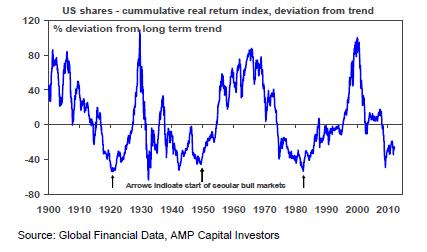
It should be well known that share markets go through longer term secular bull and bear phases. This is most clearly evident in the US share market (which of course sets the direction for global shares) and illustrated by the following chart, one of my favourites. It shows the cumulative real value of $100 invested in 1900. Secular bull markets – or 10-20 year periods where the trend in shares is up – can be seen in the 1920s, 1950s and 60s, and the 1980s and 90s. In between in the 1930s and 40s, 1970s and over the last decade are secular bear markets – which are longer term periods where shares have poor and volatile returns.
These secular bull and bear phases are driven by a combination of the macro environment and related long waves of innovation, periods of excess in the provision of credit and long term swings in market valuations.
- The 1920s bull market was associated with electricity, mass production & easy credit and ended when markets became overvalued & the world slipped into depression.


- Cheap valuations, post war consumerism, petrochemicals, electronics, aviation and low inflation underpinned the secular bull market of the 1950s & 60s.
- By the late 1960s shares had become overvalued again and this and the combination of rising inflation, poor economic management and oil shocks gave way to a secular bear market in the 1970s.
- This in turn set the scene for the secular bull market of the 1980s and 1990s which started when shares were very cheap in 1982 but was underpinned by the shift to low inflation, deregulation, globalisation, the peace dividend and ultimately the IT revolution.
- By the turn of last century shares had become expensive again & the tech wreck, corporate governance scandals, a bursting of credit and various housing bubbles and public debt concerns have all underpinned a secular bear market in US and European shares since 2000.
Where are we in the current secular bear mkt?
The first thing to note is the current secular bear market is getting quite long, running at 12 years, whereas the norm is 10 to 20 years. Furthermore there are some signs of light in the direction setting US. Cumulative real returns from US shares have now fallen well below their long term trend and are running around levels associated with the start of secular bull markets in 1920, 1949 and 1982.

Furthermore, the US manufacturing sector seems to be staging some sort of renaissance, with numerous companies opening plants or expanding production capacity in the US.
That said, our assessment is while there are some positive signs and the current secular bear market in global shares may be long in the tooth, it could still have a way to go yet:
- The message from valuation indicators is mixed. US shares are cheap compared to the history of the last 20 or 30 years and are particularly cheap compared to bonds which are offering yields at or around record lows. This is all consistent with more gains in the current cyclical upswing. Against this though, the so called Graham Dodd or Shiller PE which measures shares against a 10 year moving average of earnings to smooth out cyclical fluctuations has unwound the excesses of the 1990s but is above its long term average and only slightly below its long term rising trend. This is fine, but mean reversion often sees shares go well into cheap territory before the next long term bull market gets underway.


- Private sector deleveraging has a way to go and the credit environment is likely to remain tough post GFC. Countries post financial crises typically see many years of constrained economic growth and greater volatility.
- High public debt levels in the US, Europe and Japan have left them with little fiscal fire power to respond to future economic downturns and ongoing pressure to cut budget deficits. As such, fiscal austerity will be a constraining factor for growth.
- Monetary policy settings are extreme, providing a source of potential future volatility when it has to reverse.
- Social unrest is rising and economic policy is becoming more populist and interventionist, which is likely to be bad for productivity, in contrast to the economic rationalist policies of Thatcher, Reagan and Hawke/Keating introduced in the 1980s that coincided with the start of the last secular bull market.
- Demographic trends have become less favourable with the proportion of the population in developed countries at peak spending age now declining and baby boomers starting to retire and focusing on capital preservation.
- The greater global reliance on growth in the emerging world could add to volatility as emerging countries are inherently more volatile.
What does this mean for markets?
If the secular bear has a bit further to run it has several implications for investment markets.
- First, average medium term returns are likely to remain constrained. The next table shows our medium term return projections for key assets classes. For a diversified growth mix they imply single digit returns around 8% pa.


- Second, volatility is likely to remain high reflecting the fragile nature of the recoveries in the US and Europe, extreme settings in monetary policy and more fickle investors following the experience of the GFC.
- Third, the combination of the fragile nature of the global economic recovery combined with investor nervousness means the phenomenon of “risk on/risk off” is likely to remain a key feature. This means all risk or growth related listed assets – share markets, credit, commodities, emerging market and commodity currencies are all trading as a block. We are either in “risk on” or “risk off” and the relative merits of each asset or security in the growth block are of lesser importance.
- Fourth, the fragile macro economic backdrop means macro economic and financial events are likely to dominate over micro and more company specific news.
- Finally, the increased volatility and increased investor nervousness probably means fair value price to earnings multiples on shares may be 2 points or so lower than over the last decade or two, say 13 times for Australian shares rather than 14.5 times. In other words, investors are demanding a higher risk premium.
What does it mean for investors?
Lingering shifts in the longer term macro economic and investment background have invariably led to change in the way investment funds are managed. This is no less the case now. Key things for investors to be aware off are as follows:
- Even in secular bear markets there is still a cycle. Don’t despair after sharp falls as they throw up opportunities.
- Asset allocation is paramount in the current environment over manager selection and stock picking in terms of driving returns.
- Focus on markets less constrained by negative secular forces, eg the emerging world, corporate debt, commercial property & infrastructure. See table above.
- Focus on investments providing a decent income flow as it provides confidence regarding returns, eg corporate debt, commercial property, infrastructure and quality high yield Australian shares.
- For those with a short term horizon or specific needs consider investment strategies that target an investment outcome such as income yield or a return target.