There was one piece of great news last week. A new Mayan calendar find in Guatemala made no reference to the world ending this year.
That’s nice, so I can now go back to worrying about Greece in peace. Or maybe not. In fact it’s starting to feel a bit like Ground Hog Day for investors. Here we are with another year that started fine with share markets up on optimism about an improved global outlook, to now be in May and see the same old worries back with a vengeance. Europe seems to be falling apart again, worries about a Chinese hard landing are back and US economic data has become mixed with worries it will fall off a “fiscal cliff” next year. So far since their highs this year global shares have fallen 8% and Australian shares by 5.5%.
Europe
Quite clearly Europe remains at the head of the worry list with increasing signs of a backlash against fiscal austerity, fears Greece is about the exit the euro and increasing concerns about Spanish banks:
- The Socialist victory in France and the fall of the Dutch Government are probably less of a concern as even Chancellor Merkel is likely to agree to some easing of the pace of fiscal austerity following her own coalitions’ electoral losses and the EU seems to be moving towards a more relaxed enforcement anyway having realised that austerity is just making things worse. (That’s the downside to Austrian economics!)
- Greece is far more problematic. It is now headed for a new election with Greeks seemingly schizophrenic in wanting to stay in the euro but thinking they can substantially renegotiate the terms of their bailout. It seems that each successive crisis in Greece is taking it closer to exiting the euro, whether its via a new Government rejecting the bailout deal or if several months down the track it fails to meet its agreed deficit reduction targets. An exit from the euro would mean complete chaos for Greece – a 50-70% collapse in its new currency, the inability to fund its budget deficit and hence even worse fiscal austerity, a banking system collapse, etc. For the rest of Europe a Greek exit would be far less problematic than might have been the case a year ago as private sector financial exposure to Greece has been substantially reduced and firewalls have been strengthened. But uncertainty would still be intense in the process of Greece exiting and this may result in more market turmoil, as investors will look around for who will be next to leave – Portugal? Spain?
- Spain being much much bigger is more of a worry, with a recession and falling property prices making the situation of its banks more difficult risking the need for a public sector bailout. Some estimates put the requirement at €100bn which would add 10 percentage points to Spain’s public debt to GDP ratio which would take it to around 80% of GDP. This would still be below the Euro-zone average of 87% and normally wouldn’t be a problem but these are not normal times. And if Spain gets into deeper trouble, investors will likely focus on Italy again.
This has all resulted in a renewed blowout in bond yield spreads between Spain and Italy on the one hand and Germany on the other. Despite Europe stagnating in the March quarter rather than confirming recession as expected, we continue to expect a 1% contraction in Euro-zone GDP this year. Whichever way you cut it Europe is a mess and it is still hard to see the way out. However, several things are worth noting.
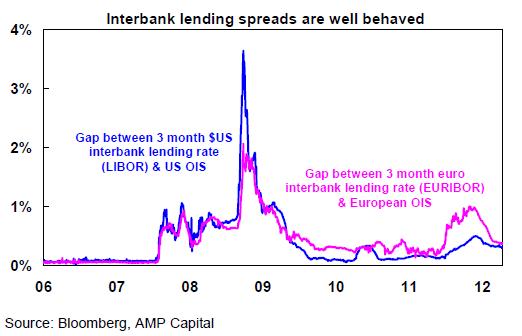
First, while the sovereign crisis in Europe has returned anew, interbank lending spreads remain under control suggesting the risk of banks not being able to fund themselves and hence a systemic banking crisis, threatening a re-run of the GFC and a huge blow to global growth, is currently low. This is thanks to the provision of cheap ECB funding for banks.

Second, the experience of the last two years where fears that European blow-ups would trigger a return to global recession and financial meltdown highlight that policy makers have the power to calm things down. Right now Europe needs a slowing in austerity and much easier monetary policy. The odds are that European authorities will move in this direction. But as always it may take more bad news before they get there.
China
A month ago, Chinese economic data was showing signs of bottoming, but this vanished with official data for April showing a further sharp slowing in industrial production, retail sales, fixed asset investment, imports, exports and bank lending. While this contrasts with business conditions indicators pointing to a stabilisation in growth it nevertheless suggests that growth could dip to 7% in the current quarter.
Fortunately with inflation and the property market having cooled there is plenty of scope for further policy easing in China which we expect over the next few months. China doesn’t have the debt constraints that the US and Europe have and so growth should stabilise over the second half.
The US
Until about a month ago US economic data was universally surprising on the upside, but recently it has been a bit mixed with notably soft readings on employment. However, current indications are that the US is growing around 2 to 2.5%. The real concern for the US is an impending fiscal tightening that will follow the end of the Bush era tax cuts and various stimulus measures at the end of this year. The fiscal cutback, commonly referred to as a “fiscal cliff” will amount to around 3.5% of GDP next year. While this is likely to be reduced to 2% of GDP, it is hard to see Congress and the President agreeing to do this until after the presidential election in November and naturally uncertainty regarding it may intensify into year end.
Some positives
While the risks are significant it is worth noting there are several positives compared to 2010 and 2011, when shares fell roughly 15% from their April high in 2010 and 20% from their April/May high in 2011.
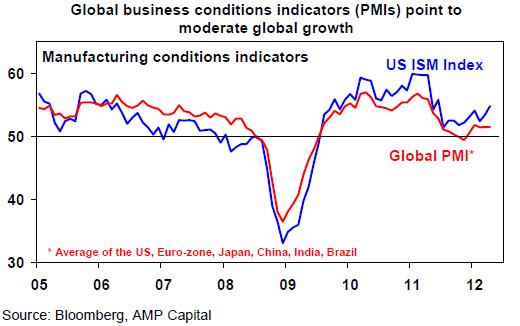
- Firstly, business conditions indicators, notably the US ISM index, have improved after last year’s falls but haven’t yet reached the cyclical highs they got to a year ago. In other words, having not increased that much, there is not as much downside. Right now they are at levels consistent with modest global growth.

- Second, the US economy is looking better in three key areas: the housing sector looks like it is bottoming; manufacturing is experiencing a renaissance and US oil production is surging thanks to shale oil.
- Third, the global economy hasn’t been hit by the supply chain disruptions that flowed from the Japanese earthquake in March last year. This time a year ago the US economy was already slowing partly due to this.
- Similarly, the rise in oil prices this year hasn’t been as great as occurred early last year in response to the “Arab Spring”. Consequently the blow to household income hasn’t been as great.
- Global monetary policy has been easing, whereas a year ago it was being tightened. This was notable in the emerging world where inflation in China was on its way to a high of 6.5%, but also evident in Europe and in Australia the RBA was still threatening to raise interest rates. Now monetary policy has been easing, notably in most emerging countries and in Australia.
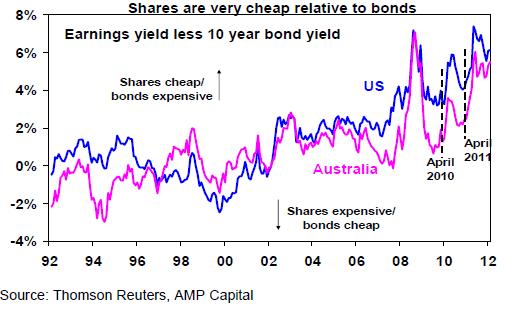
- At their April highs this year shares were cheaper than at their early 2010 and 2011 peaks in terms of the earnings yield pick up they provide over Government bonds. This can be seen in the next chart.

- Finally, it seems everyone is fearful of a re-run of the last two years where shares fell 15 to 20% after highs in April or May. When everyone expects something, sometimes it doesn’t happen.
On balance, while the tenuous situation in Europe along with normal seasonal weakness from May into the third quarter points to the likelihood of further weakness ahead, there are some positives suggesting the downside in markets won’t be as great as the 15-20% falls seen in 2010 and 2011.
What does this mean for Australia?
There are several implications in this for Australia.
- Firstly, while recent domestic data for retail sales, building approvals and employment suggest that the chance of a further June rate cut has fallen, the uncertainty regarding the global growth outlook and weakness in China which has pushed down commodity prices suggest that further interest rate cuts are likely to be justified. We continue to see the cash rate falling to 3-3.25% over the next six months.
- To the extent that global shares remain vulnerable over the next few months, Australian shares will as well. However, the combination of monetary easing (in contrast to the higher rates and threat of further tightening a year ago) and a weaker $A provide some buffer. We continue to see share markets higher by year end, notwithstanding the risk of further downside over the next few months.
- The growth sensitive Australian dollar, like share markets, is vulnerable to further weakness in the short term, possibly taking it down to last years low of around $US0.95. By year end it is likely to be back above parity though as it becomes clear that global growth is continuing, possibly helped along by more quantitative easing in the US (QE3) and Europe which will reduce the value of the $US and euro..
Concluding comments
Renewed uncertainty regarding the global growth outlook, particularly fears around a Greek exit from the euro and worries about Spanish banks, mean that further downside is possible for share markets over the next few months. However, key differences compared to the last two years including a stronger US economy, global monetary easing and cheaper share markets hopefully should help limit the downside in shares and help result in a better year end.