Share markets fell further over the past week on the back of global growth worries and in nervous trade ahead of Fed Chairman Ben Bernanke’s address in Jackson Hole, before recovering much of their losses in the case in US and European shares after his address.
- Shares and other risky assets have rallied on the hope of policy action to bring the European debt crisis under control and to boost US growth. Its coming up to crunch time and so policy makers, particularly in Europe, will now have to deliver.
- Fortunately the signs are positive that they will. Ben Bernanke’s Jackson Hole address made a strong case for more quantitative easing (ie QE3), in concluding that past quantitative easing has been effective in supporting growth, that the costs of QE are manageable and that unless growth improves quickly unemployment will remain too high. Baring a much stronger employment reading on Friday, QE3 looks to be on the way.
- Similarly in Europe, ECB President Draghi’s decision to cancel his appearance at the Jackson Hole conference on the grounds of a “heavy workload”, his comments in German magazine Die Zeit that for the ECB to fulfil its mandate it sometimes requires non-standard monetary policy tools and news that ECB governors will have about 24 hours to digest the ECB’s bond buying proposals all suggest that the ECB is on track to provide details of its plans, probably after Thursday’s ECB meeting.
- A real concern for Australia though is the ongoing slide in the iron ore price which is down by a third since June as Chinese steel producers seek to cut inventories in an environment of uncertainty regarding China’s growth. Some recovery is likely into next year as Chinese and global growth stabilises, but so far there is no sign of a bottom. If sustained it would result in a big hit to the miners and the blow to national income would be a further drag on economic growth and add to pressure on the Federal budget, which was always going to struggle to achieve a surplus this year and is already under pressure in subsequent years from large spending commitments and a possible short fall in carbon tax revenue. While the RBA is unlikely to cut official interest rates in the week ahead, our view remains that they will fall to around 3% by year end and the fall in the iron ore price and the subsequent threat to the economy only adds to our assessment that rates need to fall further.
Major global economic releases and implications
- US data remains consistent with moderate growth – okay, but still not enough to satisfy the Fed. Consumer confidence fell in August, but June quarter GDP growth was revised up to 1.7% from 1.5%, personal income and spending rose in line with expectations, a couple of business surveys pointed to improved business conditions in August, house prices rose for the fifth month in a row and pending home sales rose adding to evidence of a housing recovery, weekly retail sales rose and the Fed’s Beige Book of anecdotal evidence said the economy continues to expand “gradually”.
- European data remains consistent with a mild recession. Economic sentiment fell further in August, unemployment rose to 11.3% and German data was weak, which in some ways may be a good thing in terms of helping to solve Euro-zone debt problems as it adds pressure on the German Government to support ECB efforts. News that Catalonia will become the third Spanish region to seek financial help adds to the urgency to stabilise Spanish bond yields.
- Japanese economic data was poor with falls in machine tool orders, retail trade and industrial production against a backdrop of ongoing price deflation. Korean industrial production also fell in July.
- The news out of China also remains bleak with a further decline in industrial profits, a slump in leading indicators and further weakness in the official manufacturing conditions PMI which saw it fall from 50.1 in July to 49.2 in August. Chinese Premier Wen Jiabao appeared yet again to indicate the need for more stimulus on a visit to Guangdong, but the Chinese authorities are taking a cautious approach to providing stimulus. At least Brazil is not holding back with interest rate and tax cuts.
Australian economic releases and implications
- Australian economic data presented a mixed picture. New home sales fell 5.6% in July, building approvals fell sharply driven by a 40% fall in the volatile multi unit dwelling sector and private sector credit growth was very weak in July. Against this though business investment was up 3.4% in the June quarter and investment intentions for 2012-13 still point to another strong year of investment growth largely driven by mining investment. But while investment plans are still pointing to 40% growth in mining investment this year, they do appear to be topping out – consistent with an end to the mining investment boom in a year or two – whereas investment plans in manufacturing and other industries were upgraded.
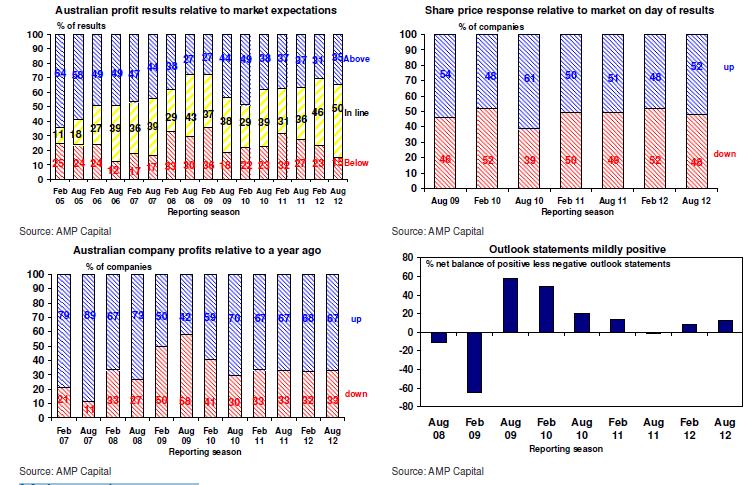
- The Australian June half profit reporting season is now complete. In the final analysis earnings per share fell by around 2% over the last financial year driven by a roughly 17% fall in the resources sector on the back of lower commodity prices, capex spend and cost blowouts but modest positive growth for banks (+1%) and industrials (+6%). Overall results were much better than feared. 35% of results came in better than expected which is below the norm of 43%, but up from just 22% three weeks ago and up from 31% in the last reporting season. But only 15% of companies came in worse than expected, which is down from 23% in the last reporting season.
- Consistent with this, 52% of companies saw their share prices outperform the market on release day. 67% of companies have seen profit gains on a year ago and the biggest surprise is that outlook statements are mildly positive on balance (bottom right chart). Nevertheless, bottom up consensus estimates for 2012-13 profit growth have fallen to 8% from 10% a month ago as analysts used the cover of the reporting season to revise earnings growth estimates to more realistic levels. These estimates are likely to be revised down still further as the slump in iron ore prices weigh on expectations for a rebound in resources profits.
- A key theme was the bounce back in previously sold down cyclicals that delivered against expectations, eg, Bradken, JB HiFi, Downer EDI, Hills, AMP, Wesfarmers, Breville, Qantas and Aristocrat. Against this, there has been some underperformance in the more expensive defensives such as Telstra. A clear positive was the strength of dividends with only 19% of companies having cut dividends with 63% raising them, highlighting the
determination of companies to maintain or raise dividends despite weaker profits.

Major market moves
- Share markets fell for the second week on ongoing concerns regarding the global growth outlook and nervousness ahead of Ben Bernanke’s address at Jackson Hole and the ECB’s meeting in the week ahead. US and European shares recovered some of their losses after Bernanke’s address though.
- Chinese shares are particularly weak having fallen to their lowest level since early 2009.
- The return of investor caution also saw commodity prices fall and a sharp fall in the $A as iron ore prices continued to slide.
- Bond yields backed up in Spain and Italy as Spain awaits more information in terms of what is on offer in terms of support before asking for it. Bonds rallied in the US, UK, Germany and Australia on safe haven buying.
What to watch over the week ahead?
- In Australia, the Reserve Bank is expected to leave interest rates on hold following its meeting Tuesday. Recent statements from the Reserve have indicated it is comfortable with current interest rate settings for now with growth seen around trend and inflation close to target but rates a bit below their long term average to balance the downside risks globally. Not enough has happened since the last meeting to change this assessment. Our view remains that the cash rate will still fall further but it may not be till closer to Christmas.
- On the data front in Australia: anecdotes point to a fall in July retail sales (due Monday) after Government handouts boosted spending in May and June; expect job ads (Monday) to remain soft; June quarter GDP growth (Wednesday) is expected to come in around 0.6 % (or 3.6% year on year) thanks to solid retail sales, investment and net exports; and August employment (Thursday) is likely to fall 10,000 pushing unemployment to 5.3%. Data for business indicators, house prices, AIG PMIs and trade will also be released.
- The ECB meeting on Thursday will be looked to for more details on the ECB’s bond buying plan. Recent signs suggest that the ECB is on track to provide details on Thursday but there is still some risk that it may chose to hold back till after the German constitutional court’s ruling on the validly of the ESM bailout fund on September 12. And whether the ECB buys bonds with the existing EFSF bailout fund or the ESM it won’t do anything until Spain and/or Italy apply to the bailout fund for assistance. It’s also possible that the ECB will announce another 0.25% cut in its key policy rate taking it to 0.5%.
- In the US, the key ISM manufacturing conditions survey (Tuesday) and payroll employment data (Friday) will be watched closely as guides to whether the Fed will provide more stimulus following its meeting on September 13. The ISM is likely to remain around the 50 level indicating continued but sub-par growth and employment is likely to rise by 120,000, neither of which are likely to be enough to satisfy the Fed and so will likely be interpreted as consistent with the Fed providing more stimulus, involving at least an extension of its low rates commitment into 2015 and probably more quantitative easing.
- Chinese inflation and activity data for August will be released on Sunday the 9th of September and are likely to show inflation rising to around a still very low 2% on the back of higher food prices but non-food inflation remaining at 1.5% and continued softness in activity indicators. This should all be consistent with further policy stimulus by the Chinese authorities but the pace of easing is likely to remain slow.
Outlook for markets
- After 10% plus gains between early June and about two weeks ago, shares remain vulnerable to a further short term setback on the back of worries about global growth and given the range of events in the US and Europe (ECB meeting, German constitutional court ruling, Dutch elections, Fed meeting and the European Union decision on Greece) that may create volatility in the month ahead. However, with the ECB on the brink of a major game changer, the Fed providing a win/win for the US share market in that either the economy improves or it eases, further easing likely in China and shares cheap, we remain of the view that shares will be higher by year end. As such any weakness over the next month or so will likely provide a good buying opportunity as the broader trend from June remains up.
- While sovereign bonds in safe countries are a good diversifier, bond yields in major countries remain very low and point to low medium term bond returns. Corporate debt is a better proposition for those after income but not willing to accept the volatility that comes with shares.
- In the short term the $A is vulnerable should iron ore prices continue to fall, however, overall it should remain strong as global central banks undertake further monetary easing, commodity prices bounce back into next year and as central bank reserve diversification continues.