Key points
- The past financial year saw returns of over 20% from Australian and global shares drive very strong returns from balanced and growth oriented investment strategies, including from superannuation funds.
- While returns are likely to slow over the year ahead, they are likely to remain solid as share valuations are still reasonable, the global economy continues to grow, the Australian growth outlook improves into next year and monetary conditions remain easy.
Introduction
The past financial year saw great returns from growth oriented investments. While returns from bonds and cash slowed to less than 5%, 20% plus returns from global and Australian shares combined with solid returns from property saw balanced growth oriented superannuation funds return on average around 16%.


Source; Thomson Reuters, AMP Capital
To be sure there was plenty to worry about:
- US economic growth was slow and threatened at various points by the “fiscal cliff” and sequester spending cuts;
- The Eurozone crisis continued to see occasional flare ups regarding Greece, Italy, Spain, Cyprus, Portugal, etc and Europe remains in recession;
- China disappointed as did many emerging countries; and
- Worries intensified in Australia as to how the economy will fare as the mining boom fades.
But these concerns were offset by a range of factors:
- The global economy continued to grow despite fears to the contrary, underpinning reasonable profit growth;
- European measures to deal with its crisis seemed to reach a critical mass and culminated with a policy by the ECB to do “whatever it takes” to defend the euro;
- The US Fed announcing another round of monetary stimulus (QE3);
- There was a sea change in Japan with Abenomics ushering in far more aggressive reflationary policies than has been seen over the last twenty years; and
- In Australia the (RBA) continued to cut interest rates.
This has all underpinned strong returns from growth oriented assets. But can it continue? Probably not at the same rate, however our assessment remains that the cyclical bull market in shares has further to go. This along with reasonable returns from property should underpin further gains in diversified investment portfolios over the year ahead despite modest fixed income and cash returns. With bond yields and cash rates extremely low (at less than 4%), equity markets and related growth assets will be the key drivers of returns for diversified portfolios.
Equity valuations – not dirt cheap but ok
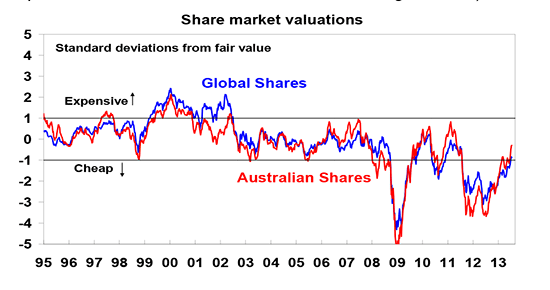
A big part of the strong returns over the last year has been the unwinding of the excessive fear of a Eurozone implosion triggering a global double dip recession. This along with worries regarding the US and China, had seen shares pushed to very cheap levels which provided a good lift off for when confidence improved. But after 20% plus gains shares are no longer so cheap. This can be seen in the next chart which shows valuation measures for global and Australia shares (which are based on a range of measures including price to earnings multiples, dividend yields and a comparison of the yields on shares to that on bonds aggregated and expressed as standard deviations with an average of zero).

Source: Bloomberg, AMP Capital
However, while shares are no longer dirt cheap they are not yet expensive either. Cyclical bull markets in shares typically go through three phases with the first phase being driven by the unwinding of cheap valuations and low interest rates, the second phase driven by stronger profits and the third phase being a blow off as investor confidence becomes excessive pushing shares into expensive territory. Our assessment is that we are entering the second phase of the cycle and as such the cyclical/profit backdrop is becoming more important.
The economic cycle – slowly on the mend
2010, 2011 and 2012 were each characterised by mid-year growth scares which were initially triggered in Europe but then spread to the US and elsewhere. However this has not happened this year. In fact the recent correction in global shares was triggered by talk of slowing or tapering the pace of monetary stimulus in the US in response to signs of more resilient growth. By region:
- The sense of crisis around whether the Euro will survive has receded. This is not to say that problems do not remain, but ECB President Draghi’s backed up commitment to do “whatever it takes” to defend the euro along with other measures has substantially lessened fears of contagion from one country to another. At the same time a gradual improvement in business conditions indicators suggest that growth is likely to return during the current half year.
- There are several reasons to believe that the gradual US recovery will continue: the housing sector is continuing to recover and looks on track to contribute around 1.5 percentage points to growth this year, business investment appears to be picking up, the jobs market is looking stronger and the shale oil/gas boom is providing a long term boost to the US.
- Abenomics has led to renewed optimism in Japan with deflationary pressures gradually receding and Japan possibly on track to see 4% growth through this year.
- While more than usual uncertainty appears to be hanging around the outlook for China, Government comments indicate that the lower limit for acceptable growth is 7% and it looks to be on track for 7.5% growth this year.
Reflecting this, the global manufacturing conditions PMI (based on an average of nearly 40 countries) is trending up, in contrast to a year ago when the trend was down.
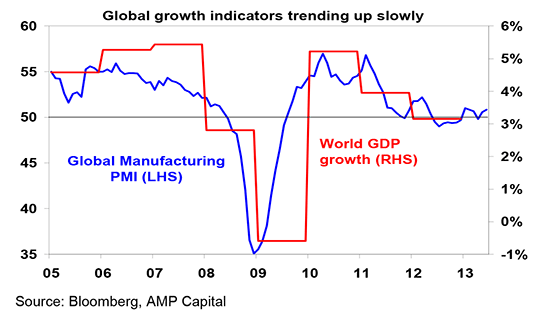

This suggests that global growth over the year ahead is likely to pick up a notch which should in turn underpin a modest improvement in profit growth.
In Australia, growth has slowed to around 2.5% and may slow further in the short term. While risks are on the downside, our assessment remains that the combination of very low interest rates and a lower $A will drive a modest pick-up in growth into next year, led by housing construction.
Global monetary conditions to remain easy
The past couple of months have seen much trepidation that the Fed is about to prematurely end its monetary stimulus program and interest rates will start to rise sooner than expected. However, this appears unlikely:
- The clear message from the Fed is that: first, a tapering of its monetary stimulus is contingent on the economy improving in line with its forecasts; second, there is no pre-set tapering timetable and in fact the pace of asset purchases could even increase if economic data disappointed; and, finally tapering will not bring forward the timing of interest rate hikes. The bottom line is that monetary policy will remain extremely accommodative for a while to come and when it becomes less so it will only be because the US economy is stronger.
- Both the European Central Bank and the Bank of England have signalled that monetary conditions in Europe will remain easy for an extended period and may even be eased further.
- In Japan monetary stimulus is set to continue until inflation rises to around 2%.
- In Australia, the RBA is expected to cut rates further.
The bottom line is that the monetary backdrop is set to remain supportive for investment markets. With plenty of spare capacity and inflation remaining low globally it’s hard to see monetary tightening any time soon.
Investor sentiment a long way from excessive
The last six months have seen an improvement in investor confidence towards share markets. But , coming from a low base it is a long way from the sort of excessive optimism that is associated with market tops. As the chart below shows, while US equity mutual funds have seen inflows this year, there is a long way to go to reverse the $US556bn in outflows seen over the previous five years. Similarly bond funds have a long way to go to reverse the $US1.1 trillion in inflows seen over the last five years. In other words as the “irrational exuberance for safety” seen since the GFC reverses there is still a lot of money that can flow from bond.
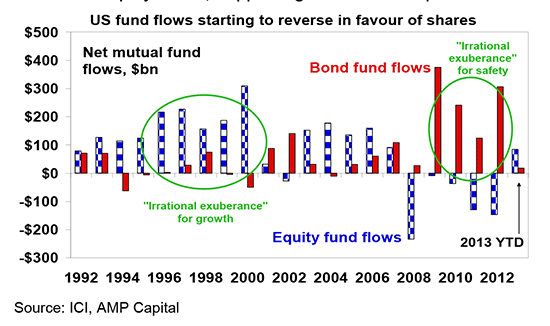

Similarly, in Australia the amount of cash sitting in the superannuation system is still double average levels seen prior to the GFC. In other words there is still a lot of money that can come into equity markets as confidence improves.
Concluding comments
Inevitably there will be a few bumps along the way with risks remaining regarding Europe, the US with another round of debt ceiling negotiations approaching, China and in Australia. However, while equity returns are likely to slow, the combination of still reasonable valuations, gradually improving economic conditions, easy monetary conditions and a lack of excessive optimism suggest further solid gains ahead. Low bank deposit rates are also likely to be a supportive factor for returns from growth assets, particularly those offering decent yields as investors are likely to continue to seek out alternatives to term deposits. This should also continue to support returns from property related assets although again at a slower pace than seen over the last year. While bond returns are likely to be modest reflecting low yields and the risk of capital loss as investors start to allow for eventual monetary tightening, solid returns from shares and related growth assets should ensure reasonable returns for diversified investment portfolios through the current financial year.
Dr Shane Oliver, Head of Investment Strategy and Chief Economist, AMP Capital