With an ageing population and increasing divorce rates, the demand for estate planning solutions will continue to grow rapidly in both the short and long-term.
For many advisers, the term ‘estate planning‘ conjures up thoughts of complex, highly technical advice solutions such as wills and testamentary trusts. Whilst some aspects of a comprehensive estate planning process can indeed be complicated, advisers are ideally placed to act as a ‘facilitator’ of such a process, bringing in highly qualified specialists as required.
Background
With more than 45% of Australians not having a valid will, an ageing population and the amount of household wealth available for transfer by bequest in 2030 is set to surpass $70billion, there is a clear and significant disconnect between the need for estate planning solutions and the current usage of those solutions.
The 2006-07 Family Characteristics and Transitions Survey (FCTS) highlighted the stark realties facing families in modern Australia with a specific focus on the impact of divorce:
Of the 4.8 million children aged 0 to 17 years in 2006- 07, just over 1 million (22%) had a natural parent living elsewhere.
Indeed, considering that around one third of all marriages end in divorce, and half of all divorces involved children under the age of 18, the increasing prevalence of ‘blended families’ and the resultant complications in estate plans reinforce the need for an advice solution that is accessible.
Add to this the life risks that insurers like Zurich know all too well:
- Over 60,000 Australians will have a stroke this year (that’s one every 10 minutes)
- 684,000 Australians are estimated to have chronic heart disease.
- 1 in 2 men and 1 in 3 women will be diagnosed with cancer before they turn age 85
- More than 110 Australians will die of cancer every day
- There are estimated to be over 800,000 diabetics in Australia. Diabetics are 5 times more likely to have a stroke and 10 times more likely to have a heart attack.
And there are – indeed overwhelming – cultural, social and economic factors driving an increased need for estate planning advice, representing a fantastic opportunity for financial advisers to provide meaningful assistance to their clients and the community at large.
Aside from the significant demographic trends which are driving growth in demand for estate planning solutions, there are 4 major benefits of applying an estate planning methodology across your business (rather than thinking of it as a service relevant only to your older clients):
- It can uncover new opportunities for advice with your active clients
- Insurance
- Business succession
- SMSF advice
- Intergenerational advice
- It can be a cost effective way of re-engaging with inactive clients
- It can be an easy to articulate, high value-add proposition to take to your referral partners
- It can add significant flesh to your proposition and can be reflected in your Fee Disclosure Statement
Why build capabilities around estate planning advice
To succeed in reatining and capturing assets during the coming intergenerational wealth transfer, advisers should develop end-to-end strategies rather than disconnected solutions, focusing on the following key areas:
Estate Planning
Family estate planning is critical during the wealth transfer period and will be an effective tool in attracting and retaining clients. The more an adviser knows about the Boomers’ and their heirs’ plans, the more they can do to proactively retain their assets. Advisers have been investing in advancing their wealth planning tools and customer relationship management (CRM) systems. While the primary focus of these systems is to support the proposal process and improve the depth of current relationships, some of the same information can be leveraged to increase client engagement on topics related to estate planning.
Make deliberate plans to help clients navigate their inheritances
A Canadian study[1] shows 39 percent of Canadians whose parents have a will have not explicitly reviewed it with their parents, and 61 percent who have deceased parents stated they never discussed it with their parents before they passed away.
By supporting the heirs during the difficult experience of a death in the family and making the process less stressful, advisers can solidify existing relationships or establish new ones with the heirs.
Advisers may consider establishing client-facing operational groups that specialize in the transfer process and support their clients in navigating this unfamiliar and unpleasant exercise.
The richness of the client interactions can be improved by investing in capabilities that increase the convenience to the client.
Whether it is led by an adviser or a specialized service, the experience should be a high-touch, branded, and personalized service that wows the clients, generates trust and makes them want to continue a relationship with the firm – regardless of the value proposition they prefer.
Establish go-to-market strategies to “catch” heirs now
Matching the heirs with their offerings of choice and “wowing” them is an important step towards retaining assets transferred across generations. According to research[2] done by Phoenix Marketing International and Cerulli Associates, dissatisfaction with current and previous provider relationships is the main reason investors left their providers, and only one out of every two wealth management clients in the 30-49 age group, which stands to inherit from the Boomers, is satisfied with their primary wealth provider. This suggests many advisers are at risk of losing these clients right at the point where their value is about to increase significantly.
To strengthen the relationships with the heirs, advisers can consider multiple approaches in tailoring their offerings including creating collective allocation models that enable managing self-directed assets alongside managed assets, bundling products around life stages, and expanding the product set to include cash management, debt management, and insurance.
Typical estate planning instruments
- Wills
- Advanced Care Directives (sometimes called ‘living wills’)
- Testamentary trusts
- Business Succession Plans
- Insurance solutions
- Power of Attorney
- Superannuation beneficiary nominations
Be prepared to ask the difficult questions
As with most aspects of the advice process, doing the job properly often involves questions which can be uncomfortable for the adviser and confronting for the client:
- What is the state of your marriage?
- Do you have any other descendants?
- Do you have any health issues?
- Who will bring up your children if you and your partner died
- Are your adult children in stable relationships?
- Do you have any children with financial, health or legal issues?
Increasingly advisers are able to access a variety of online tools that can make the discovery process more comfortable for both parties, thus encouraging more honest and comprehensive answers. These tools range from simple online self assessments to comprehensive report producing tools.
Be the facilitator, rather than the subject matter expert
The most successful advisers recognise their strengths, and which services are more suitable for outsourcing. Just like a surgeon needing a specialist anaesthetist, outsourcing a service does not have to mean ceding control or oversight of that process, and estate planning solutions are a perfect example of how a financial adviser can still facilitate the components of the process and co-ordinate them into a cohesive all-encompassing solution.
Being seen as an expert willing to bring in external specialists can also strengthen your own brand and elevate your standing as a professional.
Every adviser should aim to have a network of lawyers and accountants they work with, not just as referral sources but as true members of a virtual team, all focussed on same end goal for your clients.
When seeking a partner – for example a lawyer – to work in a field such as estate planning, remember that just like surgeons, they too tend to specialise, so make sure you find one who is genuinely experience in testamentary trusts, or wills, or buy sell agreements.
Resources to get you started
The following process is a good starting point, and involves working with Centres of Influence to identify clients who may benefit from estate planning advice and solutions.
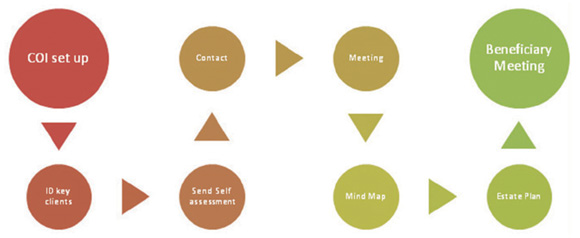
One of the key tools in this process is a self assessment questionnaire. It’s’ designed to get someone thinking about issues they may have overlooked in terms of estate planning and their personal, financial and business situation. It allows them to consider sensitive questions in their own environment. We have attached a sample for your reference. You can use this as is, or tailor to your needs or that of the client. It’s initially intended as a thought provoker which makes them more receptive to your call when you follow it up (because they will have already self identified areas where they have no plans). This means it doesn’t matter if they send it back to you. (Once you get to the stage of an appointment you will go though a comprehensive fact find anyway.)

Notes
1. Investors Group Survey Feb 2012 ‘Trillion Dollar Wealth Transfer – Myth or reality?’
2. Cerulli Associates: Cerulli Quantitative Update-Retail Investor Provider Relationships 2011 (based on data from Phoenix Marketing International, Cerulli Associates)
Other sources
a. Australian Bureau of Statistics, 2004, ‘Household and Family Projections, 2001 to 2026’.
b. Australian Bureau of Statistics, 2008, ‘Family Characteristics and Transitions’.
c. Accenture, 2012, ‘The Greater Wealth Transfer: Capitalising on the Intergenerational Shift in Wealth’.
d. AMP.NATSEM, 2003, ‘Income and Wealth Report’, Issue 5.
e. National Seniors Australia, Productive Ageing Centre, 2012, ‘It’s not just about the money : intergenerational transfers of time and money to and from mature Australians’.
—————