Investment markets and key developments over the past week
While US and Australian shares were little changed over the last week, other markets managed good gains. Eurozone shares were helped by optimism a Greek deal would be reached and better economic data and Japanese shares broke out to a 15 year high. Chinese shares also rose ahead of the Lunar New Year holiday. Australian shares saw more mixed earnings results but were supported by the takeover of Toll by Japan Post and expectations there may be more such deals. Bond yields rose but despite the risk on tone commodity prices fell slightly. The $A managed to get back just above $US0.78.
Greece getting closer to an interim loan deal. Greece has now put in a request for a six month extension to its interim loan program that appears to meet most of the conditions set by Eurozone finance ministers. While there is more to go before an extension is agreed the Greek back down suggests an agreement is in reach. Once it is agreed attention will then turn towards negotiating a longer term program and this is likely to allow Greece to run a somewhat lower budget surplus. However, there will be a long way to go before agreement on that is reached – so Greece will remain in the headlines for a while yet. However, with other peripheral countries now in better shape, Italian and Spanish bond yields around record lows and Eurozone economic data continuing to point to improved growth we don’t see a major threat to Europe. In fact, Eurozone shares continue to look relatively attractive.
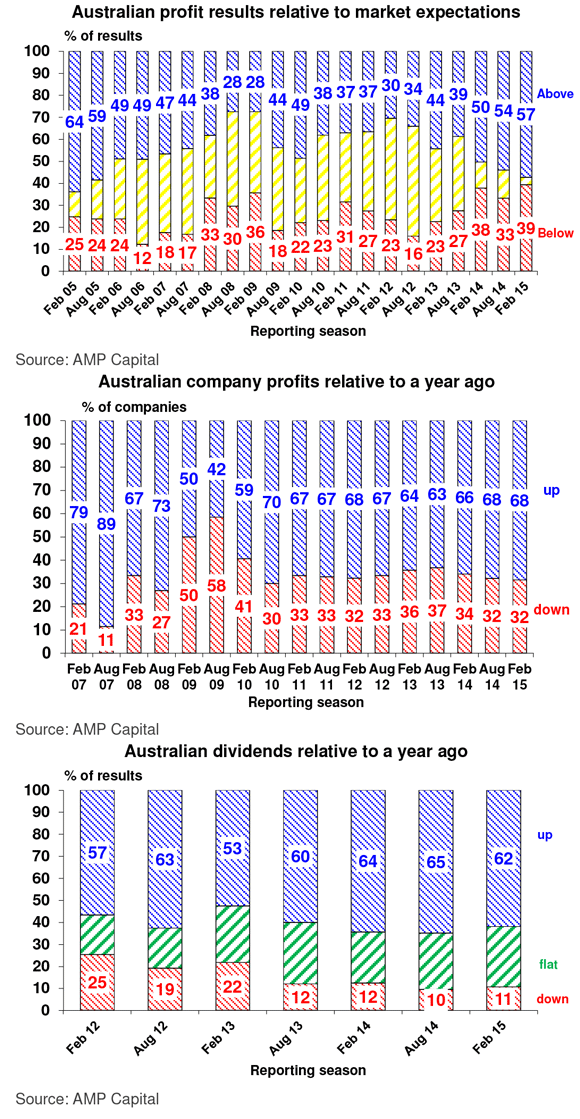
The Australian December half profit reporting season is now 60% done. While we have seen the usual pattern of good results being released early resulting in some deterioration over the past week, overall results remain better than feared. 57% of results have beaten expectations against a norm of 45%, 68% have seen profits rise from a year ago, 54% have seen their share price outperform the day results were released and 62% have increased their dividends. Key themes have been falling profits amongst resources and mining services companies, but continued strength for the banks, ongoing cost control and solid growth in dividends. With the share market now trading on an above average forward PE of 15.5 times, the market has become very sensitive to companies that under or over deliver relative to expectations and so we have seen some significant share price reactions. Through all the noise though consensus earnings expectations for this financial year and next are little changed from where they were before the results started to flow. The consensus is for earnings growth this financial year of 1% with resources -25% but industrials +10% and banks +8%.

Major global economic events and implications
In the US, the minutes from the last Fed meeting offered little that was new. The Fed is clearly grappling with cross currents in terms of economic activity data and inflation and feels that it can be patient in moving to raise interest rates. Arguably there was a slight bias away from June for the first rate hike out to around September. Economic data released in the US if anything added to the case for a later move. While jobless claims fell, the NAHB home builders survey, housing starts and permits and a couple of regional manufacturing conditions surveys all softened slightly, industrial production rose less than expected and both headline and core producer prices came in weaker than expected.
The Eurozone continues to look like its picking up pace with another improvement in the ZEW investment analysts’ survey and in consumer confidence supporting this.
After the sales tax driven recession mid last year, Japan has returned to growth. However, December quarter GDP was weaker than expected at just 0.5% quarter on quarter. While the Bank of Japan made no changes to monetary policy as they are still waiting to assess the impact of the expanded measures announced last November, more easing is likely to be required this year which in turn is likely to maintain downwards pressure on the value of the Yen.
Chinese residential property prices continued to fall in January but at a slower pace. Average prices fell 0.4% month on month, compared to 1% monthly falls earlier last year and tier 1 cities saw a 0.1% price gain. However, while property price declines have slowed prices are still falling and pose a threat to the economy. Given the soft start to growth indicators and inflation this year we remain of the view that further Chinese monetary easing is likely ahead.
Australian economic events and implications
The minutes from the last RBA Board meeting offered little that was new and in any case they were pretty dated anyway given that the Statement on Monetary Policy and Governor Steven’s Parliamentary testimony had been released since. It’s not really surprising to learn the RBA had debated whether to ease in February or March – many of those looking for an easing grappled with the same issue. The RBA’s sub-trend outlook for growth, low inflation and assessment that a lower $A is likely needed all point to an easing bias. We continue to see another rate cut in the months ahead.
What to watch over the next week?
In the US, the main focus is likely to be on Fed Chair Janet Yellen’s Congressional testimony (Tuesday and Wednesday) which is likely to confirm that the Fed remains on track to raise interest rates this year, but can be patient in doing so. Meanwhile, data for new and existing home sales (Monday and Wednesday) are likely to show slight falls after strong December gains but with pending home sales (Friday likely to be up, home prices (Tuesday) are likely to have risen further in December and durable goods orders (Thursday) are likely to show a decent rise after a few soft months. Of particular significance, December quarter GDP growth (Friday) is likely to have been revised down further to a 2% pace and inflation is likely to fall to -0.1% year on year at a headline level with core inflation falling to just 1.5% year on year. Both of which are likely to add to the case for the first Fed rate hike to come later in the year rather than in June.
In Japan, January data for household spending, industrial production and the labour market will be watched on Friday for signs that the recovery that commenced last quarter is continuing. January inflation data will also be released.
The flash HSBC China manufacturing PMI (Wednesday) will likely remain softish.
In Australia, December quarter data is expected to show that wages growth (Wednesday) remains at record lows with annual growth of just 2.5%, December quarter construction data (also Wednesday) is likely to be weak with strength in housing offset by weakness in mining related engineering construction and business investment data (Thursday) will be watched for signs of improvement in non-mining investment plans. Private credit data will be released Friday with the main interest being whether housing investor credit is breaching APRA’s 10% growth limit.
The Australian December half profit reporting season will wrap up with over 80 major companies reporting including BHP, QBE, Worley Parsons, Qantas and Woolworths.
Outlook for markets
Notwithstanding the risk of a correction – potentially as the Fed eventually moves to raise interest rates – the broad trend in shares is likely to remain up as: valuations, particularly against bonds, are good; economic growth is continuing; and monetary policy is set to remain easy with further easing in Europe, Japan, China and Australia and only a gradual tightening in the US. As such, share markets are likely to see another year of reasonable returns.
Commodity prices have been seeing a bounce from very oversold conditions, with oil in particular looking like it may have built a short term base around $US45/barrel. However, excess supply for many commodities is expected to see them remain in a long term downtrend.
Low bond yields point to soft medium term returns from sovereign bonds, but it’s hard to get too bearish in a world of too much saving, spare capacity and deflation risk.
Short term gyrations aside, the downtrend in the $A is likely to continue as the $US trends up and reflecting the long term downtrend in commodity prices and Australia’s relatively high cost base. We now expect a fall to around $US0.70, with the risk of an overshoot. However, the $A is likely to be little changed against the Yen and Euro.
By Shane Oliver, AMP Capital
————