Investment markets and key developments over the past week
The “risk on” rally fired up again in some markets over the last week helped by dovish comments from Fed Chair Janet Yellen that pushed the $US and bond yields down and US and Eurozone shares higher. However, Chinese, Japanese and Australian shares fell with worries about more bank bad debt charges weighing in the case of the latter. The weaker $US saw the $A rebound making it above $US0.77 at one point, although oil prices were flat and metal prices down.
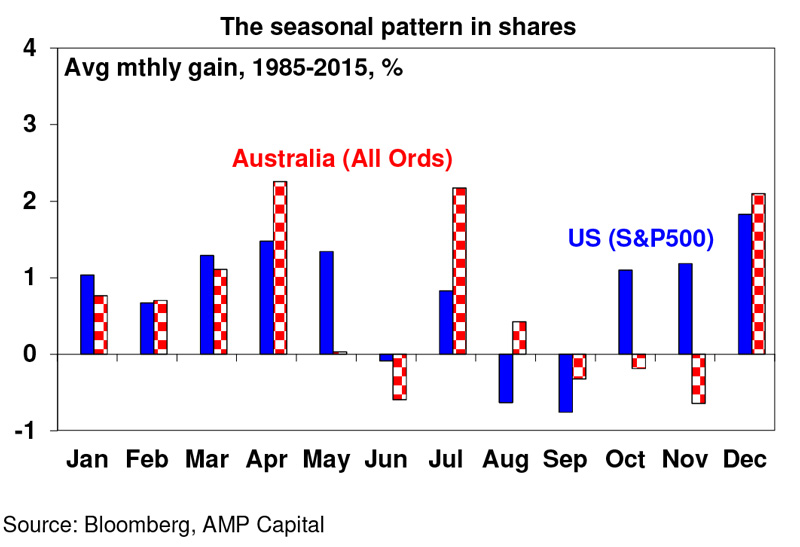
For March shares had a good rebound ranging from 2% in Europe to 9.9% in China with Australian shares up 4%, after the rough start to the year in January and February as global growth worries receded, the $US and Renminbi stabilised and commodity prices improved. Historically, April has been a good month from a seasonal perspective but the period from May can be rough.

The key message from Janet Yellen remains that the Fed will be cautious in raising interest rates reflecting global risks, weak US inflation expectations and the asymmetric ability of the Fed to respond to downside as opposed to upside threats. Quite clearly Janet Yellen would rather risk being too easy than too tight because the Fed’s ability to respond to lower growth and inflation is more limited that its ability to respond to higher growth and inflation. In this sense she doesn’t want to do anything to exacerbate global risks because of the potential blow back to US growth and inflation. While some regional Fed presidents lean hawkish as we heard immediately after the last Fed meeting, its likely Yellen has the support of a clear majority including the Fed governors and the New York Fed President. An April hike looks very unlikely and a June hike remains our base case but the probability is only around 55% in my view, particularly with the Brexit vote coming a week after the June meeting so the next hike could even be delayed till the July meeting if there is much market tension ahead of the Brexit vote.
Bad debt worries are clearly weighing on Australian banks and the Australian share market generally. While the extra $100m in bad debt charges announced by one bank due to the resources slump is small, investors naturally worry that the bad debt cycle has now bottomed and like cockroaches if there is one downgrade there are likely to be more. So the concerns could linger for a while. Putting it all in context though resources related loans are only around 2% of total loans for the big four banks.
Major global economic events and implications
US economic news was mostly good. The goods trade deficit expanded in February and household spending data for January and February were soft, but against this pending home sales rebounded, consumer confidence improved in March, labour market indicators were solid and regional manufacturing surveys continued to show an improvement in conditions in March. No signs of recession here. While the Atlanta Fed’s data tracker points to just 0.6% annualised growth for the March quarter just passed its noteworthy that over the last 20 years March quarter GDP growth in the US has averaged just 1% only to bounce back to an average 3% in the June quarter. (Looks like a seasonal glitch that the Bureau of Economic Analysis is failing to adjust for. Maybe they are still to work out that it’s usually cold in January and February!). Meanwhile, the core private consumption deflator which is the Fed’s preferred inflation measure slowed again in February leaving annual inflation at 1.7%.
Eurozone economic confidence fell in March but remains at levels consistent with reasonable growth and private lending growth picked up in February which is a positive sign given pressure on banks at the time.
Japanese economic data was mostly favourable with a surprise gain in real household spending, solid jobs data and a rise in small business confidence. Industrial production fell sharply in February but this mainly appears to related to lunar New Year distortions and a temporary shutdown at a car plant. March quarter Tankan business conditions and confidence readings were disappointing though.
There was also some good news out of China with the official and Caixin business conditions PMIs in March by more than expected and consumer confidence rising to its highest since September last year. It’s looking like Chinese growth is stabilising and policy stimulus measures are starting to impact.
Australian economic events and implications
Australian data was mostly good. Credit growth remained moderate in February with housing lending to owner occupiers continuing to accelerate but lending to investors continuing to slow, new home sales fell 5% in February and remain in a downtrend consistent with slowing building approvals, home prices rose modestly in March with ongoing confirmation of a loss of momentum compared to last year but job vacancies continue to run around levels consistent with solid employment growth and the AIG’s manufacturing conditions PMI rose to a booming reading of 58.1. In fact, the Australian manufacturing PMI is amongst the highest in the world, testament to the boost provided by the fall in the $A since 2011. The qualifier though is that it’s likely dependent on the $A remaining low in contrast to its recent rebound.
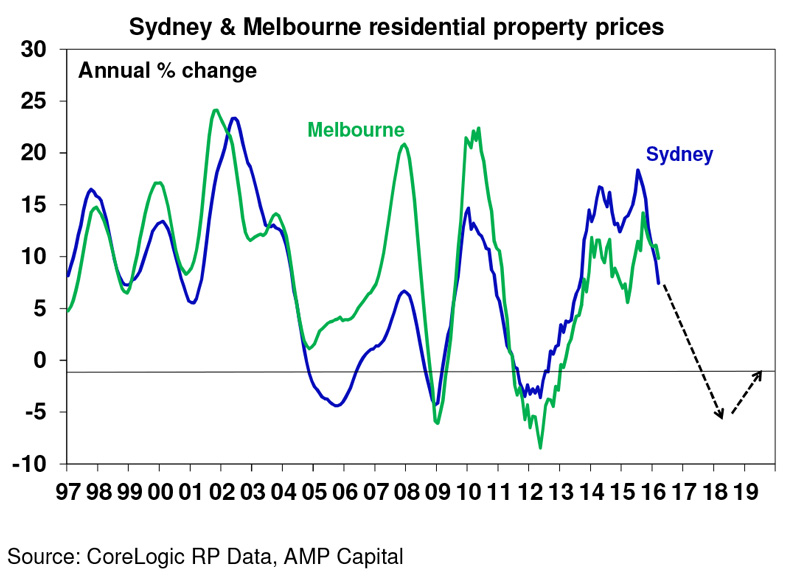
The loss of momentum in national average house price is clearly due to Sydney which has really come off the boil. A further slowing is likely ahead with a modest cyclical decline in prices likely around 2017-18. In the absence of significant rate hikes or a recession it’s still hard to see a property crash though.

Thought bubbles and tax kites. While I can understand where the Federal Government is coming from in suggesting states could levy their own income taxes (it could help promote accountability at a state level) reverting to the multiple state based tax rates of the past would not be good if we want to promote tax efficiency across the economic union that is Australia.
What to watch over the next week?
In the US, the minutes from the Fed’s last meeting (Wednesday) will be rather dated given Chair Janet Yellen’s comments in the last week, but another speech by her on Thursday will no doubt be watched closely. On the data from the non-manufacturing conditions ISM is likely to show a slight improvement and February trade data and labour market indicators will also be released (all on Tuesday).
In Australia, the RBA (Tuesday) is likely to leave interest rates on hold for the 11th month in a row. We continue to see another rate cut in the months ahead: as mining investment continues to unwind; the contribution to growth from housing looks like it will slow; to offset possible further out of cycle bank interest rate hikes; as inflation remains low; and to help push the $A back down. However, it’s doubtful that the RBA is ready to make a move just yet particularly with recent good readings on GDP growth and unemployment. However it is likely to retain an easing bias and most interest will focus on whether it responds to the 7% gain in the value of the $A since its last Board meeting by a bit a jawboning to try and get it lower again consistent with Governor Steven’s comment that it “might be getting ahead of itself”.
On the data front in Australia expect February data to show a 0.4% gain in retail sales, a 1% bounce in building approvals but in an ongoing downwards trend (both Monday) and another large trade deficit of around $2.8bn (Tuesday).
Outlook for markets
After strong gains from their February lows shares are overbought and vulnerable to a pull back. Beyond the near term uncertainties though, we still see shares trending higher this year helped by a combination of relatively attractive valuations compared to bonds, further global monetary easing and continuing moderate global economic growth.
Very low bond yields – with 25% of global sovereign bonds now having negative yields – point to a soft medium term return potential from them, but it’s hard to get too bearish in a world of fragile growth, spare capacity, weak commodity prices and low inflation. Bonds in higher yielding countries like Australia, the US and maybe even China are relatively attractive.
Commercial property and infrastructure are likely to continue benefitting from the ongoing search by investors for yield.
National capital city residential property price gains are expected to slow to around 3% this year, as the heat comes out of Sydney and Melbourne. Prices are likely to continue to fall in Perth and Darwin, but growth is likely to pick up in Brisbane.
Cash and bank deposits are likely to continue to provide poor returns, with the RBA expected to cut the cash rate to 1.75%.
The ongoing delay in Fed tightening and stronger data in Australia pose further short term upside risks for the $A. However, any further short term strength in the $A is unlikely to go too far and the broad trend is likely to remain down as the interest rate differential in favour of Australia narrows as the RBA eventually resumes cutting the cash rate or at least resorts to jawboning and the Fed eventually resumes hiking, commodity prices remain weak and the $A undertakes it’s usual undershoot of fair value.
By Shane Oliver, AMP Capital