

Adele Oshannassy
Trying to find a reasonable income stream can be difficult at the best of times. In recent times, it has become a monumental task.
The bellwether for income is the yield of Australian 10-year government bonds. Although the yield has increased over the last 12 months, it remains materially below the long-term average.


This yield dynamic has given rise to investors accepting higher levels of risk in search for greater income.
Enter market neutral strategies
In the search for greater levels of income, investors have turned towards higher risk asset classes such as equities, infrastructure and property. Whilst these asset classes can be a strong source of income, they may be inappropriate for investors who are uncomfortable with the associated level of market risk.
We believe an alternative investment option to consider is equity market neutral strategies, which have the potential to produce meaningful levels of income.
Sources of income for market neutral strategies
Equity market neutral funds have multiple income levers, outlined below.
- Realised capital gains: equity market neutral strategies typically have a shorter-term focus than their long-only peers, taking advantage of price discrepancies and dislocations. As such, portfolio turnover for market neutral strategies can be substantially higher than long-only peers, which results in more frequent realised capital gains. Under unit trust law, realised gains are required to be distributed annually.
- Proceeds from sold options: the premium received from selling call and put options is a source of income.
- Income from collateral and stock dividends: income can also be derived from the structure of market neutral strategies. When managers initiate short positions, the cash proceeds received from selling a position short are held by the fund’s prime brokers in an interest earning account. However, in some cases, the cost of borrow to short the stock may offset the interest received. In addition, market neutral funds receive dividend income from stocks.
- Franking arbitrage: under Australia’s taxation structure, franking credits are payable to domestic holders only. In the instance where a foreign entity holds a dividend-paying company, they’re not entitled to the franking. This regulatory nuance allows a fund to hold long positions in domestic dividend-paying stocks, which are entitled to franking credits. However, short sold positions will typically be sourced from offshore lenders, which means that the fund is not required to pay franking credits to the lender. It’s important to note that funds are not entitled to franking credits if insufficient exposure (a minimum of 30% effective risk to the position) to a stock is maintained.
How do the income characteristics of our rated market neutral funds compare to other asset classes?
We’ve compared the average annual income[i] of our rated market neutral funds over the last five financial years to benchmarks of other traditional asset classes. In addition, we assessed this income generation against annualised volatility over the same period.
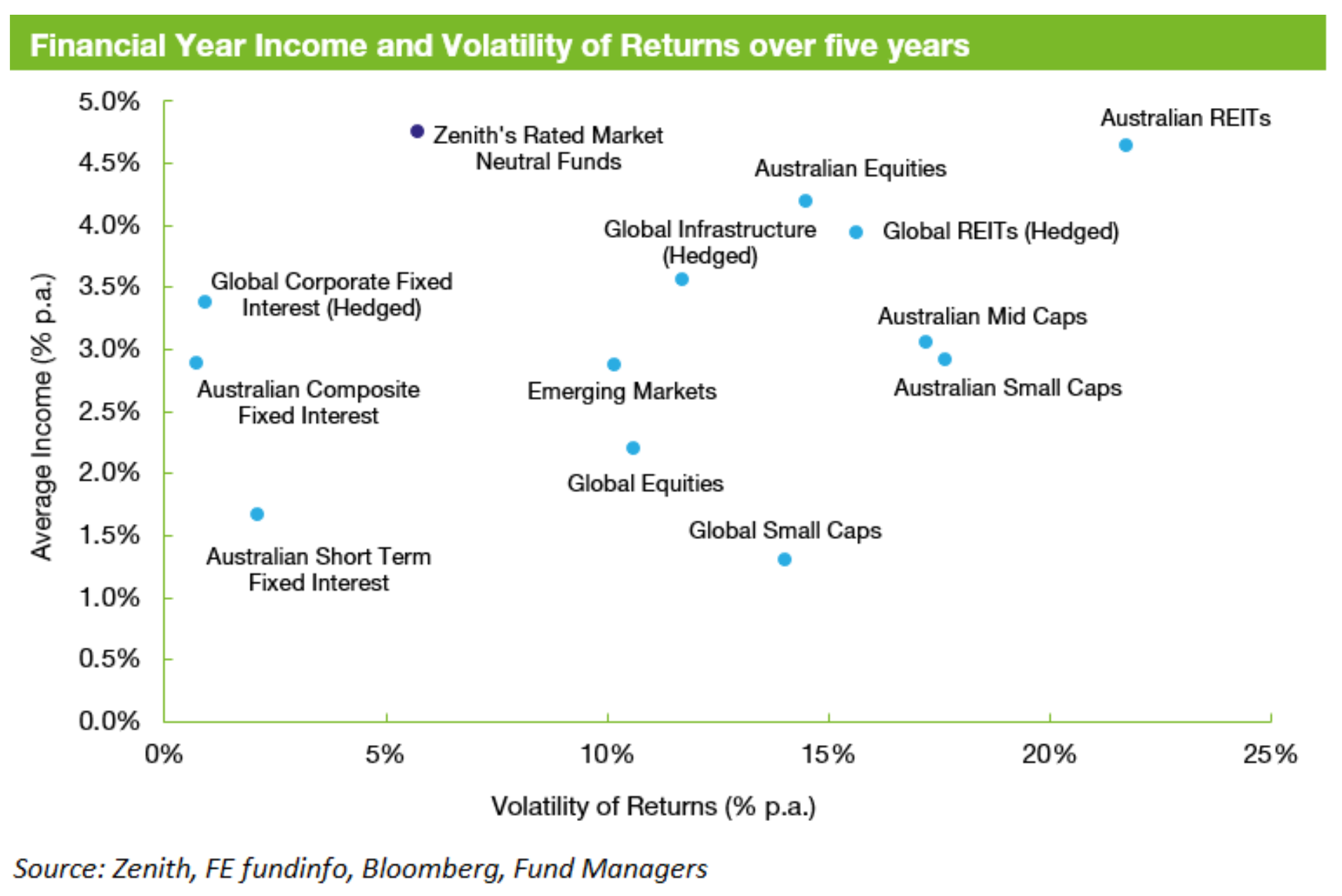

Over this period, our rated market neutral funds averaged 4.75% p.a. of income, as shown on the vertical axis. This was higher than any of the benchmarks analysed, with the next highest being listed Australian property (S&P/ASX 200 AREIT), averaging 4.65% p.a. of income.
The volatility of the average monthly return series of our rated market neutral funds was 5.72% p.a. This was significantly lower than the volatility of the growth benchmarks analysed. For example, the listed Australian property market, the highest income paying benchmark over the period, recorded a volatility of 21.73% p.a.
The volatility of capital base can have meaningful implications on the consistency of the final distributions received by investors. For investors seeking a dependable, steady stream of income, we believe capital base stability is paramount.
Over the five-year period, our rated market neutral peer group generated an average 0.85% p.a. in additional income via franking credits, which brings the gross income of market neutral funds to 5.60% p.a. on average.
Beware of variability in income
While the average income over the last five financial years of rated market neutral funds may be an attractive outcome to many investors, it’s worth noting the variability between the funds’ income properties.
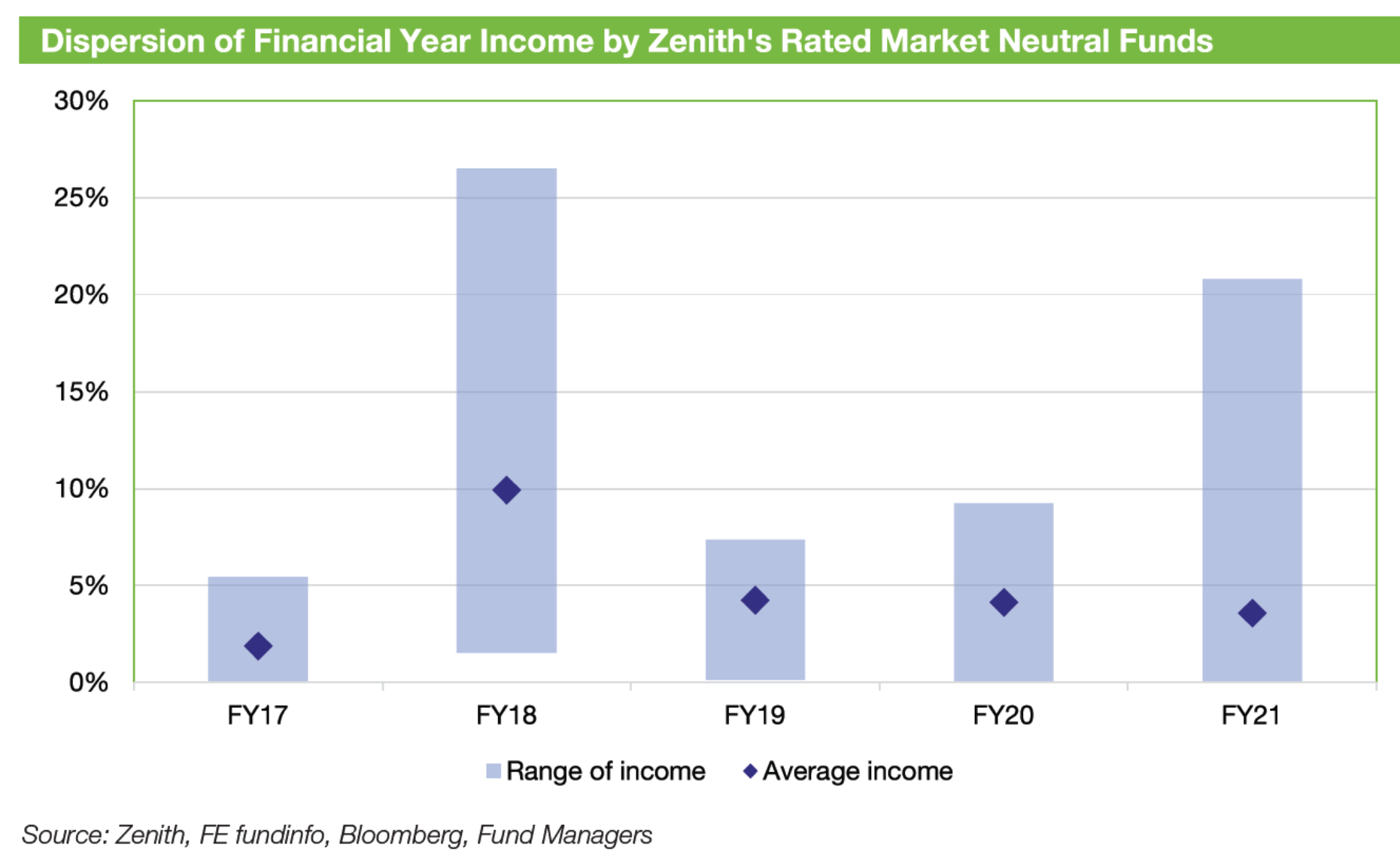

One reason for this variability is the significant differences between the funds’ investment objectives, portfolio constraints, portfolio turnover and use of options; all of which can impact the resulting income profile for a fund.
Another reason for this variability is that, for funds that qualify as an Attribution Management Investment Trust (AMIT), there’s additional flexibility for tax treatments, with investors taxed on the taxable net income that’s ‘attributed’ to them on a ‘fair and reasonable basis’. Under the regime, a fund is not required to distribute all its income (including capital gains) to ensure it does not pay tax and, hence, may accumulate income in the Fund.
It’s important for investors to seek professional tax advice if this is an important element in their investment decision.
Is there a trade-off?
Whilst many of our rated market neutral funds produced a high income and low volatility profile, investors must also be cognisant of the total return.
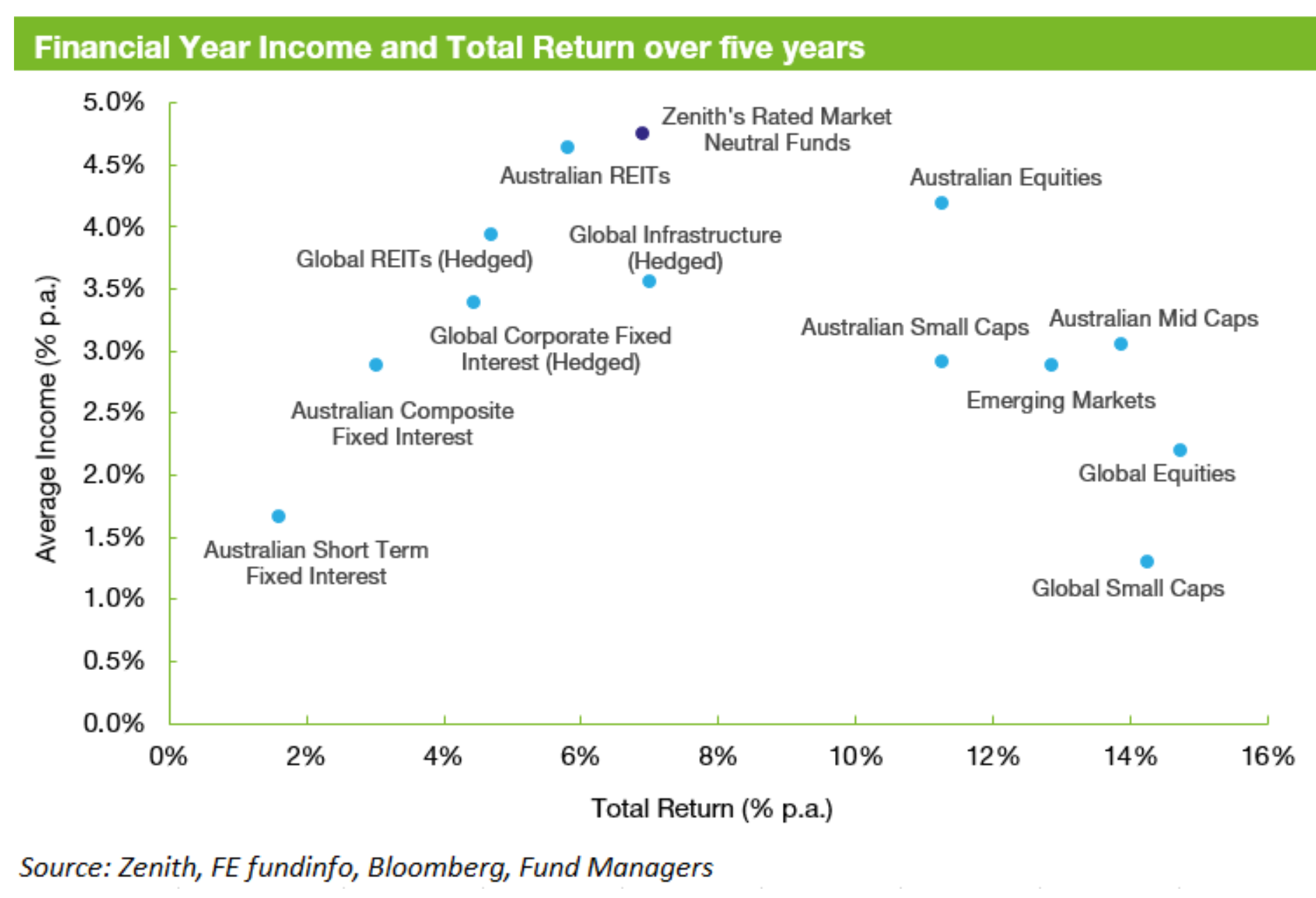

In the chart above, the total return of the average monthly return series of rated market neutral funds was 6.90% p.a. over the five years to 30 June 2021.
This was materially less than various other equity benchmarks, such as global equities (MSCI World ex Aust $A), returning 14.73% p.a. for the five-years ending 30 June 2021.
This outcome is expected, given that the primary objective of many market neutral funds is to deliver positive absolute returns with a focus on capital preservation.
Market neutral funds – an alternative source of income
On average, our rated market neutral funds have delivered a respectable total return, whilst also generating a relatively high level of income at a relatively low level of risk. In addition, given their low correlation to other asset classes, market neutral funds have offered investors diversification benefits to an overall portfolio.


By Adele O’Shannassy, Investment Analyst
——–
[1] The analysis does not consider franking credits associated with distributions