
CPD: Trust – the unseen foundation of ethical financial advice

Build trust with your clients will contribute to running an ethical advice practice.
Trust sits at the heart of every successful financial advice relationship. In this article, proudly sponsored by GSFM, the importance of the trust relationship and its link to ethical practice is explored.
At the heart of the adviser-client dynamic lies trust, which the Oxford Dictionary defines as the conviction that someone is sincere, honest and reliable. This foundational element mirrors the very values of honesty and fairness that anchor the Financial Planners and Advisers Code of Ethics (the Code). Ultimately, the Code’s standards – such as mandating integrity and prioritising the client’s best interests – serve to put this definition into practice.
While it cannot be measured on a balance sheet or captured in a performance report, trust is one of the most valuable assets an adviser can build. It is earned through consistency, integrity and a genuine commitment to putting clients’ interests first.
For financial advisers, ethical conduct is more than a regulatory obligation, it’s the foundation upon which trust is built. The best interests duty and the Code provide an important framework, but their true value lies in how they shape everyday decisions, conversations and client relationships.
In an industry where clients often seek guidance through some of life’s most significant milestones, trust is the intangible asset that sets exceptional advice apart. It is what gives clients confidence that their adviser understands their goals, respects their circumstances and is committed to helping them achieve better outcomes.
There are times when trust has been a challenge for the financial advice profession. ASIC’s 2019 report[1] explored consumer attitudes towards financial advice, including barriers to seeking advice. It found that while Australians recognise the expertise advisers can provide, concerns about cost, accessibility and lack of trust remain barriers for some consumers.
However, research increasingly shows that when advisers act in their clients’ best interests and deliver meaningful value, trust becomes one of the profession’s greatest differentiators. The Financial Advice Association Australia’s Value of Advice Index[2] highlights the critical role trust plays in the adviser-client relationship. It found trust in financial advisers was reported at an all-time high, with 94% of advised clients saying they trust their adviser to act in their best interests.
When trust is misplaced
Despite high levels of trust in advisers, there are times when it is misplaced. In recent times, headlines have been dominated by the collapses of the First Guardian and Shield master funds. These provide an unfortunately clear illustration in recent history of a trusted relationship functioning perfectly on the surface while failing completely underneath.
Around eleven thousand Australians invested roughly $1.1 billion in these two funds[3]. Many of these investors hadn’t sought out these investments themselves; instead, people were contacted by lead generators and referred to financial advisers, who then told them to roll their superannuation into a chosen fund or set up a self-managed super fund to invest in First Guardian. To the investor, this looked like ordinary advice. A professional had assessed their situation and made a recommendation. The relationship carried every outward marker of trust: a licensed adviser, a regulated superannuation system, paperwork that looked in order.
What made this possible wasn’t a single bad actor slipping through the cracks. It was a chain of gatekeepers, advisers, platforms and trustees, each one relying on the layer above or below it to have done the checking. Some platforms did their due diligence properly and refused to list these funds at all. Others didn’t, and, with the 20/20 vision of hindsight, the concentration of money flowing through a small number of advisers should have raised questions long before it did.
This is what makes the case useful for thinking about trust rather than just compliance. Nobody investing their super believed they were taking a risk on an unvetted product. They believed they were following professional advice, which is exactly the point. The mechanism of trust, an adviser telling a client what to do with money the client couldn’t independently evaluate, worked exactly as designed. What was missing was the substance that’s supposed to sit behind it: genuine, disinterested assessment of whether this was actually in the client’s best interest.
Standard 12 of the Code is worth naming directly here; it is the one standard that isn’t really about a single adviser’s conduct toward a single client. It’s about the profession policing itself, and it’s exactly this collective accountability that was missing in the Shield and First Guardian collapse. This standard asks advisers to hold their peers to account, not just themselves and the Shield and First Guardian collapse is an example of a headline grabbing trust breakdown that can have industry-wide ramifications.
 Genuine trust between advisers and clients, backed by advisers holding each other to account, is what stands between isolated failures and events that damage the whole profession’s reputation.
When trust is broken
Trust is a complex topic because it is intangible and personal. The factors that build and break trust can vary from person to person. However, one certain way to breach the trust of your client is to provide them with inappropriate advice and/or fail to act in their best interests. As well as being a trust breaker, such behaviour is also a clear breach of ethical standards.
The number of consumers who believe they’ve been given inappropriate advice or advice that is not in their best interest has increased according to the Australian Financial Complaints Authority (AFCA). In financial year 2025, AFCA received 4,193 complaints about investment and advice, an 18 percent increase on financial year 2024, when complaints had fallen to 3,559.
Further, AFCA’s calendar year 2025 data (a separate release from the FY25 annual review) shows investment and advice complaints jumped further to 5,816, up 58 percent, largely driven by First Guardian and Shield complaints.
AFCA’s chief ombudsman and chief executive, David Locke, linked the rise directly to systemic problems in how advice is delivered, saying the complaints data points to “systemic issues in advice models, particularly where conflicts of interest and inappropriate use of SMSFs are involved.”[4]
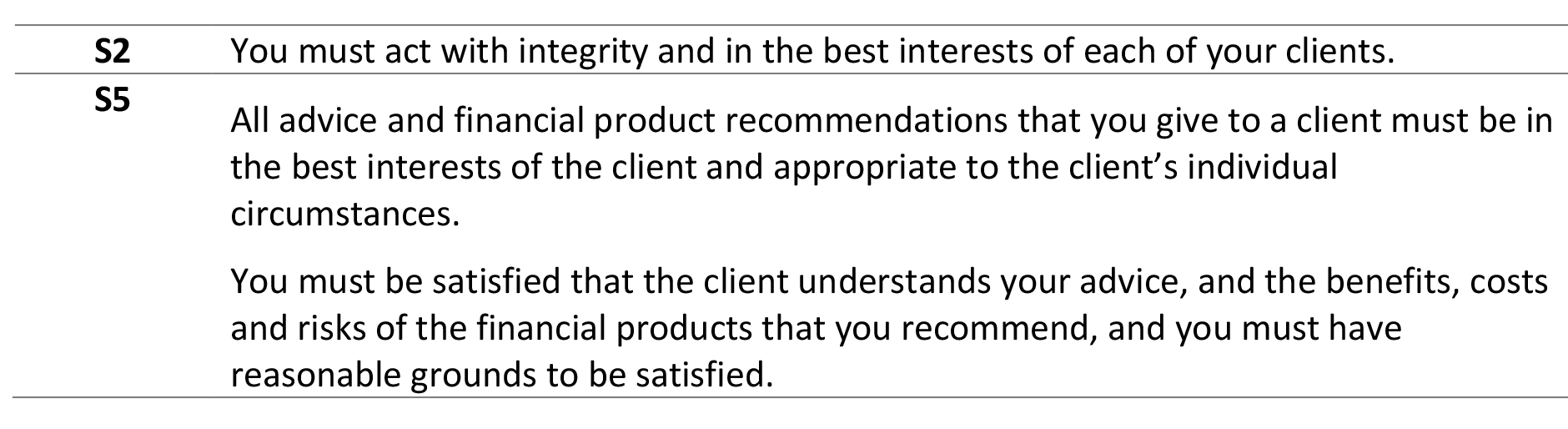
Claims of failing to act in the client’s best interest now dominate AFCA’s complaints in the investment and advice sector, overtaking inappropriate advice, which was the leading issue the previous year. While each case will have potentially breached a range of standards in the Code of Ethic, these cases – assuming they were upheld – will have most likely breached standards two and/or five.
 Once broken, trust is notoriously difficult to rebuild, particularly in financial advice where clients depend on advisers to act with absolute honesty and integrity. This trust can be eroded in many ways. Some are intentional, such as hidden fees or misleading advice, while others are external, like market downturns or economic shifts.
Yet, even when market forces are beyond an adviser’s control, clients may still feel betrayed if they encounter poor communication, negligence or a lack of transparency. Mending these relationships requires a sustained commitment to transparency, clear communication and prioritising the client’s financial well-being.
Building trust in an advice practice
Simply put, ethical behaviour is the foundation of trust. By adhering to the twelve standards of the Code, you naturally foster deep, lasting trust with your clients.
 Trust-building isn’t just a fair-weather strategy; it is forged in times of volatility. With ongoing geopolitical instability, sticky inflation, shifting interest rates and changes to CGT tax rules, your clients’ fortitude will likely be tested this year.
To safeguard your client relationships, consider these core pillars of trust:
- Ditch the jargon – meet client questions with honest, straightforward answers. Proactive communication about market risks can transform anxiety into confidence.
- Prioritise responsiveness – timely, efficient communication signals respect. Evasiveness or delays only breed doubt.
- Act as a true fiduciary – put each client’s financial wellbeing ahead of the practice’s bottom line. Deliver rigorous research and educate clients so they feel empowered rather than dependent.
Ultimately, trust is earned through consistent, integrity-driven actions. Cultivating transparency today secures the long-term client loyalty of tomorrow.
While a little dated (last updated in 2022), the CFA Institute Investor Trust Study examined investor trust dynamics that revealed three “trust enhancers” for financial advisers:
- Technology – investors have more trust in firms that use technology effectively.
What technology can you use in your practice to add value to clients? - Aligned interests – not only should you disclose and mitigate conflicts of interest (per Standard 3 of the Code of Ethics) you should also understand the client’s interests, goals and values and ensure their financial plan is appropriately aligned to them.
- Connections – at an organisational level, the research found that investors are increasingly using brands as proxies for trust. At the adviser level, personal interactions are required to build a strong foundation.
In financial planning, client trust has been found to be the most important factor for relationship quality[5]. Trust comes from building relationships and having deep engagement with your clients.
The degree to which clients trust their financial adviser is positively influenced by the belief that the adviser is acting in their best interests (customer oriented) and is negatively influenced by the belief that the adviser is acting out of self-interest (sales-oriented)[6]. As well as being a trust breaker, acting out of self-interest will breach several standards in the Code, again highlighting the important connection between trust and ethical behaviour.
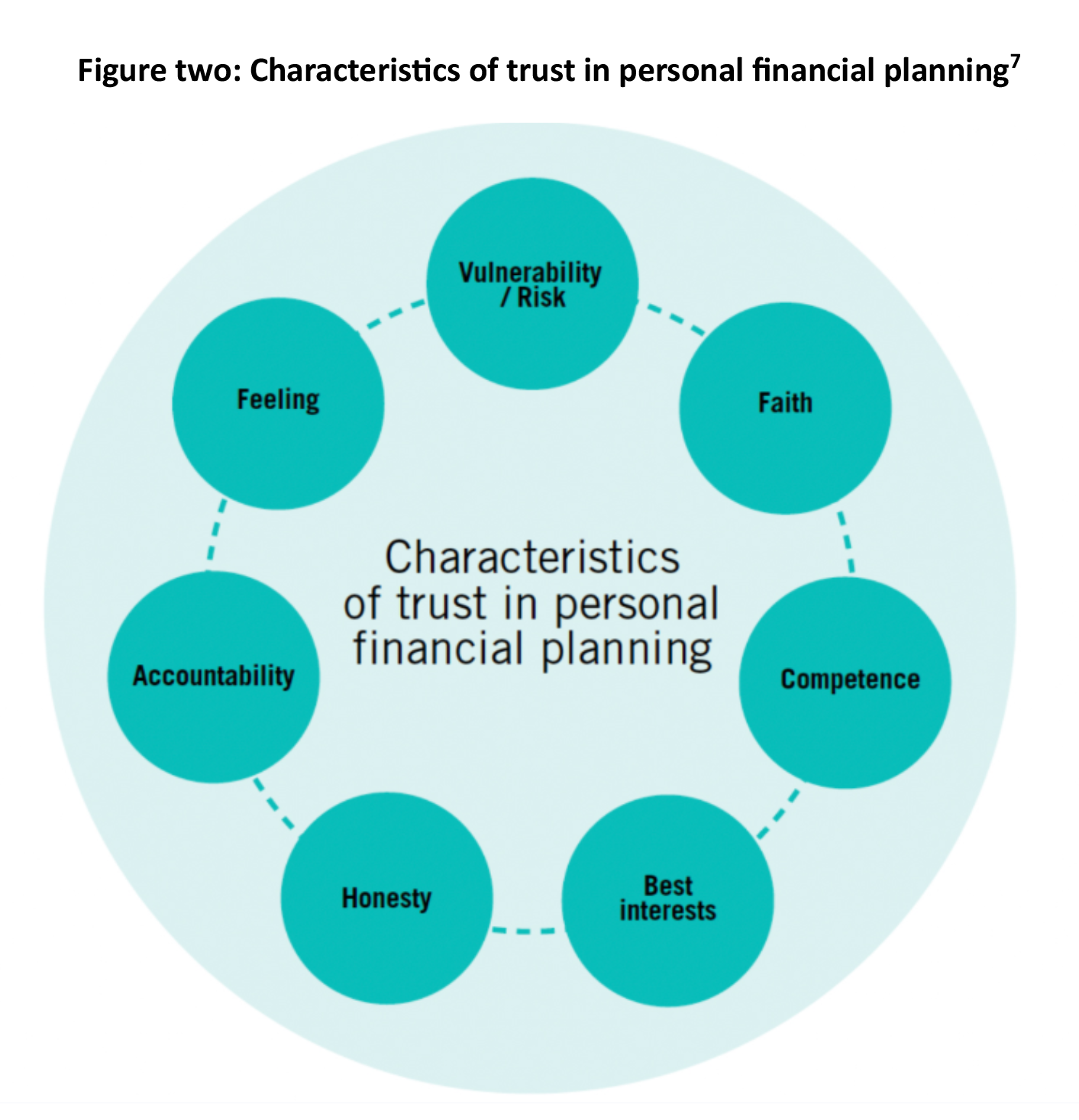
Figure two illustrates a model of trust developed following research undertaken for a PhD Dissertation in 2015[7]. As well as illustrating the characteristics of trust as it pertains to financial planning, it can also be used to link the importance of ethical behaviours to the elements that constitute a trust relationship. Starting at the top and moving clockwise, we will explore this interrelationship between trust factors and ethical standards more closely.
Vulnerability/Risk – each of your clients will have periods of feeling vulnerable as they move through life. These may be personal vulnerabilities or from the influence of external factors.
The stronger the trust relationship between you, the knowledge that you have acted in their best interests means the client is less likely to be fearful during periods of market volatility or challenging personal circumstances. By providing you with informed consent, your client acknowledges the trust they are placing in you.

Faith – clients want to have faith in their adviser, want to have a trust relationship, want to know you are doing the best by them. By acting in their best interests and building a strong interpersonal connection, your client is best positioned to have faith in your role and their ability to meet their financial objectives.
Competence – while competence is implicit in most of the Code’s standards, it is explicit in standards nine and ten – all advice, not just financial product advice, must be offered with competence. From a trust perspective, this competence will be demonstrated not simply through a Statement of Advice and financial products you recommend, but also through the communications and other interactions you have with your clients.

Best interests – you don’t need research to know that failure to act in a client’s best interest is a trust killer. It is also a sign of unethical behaviour and, while it impacts a number of standards in the Code of Ethics, it is an explicit breach of standards two and five.
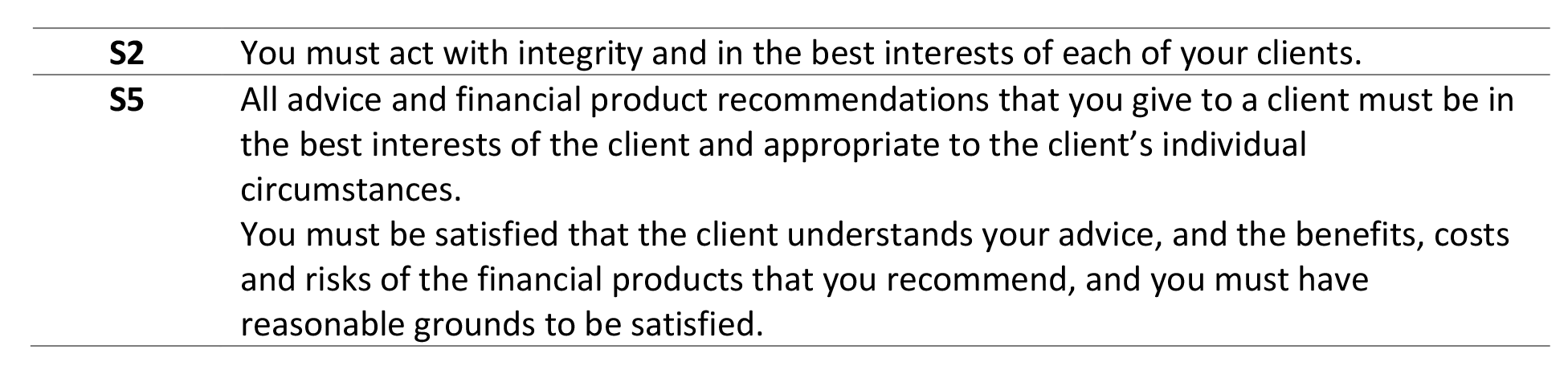 Honesty – honesty and ethical practice go hand in hand. Dishonesty of any type will crush the trust built between two people and, in the context of financial advice, destroy the adviser-client relationship. Depending on the nature of the dishonesty, it will likely see you breach several of the Code’s standards, in particular standard two, which requires you to act with integrity.
 Accountability – it is important to demonstrate that you, and other members of your practice, are accountable for all actions in relation to your clients. Particularly in situations where things haven’t gone to plan, accountability is essential to maintaining the trust you have developed with your client.
 Feeling – while trust is built over time, it is often driven by a feeling of wellbeing (or lack thereof). By acting your clients’ best interests and adhering to the standards that comprise the Code of Ethics, you’re more likely to engender and maintain a trust relationship with your clients.
Case studies
The following case studies are based on real events; however, the names of people and organisations have been changed, and some details altered. The case studies have been drawn from ASIC and AFCA. For each, potential breaches of the Code of Ethics are identified.
Case study one: Dishonest conduct
There is nothing like dishonest conduct to erode trust; if that conduct is widespread or becomes more widely known, it can also create a sense of distrust for the industry as a whole.
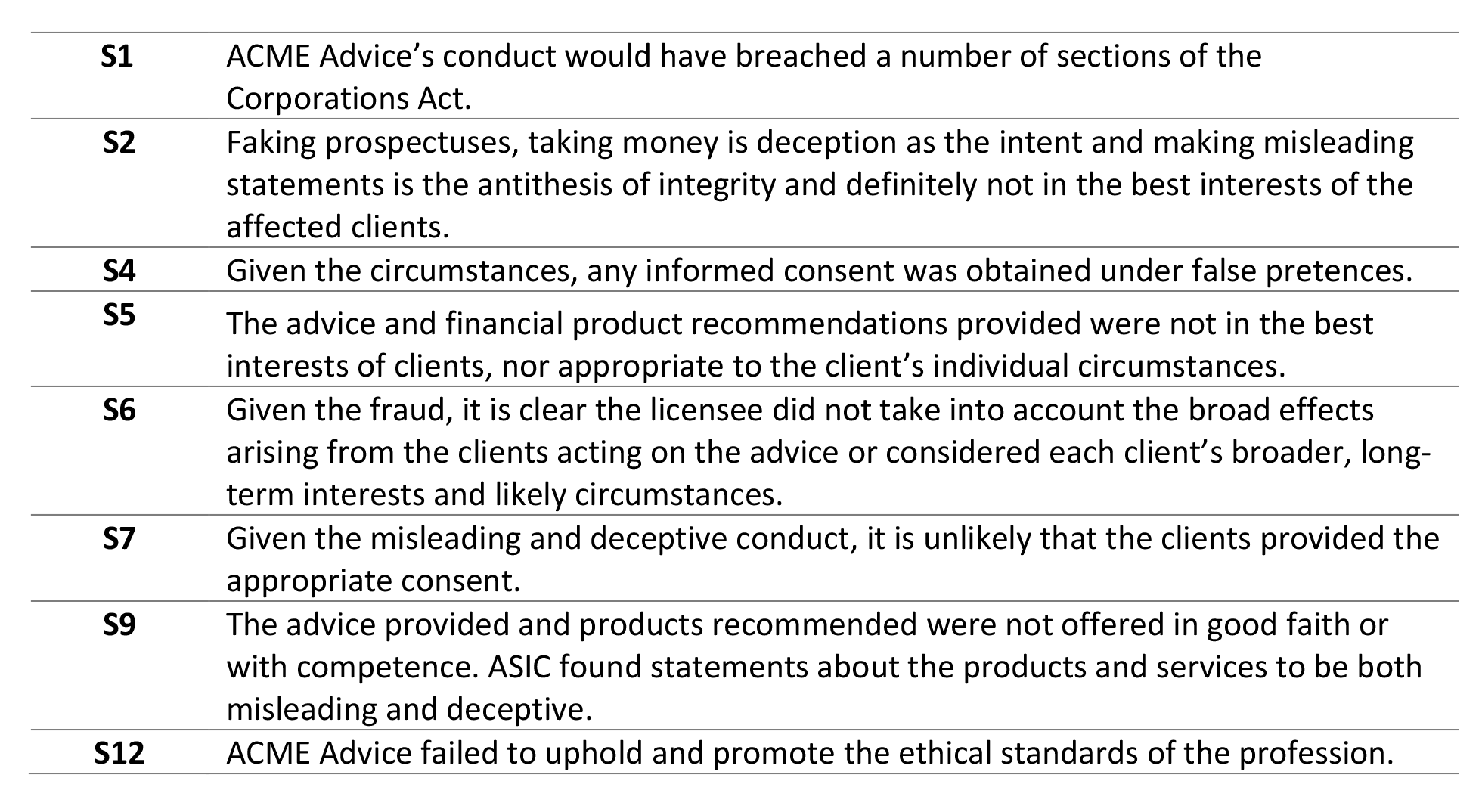
ACME Advice has held an AFS licence since 2017; however, the business was sold in 2024. The licence was cancelled after ASIC found ACME Advice had contravened its obligations as an AFS licensee. This was based on findings including misleading or deceptive conduct, dishonest conduct in connection with its financial services business, as well as failures in compliance, supervision and resourcing.
ASIC found that ACME Advice:
- Created a fake bond prospectus for a bond related to a major bank and used it to solicit investor funds
- Encouraged and facilitated client investment into the non-existent bond product, including arranging payment and documentation for transactions
- Obtained at least $100,000 from investors for a bond that did not exist
- Made misleading or deceptive statements on its website, including misrepresenting its experience and altering scam warnings about it that were issued by third parties
- Provided false documents to an auditor, amounting to dishonest conduct.
In its review of the case, ASIC noted it considered that ACME Advice had engaged in conduct that was misleading or deceptive, dishonest and inconsistent with the fundamental obligations of AFS licensees to act efficiently, honestly and fairly.
Based on these details, a case could be made that licensee ACME Advice breached the following standards in the Code.
 Case study two: Unlicensed advice
Running a financial advice business without a proper licence and operating unregistered managed investment schemes are direct violations of the law. Doing so by exploiting inexperienced investors and steering their money into these schemes is a profound breach of trust.
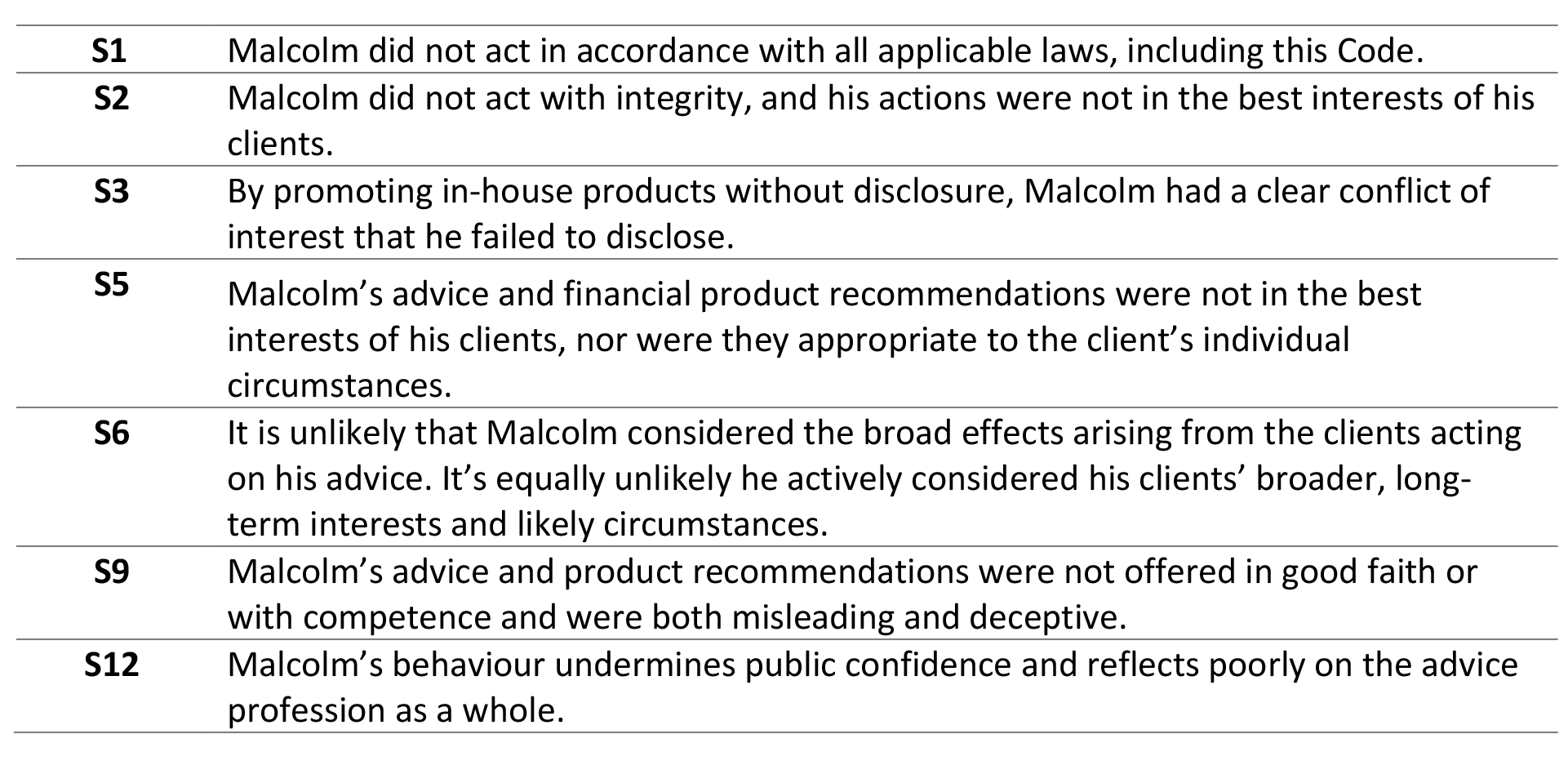
Pari and Rohan sought advice from adviser Malcolm, who was also a director of his advice business, ACME Investments. The couple was approaching retirement and wanted advice as to how to best structure their superannuation and other assets for retirement.
The couple had become aware of Malcolm and ACME Investments via promotions the financial firm ran on social media. These promotions offered fixed returns of 25-35 percent to be paid between 12 to 36 months.
Malcolm did not disclose that the schemes he recommended were operated by ACME Investments. He recommended Pari and Rohan establish an SMSF and each roll their superannuation assets into the fund. The couple did this and then invested the proceeds in the recommended investments.
By the end of the first year, the couple realised the promised returns had failed to materialise. Although they were persuaded to extend their investment for another year, an ASIC investigation soon intervened, freezing both Malcolm’s and the firm’s assets. Later that year, ASIC launched civil action against Malcolm and ACME Investments for alleged unlicensed conduct and the operation of multiple unregistered managed investment schemes. Consequently, receivers were appointed over the schemes’ properties and their associated trusts.
The Federal Court found company director Malcolm guilty of operating unregistered managed investment schemes and carrying on a financial services business without holding an AFSL. Handing down its judgment, the Federal Court ordered Malcolm to pay $1.45 million and that he be disqualified for four years. He was also ordered to pay $52,000 of ASIC’s costs.
Additionally, the court ordered that ACME Investments, of which Malcolm was the sole shareholder and director, be wound up alongside five of the investment schemes and associated companies.
The court heard that numerous investors were referred to third parties to establish SMSFs in order to invest in the schemes. The court found that many of the 217 investors in the schemes were inexperienced investors and believed that the funds they had invested were secure and that returns would be significant. Investor losses totalled approximately $32 million.
The court’s judgment was understood to be the first time a court has ordered a pecuniary penalty against an individual for a contravention of section 601ED of the Corporations Act. This section mandates that a managed investment scheme (MIS) must be registered with ASIC if it has more than 20 members, is promoted by a business in the MIS promotion industry or is determined by ASIC to be closely related to schemes with more than 20 investors in total. It is also the third highest civil penalty ordered against an individual in relation to a proceeding commenced by ASIC.
Malcolm’s actions potentially breached the following standards of the Code.
 Case study three: Investment in the adviser’s best interest
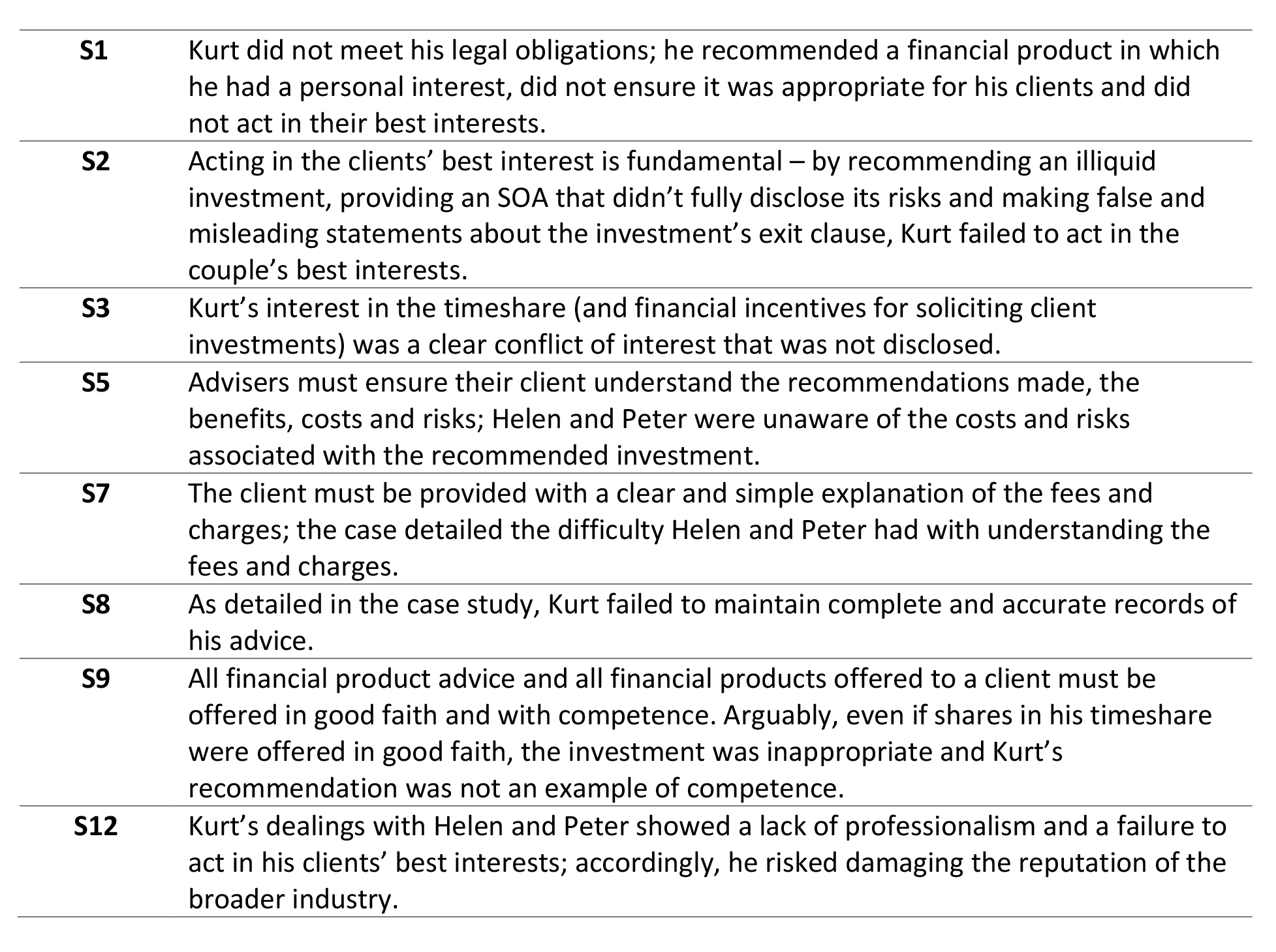
Helen and her husband Peter had been clients of ACME Financial Planning for nine years. They trusted their adviser, Kurt and when he invited them to purchase membership in a timeshare managed investment scheme operated by his licensee, they expressed interest.
Helen and Peter attended an information session for the investment, during which Kurt provided them with information and advice about the investment. Kurt received a financial incentive for each sale, which he did not disclose to his clients.
During this information session, Helen asked Kurt if it was possible to cancel membership in the scheme at any time. She was told they could cancel the investment for an exit fee of $550; Helen and Peter relied on that statement when deciding to take up the investment. As it turned out, this statement was misleading and Kurt later denied specifying an exit fee or exit clause.
To exit the investment, Helen and Peter were required to:
- pay out the investment loan they had taken out to purchase the timeshare
- find a buyer for their portion of the timeshare
- pay an additional exit fee – one much higher than they believed they were told. This was outlined in fine print on page 42 of the scheme’s offer document.
An investigation found a range of other issues with the advice the couple received, including:
- Kurt’s file notes were incomplete and did not record all the matters referred to by Helen and Peter in their complaint.
- The statement of advice (SOA) provided to Helen and Peter was generic and not tailored specifically to them; it did not identify their objectives, nor did it provide advice reasonably likely to satisfy those objectives.
- The SOA also failed to discuss the specified risks associated with accepting the advice to invest in a non-liquid managed investment scheme on a long-term basis.
From the details provided in the case study, Kurt potentially breached the following standards.
 Trust and ethical conduct aren’t separate goals for financial advisers, they’re the same goal seen from two angles. When advisers put their clients’ best interests first, maintain transparency and provide accurate, impartial advice, they’re not just meeting the requirements of the Code of Ethics, they’re building the kind of trust that long-term relationships depend on.
In a financial environment as complex as this one, trust becomes the foundation for sound decision-making, supporting both individual client outcomes and the stability of the broader system. It also has a practical benefit that’s easy to overlook. Advisers who genuinely earn their clients’ trust, rather than simply satisfying the letter of the Code, are far less likely to face the complaints, investigations and reputational damage that come when a relationship breaks down. Ethics, in this sense, isn’t a constraint on good advice. It’s what makes good advice possible in the first place.
Take the FAAA accredited quiz to earn 0.75 CPD hour:
CPD Quiz
The following CPD quiz is accredited by the FAAA at 0.75 hour.
Legislated CPD Area: Professionalism and Ethics (0.75 hrs)
ASIC Knowledge Requirements: Ethics (0.75 hrs)
please log in to start this quiz

———–
Notes:
[1] ASIC Report 627 – Financial advice: What consumers really think, August 2019
[2] FAAA, Value of Advice Index, October 2024
[3] ASIC media release 26-019MR, ASIC takes further steps to support Australians impacted by First Guardian and Shield collapse, 5 February 2026
[4] Financial Newswire, Fund collapses fuel spike in AFCA advice complaints, 24 October 2025
[5] Hunt, K., Brimble, M. and Freudenberg, B. (2011), ‘Determinants of Client-Professional Relationship Quality in the Financial Planning Setting’, Australasian Accounting Business and Finance Journal
[6] Bejou, D., Ennew, C. and Palmer, A. (1998), ‘Trust, ethics and relationship satisfaction’, International Journal of Bank Marketing
[6] Cull, M. (2015), The role of trust in personal financial planning, PhD Dissertation, University of Western Sydney
CPD Quiz
The following CPD quiz is accredited by the FAAA at 0.75 hour.
Legislated CPD Area: Professionalism and Ethics (0.75 hrs)
ASIC Knowledge Requirements: Ethics (0.75 hrs)
please log in to start this quiz
———–
Notes:
[1] ASIC Report 627 – Financial advice: What consumers really think, August 2019
[2] FAAA, Value of Advice Index, October 2024
[3] ASIC media release 26-019MR, ASIC takes further steps to support Australians impacted by First Guardian and Shield collapse, 5 February 2026
[4] Financial Newswire, Fund collapses fuel spike in AFCA advice complaints, 24 October 2025
[5] Hunt, K., Brimble, M. and Freudenberg, B. (2011), ‘Determinants of Client-Professional Relationship Quality in the Financial Planning Setting’, Australasian Accounting Business and Finance Journal
[6] Bejou, D., Ennew, C. and Palmer, A. (1998), ‘Trust, ethics and relationship satisfaction’, International Journal of Bank Marketing
[6] Cull, M. (2015), The role of trust in personal financial planning, PhD Dissertation, University of Western Sydney


Have feedback on this article? Contact Us
Earn CPD Points
 CPD: US middle market private credit – the investment case
In today’s rapidly shifting investment landscape, traditional sources of fixed income are struggling to meet the yield and diversification needs of investors. They are also becoming more closely correlated with [...]
 CPD: A new global order and implications for investors
The new global order differs from its predecessor in four ways, as outlined in the following article from GSFM’s investment partner TD Epoch. For decades, the US has been unrivalled [...]
 CPD: Is your approach to client risk profiling putting you at risk?
Introduction The shockwaves that followed the announcement of ‘Liberation Day’ tariffs by Donald Trump brought an abrupt and unsettling end to a three-year bull market. Major global indices plummeted by [...]