

Shane Oliver
Key points
- Given recession and geopolitical risks, the ride for shares may still remain choppy and new lows can’t be ruled out.
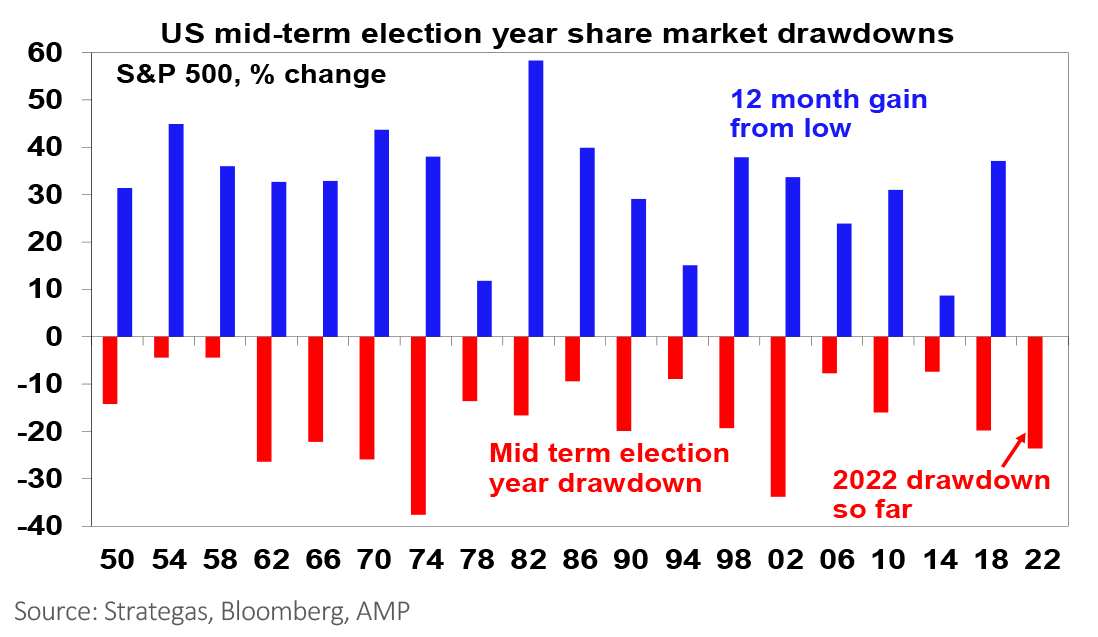
- But the increasing evidence of a peak in US inflation (which will lead Australian inflation), central banks slowing (or moving to slow) their rate hikes, China moving to do more to support its economy, along with positive seasonals and the track record of US shares rallying after mid-term elections indicate we may have seen the low in share markets and add to our confidence the next 12 months will be positive for shares.
- The same will likely also apply for the $A, being a cyclical currency.
Introduction
At last, it seems some of the bad news for shares appears to be abating. It’s certainly been a rough year. Thanks to a combination of high inflation, hawkish central banks, a surging US dollar, war in Ukraine along with other geopolitical tensions and rising recession risks, bonds and shares have had poor returns. It’s been the rise in inflation that has been the key driver. From their highs late last year or early this year to their lows in October US and global shares fell around 25%. Australian shares held up better thanks to strong resource earnings & a less hawkish RBA but still fell 16% to their low in June and held just above this in October. Bonds which are normally a source of stability in the face of share market falls have had their biggest losses in decades as rising inflation pushed yields up. Tech stocks and crypto currencies, being amongst the biggest winners of easy money and the pandemic lockdowns, have been amongst the biggest losers from monetary tightening and reopening, with crypto land still in turmoil.
But, from their recent lows, global and Australian shares are up 10% or so. In fact, Australian shares are now only down about 4% year to date. Shares may have run a bit ahead of things in the near term as they often do, but the big question is whether the rebound is sustainable?
Some better news
Bear markets are known for having periodic spikes higher as investors’ short positions are squeezed, often after a bit of less bad news. In the tech wreck and GFC, bear market rallies were up to 20% or so. And of course, we have seen two bear market rallies into March and August that proved short lived. But this time there’s been more fundamental improvement:
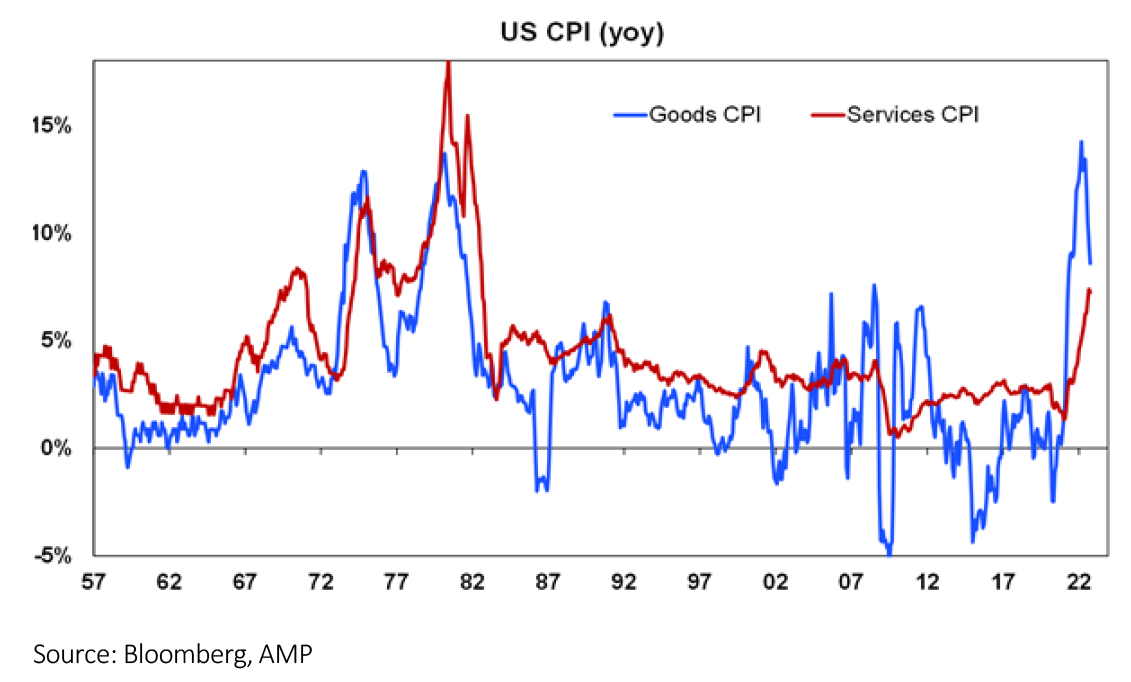
First, it’s been a long time coming, but underlying US inflation finally appears to be easing. Headline inflation in October dropped to 7.7%yoy (well down from a peak of 9.1% in June) but more importantly core (ex food and energy) inflation came in at a slower than expected 0.3%mom, easing to 6.3%yoy from 6.6%yoy. Prices for used cars, household furnishings, medical care and airfares fell. US goods price inflation has rolled over and this tends to lead services price inflation

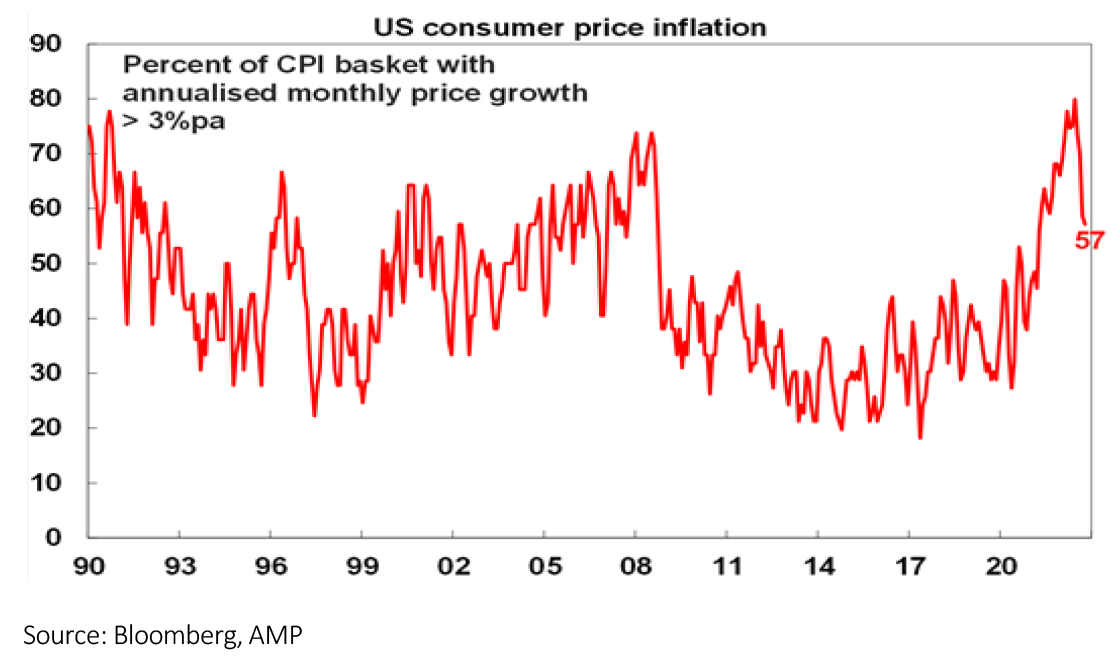
What’s more, the proportion of CPI components with annualised monthly inflation above 3%yoy is falling sharply.

This is all consistent with falls in our Pipeline Inflation Indicator due to easing supply constraints, freight rates, commodity prices and cost pressures in business surveys. This Indicator correlates more with goods inflation (which is slowing), but this leads services inflation so its likely to slow too. A year ago global growth, US wages, rents, commodity prices, US public spending, anecdotes, car prices, money supply growth, freight rates and business surveys were all pointing up for US inflation. Now they are all slowing, or clearly pointing down.
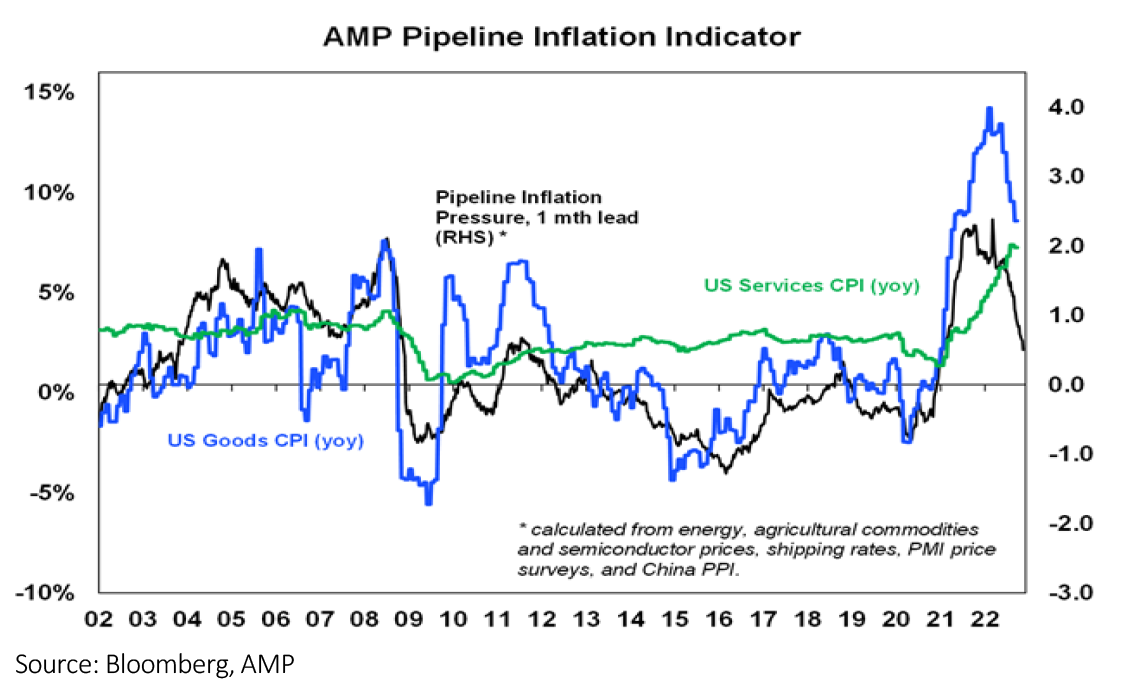

Inflation in Australia is lagging the US by around 6 months, so it should start to decline here from early next year as well. And Australian shares take their directional lead from the US most of the time anyway.
- Central banks are slowing or moving to slow their rate hikes. This started with the RBA dropping to 0.25% hikes, the Bank of Canada dropping to a 0.5% hike, the ECB sounding less hawkish, the Fed opening the door to slowing down (with lower inflation data adding to its likelihood) and the Bank of England pushing back against market expectations for how high it will raise rates. The common denominator is that rates are now around neutral or restrictive and there is a need to allow for the lags with which monetary policy impacts economic activity. Of course, central banks are still hawkish as inflation is too high and jobs markets still too tight, so more rate hikes are likely. But a slowing in the pace reduces the risk of hard landings.
- The US dollar and bond yields are showing signs of rolling over. This is significant as the rise in both have been key aspects of this bear market, a roll over in the $US will reduce the risk of a financial accident in emerging countries and will stop exporting US inflation globally, and lower bond yields will ease the valuation pressure on shares.
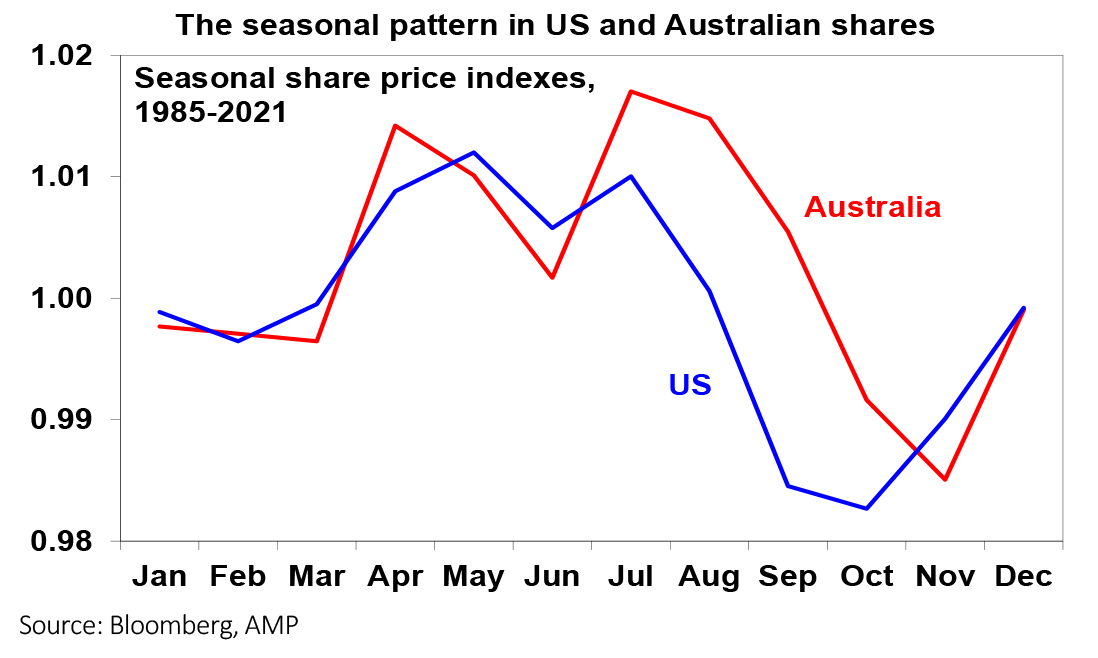
- We have now entered a positive part of the year for shares from a seasonal perspective, with US, global and Australian shares tending to rally from October/November into year end and out to the middle of the next year, reflecting an end to tax loss selling in the US, new year cheer and a lack of capital raising over the Christmas/New Year period.

- Post US mid-term election returns tend to be strong as getting the mid-terms out of the way reduces uncertainty, just as mid-term election year falls tend to be severe – with an average 17% fall in mid-term years followed by an average 33% gain 12 months from the low.

- With the Party Congress over, China is focussing on boosting its economy. It has announced 20 measures to “optimise” its Covid policy – with some easing in controls and measures to step up medical preparations including for vaccinations and treatments. It looks likely to exit from zero-Covid around March next year. And it has announced 16 measures to support its ailing property sector. The latest upswing in Covid cases will cause short term disruption, but an exit from zero-Covid and increased property construction work mean Chinese growth will likely surprise on the upside next year, which could boost global growth. This is not to say that China’s longer term growth potential is not trending down (with slowing workforce growth, greater Government intervention reducing dynamism, trade tensions with the West and its property issues), but it will still see cyclical swings.
- Longer term inflation expectations remain reasonably “well anchored” suggesting that it should be easier for central banks to get inflation back down than it was in the 1980s when deep recessions were needed to break an entrenched inflation psychology.
There is a rising chance we have seen the low in shares and we remain optimistic on shares on a 12-month horizon as investors will start to focus on monetary easing from late next year and then economic recovery.
What are the risks?
There are four main risks:
- Inflation could surge anew or remain sticky at high levels necessitating more aggressive rate hikes. This is possible and we remain of the view that inflation will be higher over the medium term as the world is now more inflation prone. However, slowing growth is known to slow inflation so there is still likely to be a cyclical downswing in inflation.
- Recession – this is likely in Europe, about a 50% probability in the US and about a 40% probability in Australia. Deutsche Bank has pointed out that since 1950 the third year of the US presidential cycle has not had recessions in quarters 2 to 4 and this may partly explain why shares have been strong in the third year. So, if the US has a recession next year it may break the record of positive returns after the mid-terms. A counter is that the share slump this year has been consistent with mid-term election year slumps & it may have discounted a mild recession, which would not preclude shares having their typical post mid-term rally even if there is a recession next year, providing its mild.
- Geopolitics could worsen. Russia could escalate further in Ukraine. Problems in the Middle East could also escalate given the failure to return to the 2015 nuclear agreement with Iran, social unrest in Iran and the return of Netanyahu as Israeli PM increasing the risk Israel will take action against Iran’s nuclear capability. China could move on integrating Taiwan. And tensions could be fanned if President Biden adopts a more hawkish foreign policy stance. But getting geopolitical problems right is never easy & some of these could go the other way.
- Republican control of the US House will likely lead to brinkmanship in funding the US Government and increasing its debt ceiling.
What about the latest problems in crypto land? Bitcoin has fallen to a new cycle low on liquidity issues at FTX crypto exchange (now bankrupt). Cryptos were a beneficiary of easy money and have been suffering from its withdrawal. Financial accidents are common outcomes of Fed tightening & the crypto problems could go further. This may be bad for crypto traders but its unlikely to have a major impact on global growth and share markets as investor and financial system exposure to it is relatively low. Its good news for gold though as the crypto craze was sucking the life out of it.
Concluding comment
The ride for shares may still remain choppy & new lows can’t be ruled out. But the increasing evidence of a peak in US inflation and central banks slowing their rate hikes along with positive seasonals & the track record of US shares rallying after the mid-terms indicate we may have seen the low and add to our confidence that the next 12 months will be positive for shares. The same is also likely to apply for the $A, being a cyclical currency.
By Dr Shane Oliver, Head of Investment Strategy and Chief Economist