

The three components of shareholder yield – dividends, buybacks and debt reduction – are best thought of collectively rather than in isolation.
For years, income-focused investors have leaned on a familiar approach: find companies with high dividend yields and hold them. It is a reasonable starting point, but it is an incomplete one. Strong equity markets have compressed dividend yields in many parts of the world, and investors who look narrowly at dividends alone are missing a large part of how companies actually return value to shareholders.
Shareholder yield is a broader framework. It looks at the ways a company returns cash, not just dividends, and it asks a more useful question than “what is the yield today”. It asks whether a company can sustain and grow its total distributions over time. For advisers building income and growth portfolios for clients navigating volatility, rate uncertainty and a market increasingly concentrated in a small number of large companies, that is a distinction worth understanding and worth explaining to your clients.
The holy trinity: dividends, share buybacks and debt reduction
The three components of shareholder yield – dividends, buybacks and debt reduction – are best thought of collectively rather than in isolation. The key question is not which lever is most attractive, but whether the underlying free cash flow can sustain and grow total distributions over time. In today’s environment, TD Epoch sees encouraging trends across all three.
Shareholder yield measures the total cash a company returns to its investors, combining dividends, share buybacks and debt reduction into a single figure. TD Epoch, whose investment philosophy centres on free cash flow as the best predictor of shareholder return, argues that the way management allocates that cash flow determines whether a business rises or falls in value.
Dividends remain a core component of return and continue to anchor investor expectations. At the same time, share buybacks have become more prevalent as companies deploy excess cash in a flexible way, particularly where balance sheets are strong. Debt reduction has also taken on greater importance, as higher interest rates incentivise companies to strengthen their balance sheets. What stands out most is the increasing discipline in capital allocation decisions, particularly among large, mature companies.
Dividends are the most familiar channel and remain a core anchor of investor expectations. A company that pays a dividend, particularly one that grows it consistently, is signalling confidence in its future cash generation and a commitment to sharing that with shareholders.
Share buybacks work differently but achieve a similar outcome. When a company repurchases its own shares, the number of shares outstanding falls, which increases the value attributable to each remaining share. Like a dividend, this transfers value to shareholders, just through a different mechanism. Buybacks have become more prevalent as companies with strong balance sheets look for flexible ways to deploy excess cash, particularly in environments where certainty about future capital needs is lower than usual.
Debt reduction is the least obvious of the three but fits the same logic. When a company uses free cash flow to pay down debt rather than distribute it, it reduces interest costs, improves future earnings and strengthens its balance sheet. This effectively shifts value from creditors to equity holders, because there are fewer future claims on the company’s cash flows. Shareholders do not receive cash immediately, but they benefit through higher earnings available to them later. Debt reduction has taken on added importance in a higher rate environment, where companies have a clearer financial incentive to reduce leverage.
Framed this way, shareholder yield is less an income metric and more a capital allocation question. It asks whether management is generating sustainable free cash flow and using it in ways that build long-term value for the people who own the business – the shareholders.
Companies with strong shareholder yield typically have management teams focused on creating value through consistent and rational capital allocation. Rather than looking at dividend yield alone, shareholder yield gives a fuller picture of how a company treats its shareholders financially and can point to businesses generating the kind of cash flow that supports sustainable returns over time.
TD Epoch believes the current environment is constructive for shareholder yield investing. Elevated volatility, geopolitical uncertainty and shifting rate expectations have created greater dispersion across sectors, which tends to reward a bottom up, cash-flow-driven approach. In that context, companies with sustainable free cash flow and a track record of returning capital to shareholders have historically been able to deliver relatively resilient results. The firm has also seen a broadening of market participation beyond a narrow set of leaders, which may support a more diversified yield opportunity set.
That said, challenges remain. Strong market performance in recent years has compressed dividend yields in parts of the market, making income harder to source if one looks narrowly at dividends. At the same time, certain segments, such as those driven by long-term growth expectations, continue to be influenced more by sentiment than by near-term cash generation.
Why dividend yield alone is an incomplete measure
Historically, the main drivers of equity market returns can be broken down into three components: earnings per share growth, dividends and changes in valuation multiples such as the price-to-earnings ratio (figure one). Of these three, valuation changes have tended to expand and contract over time without contributing much to total return over the longer term. The bulk of long-term return has instead come from earnings growth, with dividends providing a smaller but consistently positive contribution.
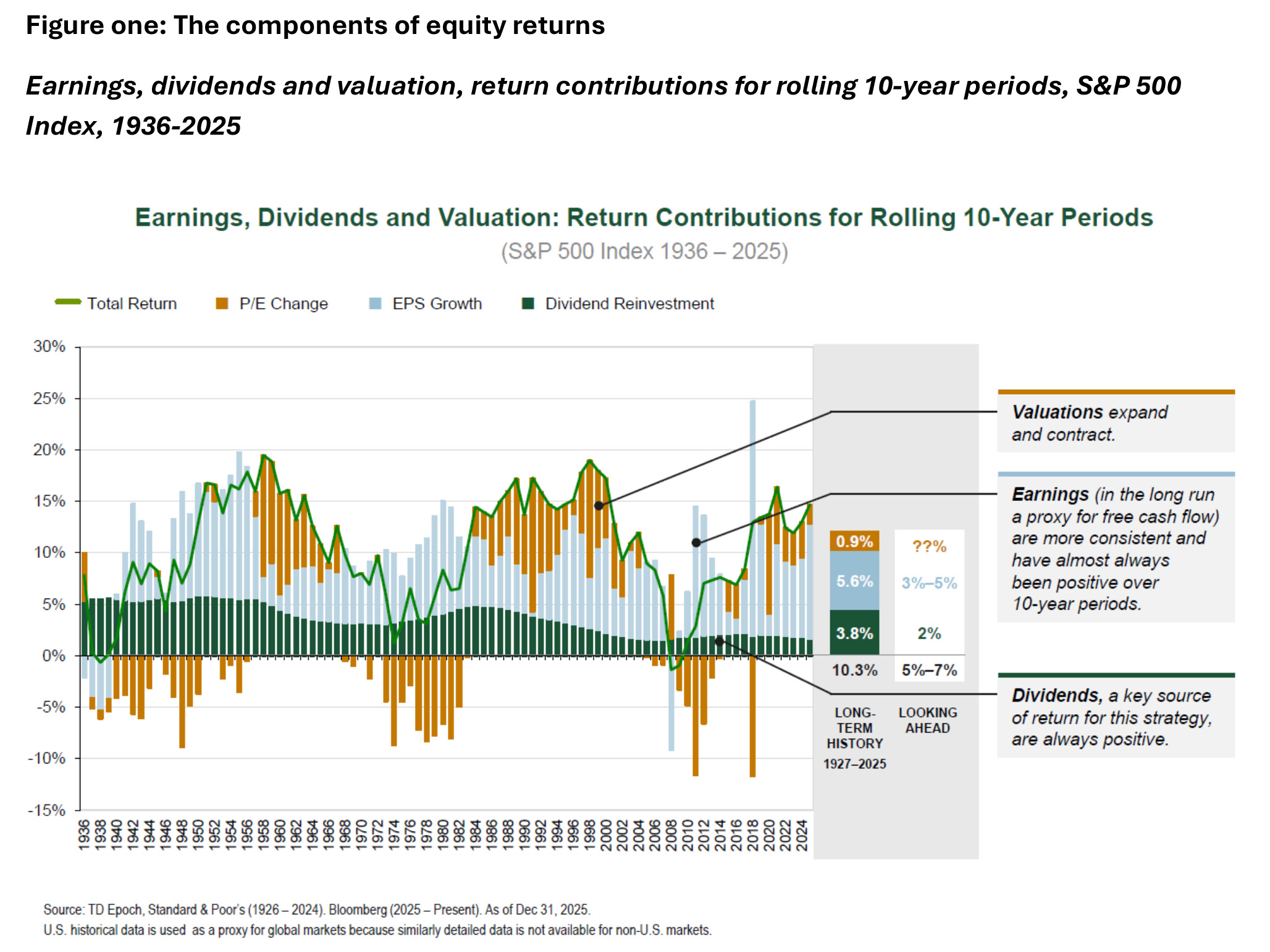
It is worth noting that the contribution from dividends has declined somewhat since the early 1990s. This is not because companies have become less generous to shareholders. It largely reflects a regulatory shift in the United States that made share buybacks a more tax-efficient way of returning cash than dividends. Buybacks became a substitute channel for capital return rather than a sign that companies were retaining more cash for themselves. They still drive earnings per share growth and still represent a genuine transfer of value to shareholders, even though they do not appear in a traditional dividend yield figure.
This perception matters. A company with a modest or non-existent dividend is not automatically a poor candidate for an income or total-return-oriented allocation. If that same company is consistently buying back shares or paying down debt from a strong base of free cash flow, it may be delivering shareholder yield that a headline dividend figure does not capture at all.
The opportunity set is broader than it looks
There is a common assumption that yield only lives in a narrow set of traditional, defensive sectors such as utilities, banks, telecommunications and real estate investment trusts. That assumption can lead investors to overlook a large and growing part of the market.
Many companies outside these traditional income sectors have matured into highly cash-generative businesses with strong margins and recurring revenue. As these companies mature, capital allocation priorities often shift, with a greater willingness to return cash to shareholders through dividends and buybacks, alongside continued reinvestment in growth. A company can combine structural growth drivers with meaningful cash returns. These are not competing priorities.
It also helps to look within sectors rather than treating them as uniform. Healthcare is a useful example. A biotechnology company focused purely on research and development may have little or no capacity to return cash to shareholders, because most of its free cash flow, where it exists at all, needs to be reinvested. Compare that with a large, diversified pharmaceutical company with strong recurring cash flow; such companies may be able to fund ongoing research and development while also paying a growing dividend and buying back shares. Both are technically in the same sector; however, their shareholder yield profiles are entirely different.
This is one of the practical strengths of a shareholder yield approach to portfolio construction. Because it starts from free cash flow generation and capital discipline rather than sector classification, it naturally leads to a more diversified set of opportunities than a screen built purely around current dividend yield. Innovation, scale and competitive position drive strong cash flow across many parts of the market, not just the traditionally defensive sectors.
This broader opportunity set has practical benefits for portfolio construction. A dividend yield screen applied narrowly tends to concentrate a portfolio in a relatively small number of sectors, often financials, utilities and real estate, which leaves the portfolio exposed to whatever affects those sectors specifically, such as interest rate movements or regulatory change.
A shareholder yield approach that considers the full range of capital return channels, one that looks across sectors for genuine free cash flow generation, tends to spread that exposure more evenly. For investors, this can mean a portfolio that is earning its income and total return from a wider range of underlying business drivers, rather than depending heavily on the fortunes of one or two industries.
Broadening the opportunity set does not mean lowering the bar. The same discipline around sustainable free cash flow and consistent capital return applies whether the company in question is a bank, a packaging manufacturer or a mature technology business. The point is not that yield can be found everywhere in equal measure, but that it should not be assumed to be absent from sectors that do not fit the traditional income mould.
How to identify genuine, sustainable yield
Finding companies capable of sustaining and growing shareholder yield requires looking past headline numbers. The first question is: where the cash flow is coming from? Is it generated from a reliable, recurring source of revenue, or does it depend on one-off items that are unlikely to repeat? A company whose cash flow comes from genuine revenue growth is in a fundamentally different position to one whose cash flow improvement is driven mainly by cost-cutting. Both can look similar in the short term. Only the first tends to support cash flow growth over the long term.
The second question is how management is allocating that cash. If a company can reinvest in the business or make acquisitions at returns above its cost of capital, it should generally be doing so, because that is how it compounds value over time. But profitable reinvestment opportunities are not unlimited. When a company cannot find them, the more disciplined path is to return the surplus cash to shareholders through dividends, buybacks or debt reduction, rather than pursuing growth for its own sake.
This is why free cash flow analysis tends to be a more reliable foundation for assessing sustainability than accounting-based metrics like price-to-earnings or price-to-book. Those multiples can be influenced by accounting choices in ways that free cash flow, which reflects actual cash generated and actual cash distributed, is harder to manipulate.
In practical terms, advisers assessing a company or a strategy built around shareholder yield should look for a track record of consistent or growing dividends, evidence of management’s ongoing commitment to returning capital rather than a one-off distribution, as well as cash flow growth that is underpinned by revenue rather than by cost reduction alone. Consistency of behaviour across market cycles is often as informative as the current yield figure itself.
Capital intensity is another factor worth weighing. A company that needs to reinvest heavily in plant, equipment or inventory just to maintain its current level of business will naturally have less free cash flow available for shareholders, even if its reported earnings look healthy.
Businesses with lower ongoing capital needs, relative to the cash they generate, tend to have more flexibility to fund dividends, buybacks and debt reduction simultaneously, rather than having to choose between them. This is part of why service-based and recurring-revenue businesses, where the incremental cost of serving an existing customer is relatively low, often screen well on shareholder yield measures once they reach a mature stage of growth.
It is also worth distinguishing between a company that is returning cash because it has genuinely run out of better uses for it, and one that is returning cash because management has stopped looking for growth. The first is a sign of discipline. The second can be a sign of a business in decline, propping up its share price with buybacks while the underlying franchise erodes. Reviewing whether revenue and market share are stable or growing, alongside the capital return numbers, helps separate the two.
Yield traps: what to watch for
Not every high yield is a good yield. In some cases, elevated yield is a warning sign rather than an opportunity, and this is one of the more important concepts for advisers to be able to explain to clients who are drawn to headline numbers.
The most common warning sign is a disconnect between the yield on offer and the underlying fundamentals of the business. A high dividend that is not supported by sustainable free cash flow is fragile. Deteriorating cash flow, excessive leverage and capital allocation decisions that favour short-term payouts over the long-term health of the business are red flags worth investigating.
A particularly common trap is a rising yield that is driven by a falling share price rather than by a rising payout. Dividend yield is a ratio, so it rises automatically as a share price falls, even if the dividend itself is unchanged or under pressure. A yield that looks attractive purely because the market has marked the shares down deserves closer scrutiny, not less. The relevant question is always whether the company has the capacity to maintain and grow its distributions, not simply what the current yield happens to be.
This is another reason free cash flow discipline matters more than the yield figure in isolation. A sustainable yield is one supported by a business that continues to generate the cash needed to fund it, through good conditions and more difficult ones.
The portfolio construction case
Beyond the merits of individual companies, there is a case for shareholder yield as a portfolio-level strategy, particularly in the market environment your clients are currently navigating.
Companies that generate sustainable free cash flow and have a track record of returning capital to shareholders have historically tended to deliver more resilient results through periods of volatility. A business funding consistent distributions from recurring cash flow is one with a degree of underlying stability. That stability tends to show up in lower volatility of returns over time, alongside the more visible benefit of income.
This makes a shareholder yield approach useful as a total return framework, not simply a defensive or income-only allocation. It does not rely on valuation multiples expanding; this is an unpredictable measure which, over long periods, contributes relatively little to total return as illustrated in figure one. Instead, a shareholder yield approach emphasises the components of return that are more observable and durable: cash flow growth and disciplined capital allocation. Investors following this framework can participate in equity market upside while also benefiting from a degree of downside resilience when conditions deteriorate.
For Australian investors in particular, this framing is relevant against a backdrop of tariff and trade policy uncertainty, shifting interest rate expectations, geopolitical risk and a market where much of the recent return has been concentrated in a narrow set of very large companies. A broader, cash-flow-driven approach to yield offers a way to keep clients invested in equities for growth, while managing some of the risk that comes with that concentration.
This is a particularly relevant conversation for retirees and pre-retirees who need income but cannot afford to sacrifice growth exposure entirely. The spectre of ongoing inflation and the reality of longevity risk both argue against allocating too much of a portfolio in low-growth assets.
Yield is broader than the number printed next to a dividend. Dividends, share buybacks and debt reduction are three different mechanisms for the same underlying idea, a company returning the cash it generates to the people who own it. Free cash flow is the thread that connects all three, and it is a more reliable guide to sustainability than a current dividend yield figure on its own.
For advisers, shareholder yield offers a good framework to talk to clients about income, particularly in a market where dividend yields have been compressed and where the appeal of a high headline yield can mask real underlying risk. By focusing on companies that generate and return cash, TD Epoch believes investors can participate in equity upside while also benefiting from a degree of downside resilience. In today’s more uncertain environment, a combination of participation and resilience is particularly valuable, helping investors stay invested and compound returns over full market cycles.
The information included in this article is provided for informational purposes only and is general advice only. It does not take into account an investor’s own objectives. The information contained in this article reflects, as of the date of publication, the current opinion of TD Epoch and is subject to change without notice. Sources for the material contained in this article are deemed reliable but cannot be guaranteed. We do not represent that this information is accurate and complete, and it should not be relied upon as such. Any opinions expressed in this material reflect our judgment at this date, are subject to change and should not be relied upon as the basis of your investment decisions. All reasonable care has been taken in producing the information set out in this article however subsequent changes in circumstances may occur at any time and may impact on the accuracy of the information. Neither TD Epoch, GSFM Pty Ltd, their related bodies nor associates gives any warranty nor makes any representation nor accepts responsibility for the accuracy or completeness of the information contained in this article.
Take the FAAA accredited quiz to earn 0.5 CPD hour:
CPD Quiz
The following CPD quiz is accredited by the FAAA at 0.5 hour.
Legislated CPD Area: Technical Competence (0.5 hrs)
ASIC Knowledge Requirements: Securities (0.5 hrs)
please log in to start this quiz
CPD Quiz
The following CPD quiz is accredited by the FAAA at 0.5 hour.
Legislated CPD Area: Technical Competence (0.5 hrs)
ASIC Knowledge Requirements: Securities (0.5 hrs)
please log in to start this quiz


Have feedback on this article? Contact Us
Earn CPD Points
 CPD: US middle market private credit – the investment case
In today’s rapidly shifting investment landscape, traditional sources of fixed income are struggling to meet the yield and diversification needs of investors. They are also becoming more closely correlated with [...]
 CPD: A new global order and implications for investors
The new global order differs from its predecessor in four ways, as outlined in the following article from GSFM’s investment partner TD Epoch. For decades, the US has been unrivalled [...]
 CPD: Is your approach to client risk profiling putting you at risk?
Introduction The shockwaves that followed the announcement of ‘Liberation Day’ tariffs by Donald Trump brought an abrupt and unsettling end to a three-year bull market. Major global indices plummeted by [...]
 CPD: Ethics and the advice practice
When last published, the FAAA’s Value of Advice Index[1] saw trust in financial advice at an all-time high, which reinforces the importance of ethical practice. This article, proudly sponsored by [...]
 CPD: Retirement income strategy choices
There’s a wide variety of income strategies used across the market, with an equally wide variety of labels attached to these strategies. Each varies in complexity, its ability to mitigate [...]