

Quality investing is evolving, with changing market dynamics reshaping the relationship between growth, quality and the role of active management.
For much of the post-Global Financial Crisis period, quality growth investing occupied a privileged position within institutional portfolios. The proposition was straightforward: invest in businesses with durable competitive advantages, high margins, strong returns on capital, recurring revenue streams, and predictable cash flows.
Over time, the compounding of superior business economics would overwhelm short-term market volatility. The approach attracted significant investor capital. Quality growth strategies often delivered a compelling combination of growth, resilience and lower volatility than many traditional growth strategies. For many asset owners, quality growth became the ‘sleep-at-night’ component of their equity allocation.
However, a curious shift appears to have occurred in recent years. Many of the sectors and companies that historically exemplified traditional quality growth characteristics have experienced a meaningful slowdown in growth, even while many of their traditional quality characteristics have remained intact. The result is an important question for investors: has the relationship between quality and growth changed?
When quality and growth diverge
For much of the last decade, quality and growth often went hand in hand. Many of the market’s strongest growth companies also exhibited the characteristics traditionally associated with quality investing: high margins, strong returns on capital, recurring revenue streams, stable earnings and asset-light business models.
The success of these businesses was not accidental. Software companies, consumer franchises and select healthcare businesses often benefited from powerful secular tailwinds while simultaneously exhibiting many of the characteristics traditionally associated with quality investing. Strong growth supported margins and returns on capital, while high profitability provided the resources necessary to sustain innovation, market leadership and competitive advantages.
This combination created a powerful feedback loop. Companies with superior economics often became stronger over time, reinforcing both their quality and growth characteristics. As a result, quality became an increasingly effective lens through which to identify attractive growth opportunities. In many respects, quality served as a useful proxy for future growth. Investors did not necessarily have to choose between the two because the market’s most successful companies frequently exhibited both.
More recently, however, the relationship has become less straightforward. Some of the sectors that historically exemplified quality growth characteristics have experienced slower growth, while many of today’s most compelling growth opportunities exhibit characteristics that differ meaningfully from the traditional quality framework.
The growth has slowly bled out of quality
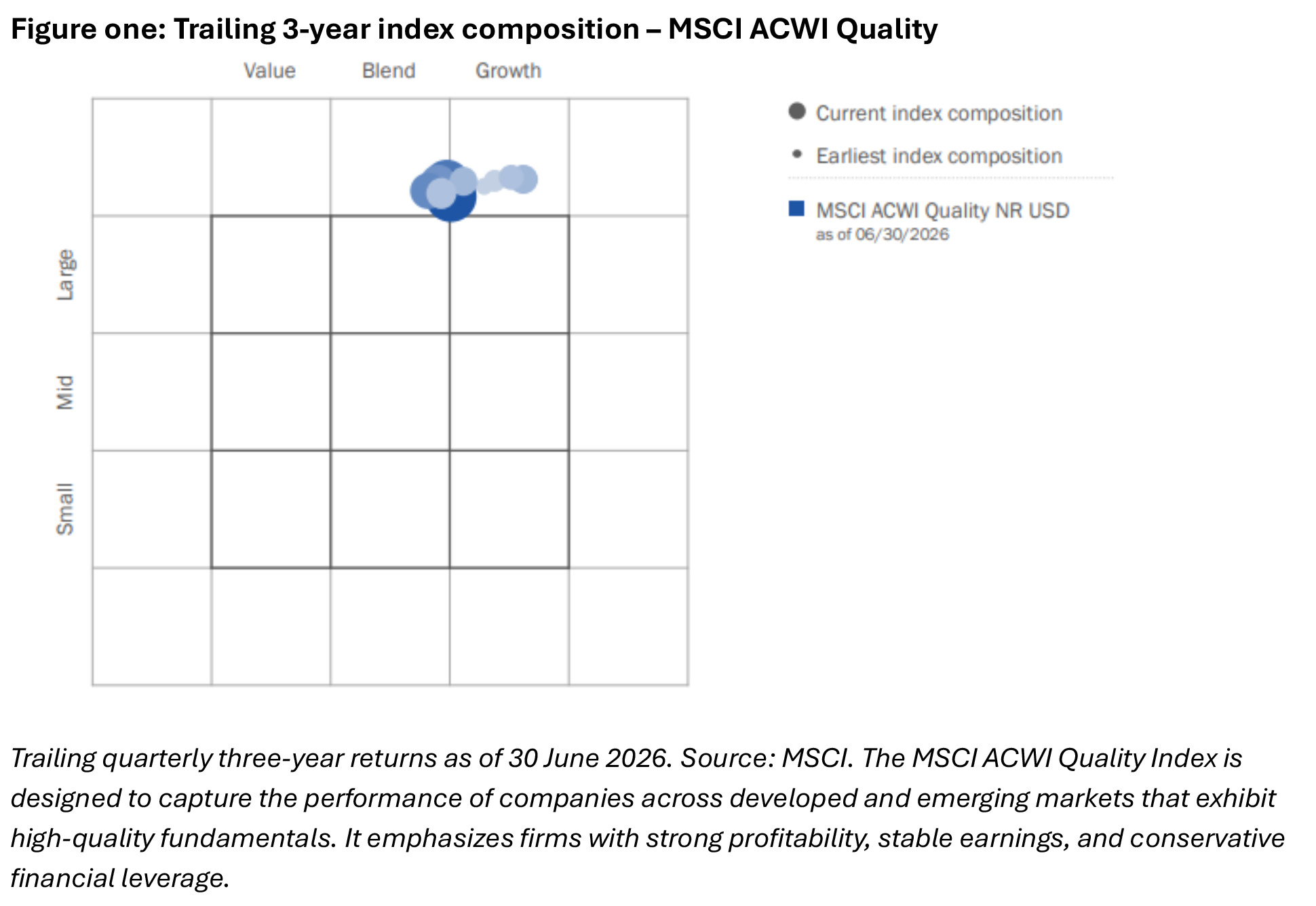
In the following chart, the larger circles represent the composition of the MSCI ACWI Quality Index as of more recent quarter-ends (i.e. the larger the circle, the more recent the time period, and the smaller the circle the farther away the time period).
As the chart shows, over the trailing three years the quality index has slowly migrated away from growth characteristics and toward the value end of the spectrum. In other words, the growth has slowly bled out of quality and managers who remained focused on backward-looking growth characteristics have sacrificed forward-looking growth in the process.
The opportunity set has changed
Part of the explanation may lie in the changing nature of the opportunity set itself.
Historically, many of the market’s most successful growth companies were asset-light businesses that benefited from network effects, recurring revenue streams and attractive unit economics. Software companies, internet platforms, consumer franchises and select healthcare businesses often required relatively modest levels of capital investment while generating substantial cash flow and high returns on capital.
Today’s investment landscape appears different.
The buildout of generative AI infrastructure has created significant demand for semiconductors, data centre infrastructure, networking equipment, power systems, electrical components, cooling technologies and other enabling technologies. These businesses are critical to supporting the rapid adoption of artificial intelligence across the global economy.
Importantly, many of these businesses look quite different from the companies that dominated the previous decade. They are often more capital intensive, operate with lower margins than traditional software companies, and exhibit earnings profiles that can appear less predictable. In many cases, they are choosing to reinvest aggressively rather than maximise near-term profitability.
Traditional quality metrics were developed to identify businesses that had already achieved economic maturity and demonstrated sustained profitability. During periods of stability, these metrics can be highly effective. However, during periods of significant technological change, some of the most attractive opportunities may emerge in businesses that are investing heavily to capture future growth rather than optimising for current profitability.
The current AI investment cycle illustrates this dynamic. Much of the value creation is occurring within the physical infrastructure required to support AI adoption.
Data centres require semiconductors, networking equipment, electrical systems, power management, cooling solutions and other enabling technologies. The companies providing these solutions may not always score as highly on traditional quality measures, yet they are benefiting from some of the strongest secular growth drivers in the market. This does not diminish the importance of quality. Rather, it highlights the limitations of relying too heavily on any single framework. Traditional quality metrics remain valuable tools, but they may not fully capture the companies best positioned to benefit from major shifts in technology, infrastructure and capital investment.
As a result, investors relying primarily on traditional quality metrics may underappreciate parts of today’s evolving opportunity set.
Where did the growth go?
The slowdown in growth did not occur in a vacuum. Many of the sectors that historically produced businesses exhibiting traditional quality growth characteristics have experienced a meaningful moderation in growth over recent years.
Consumer franchises provide one example. For much of the past two decades, global consumer and luxury brands benefited from the rise of the Chinese consumer and expanding global demand. More recently, slower Chinese growth, changing spending patterns, elevated savings rates and a weaker real estate backdrop have reduced what was once a powerful source of growth. While many of these businesses continue to possess strong brands, attractive margins, and solid cash generation, their growth trajectories have become less compelling.
Enterprise software has faced a different challenge. For years, software companies represented the ideal combination of recurring revenue, high margins, strong cash flows and attractive returns on capital. The emergence of generative AI has introduced uncertainty regarding the durability of traditional software business models and long-term growth assumptions. While many software companies remain high-quality businesses, investors have increasingly questioned whether future growth rates can match those achieved in the past.
Healthcare has also become a more challenging hunting ground for investors seeking businesses with the profitability, stability and returns on capital traditionally associated with quality investing. Regulatory pressures, reimbursement concerns and heightened policy scrutiny have weighed on growth expectations across portions of the sector.
While the underlying causes differ across sectors, the outcome has been remarkably similar. Businesses that once benefited from powerful structural growth drivers increasingly face slower growth, more uncertain demand, or heightened competitive pressures. Importantly, this does not mean these businesses are poor investments or that their quality characteristics have disappeared. Rather, it suggests that investors can no longer assume that the sources of growth that defined the previous decade will be the same sources of growth that define the next one.
The quality growth dilemma
This highlights an important tension within quality growth investing.
Quality metrics are largely backward-looking. They measure what a company has achieved: historical profitability, historical returns on capital, earnings stability and cash generation. Growth is inherently forward-looking. It reflects future demand, future market opportunities, future competitive positioning and future earnings potential. During periods of stability, quality and growth often reinforce one another. During periods of significant technological or economic change, however, they can diverge.
This is particularly true when new growth opportunities emerge in industries that do not yet exhibit the characteristics traditionally associated with quality investing. Businesses investing heavily to build infrastructure, capture market share, or establish leadership in emerging technologies may appear less attractive on traditional quality measures even as their long-term growth prospects improve.
This is not a failure of quality investing. Rather, it is a reminder that quality and growth are not the same thing.
The important role of earnings
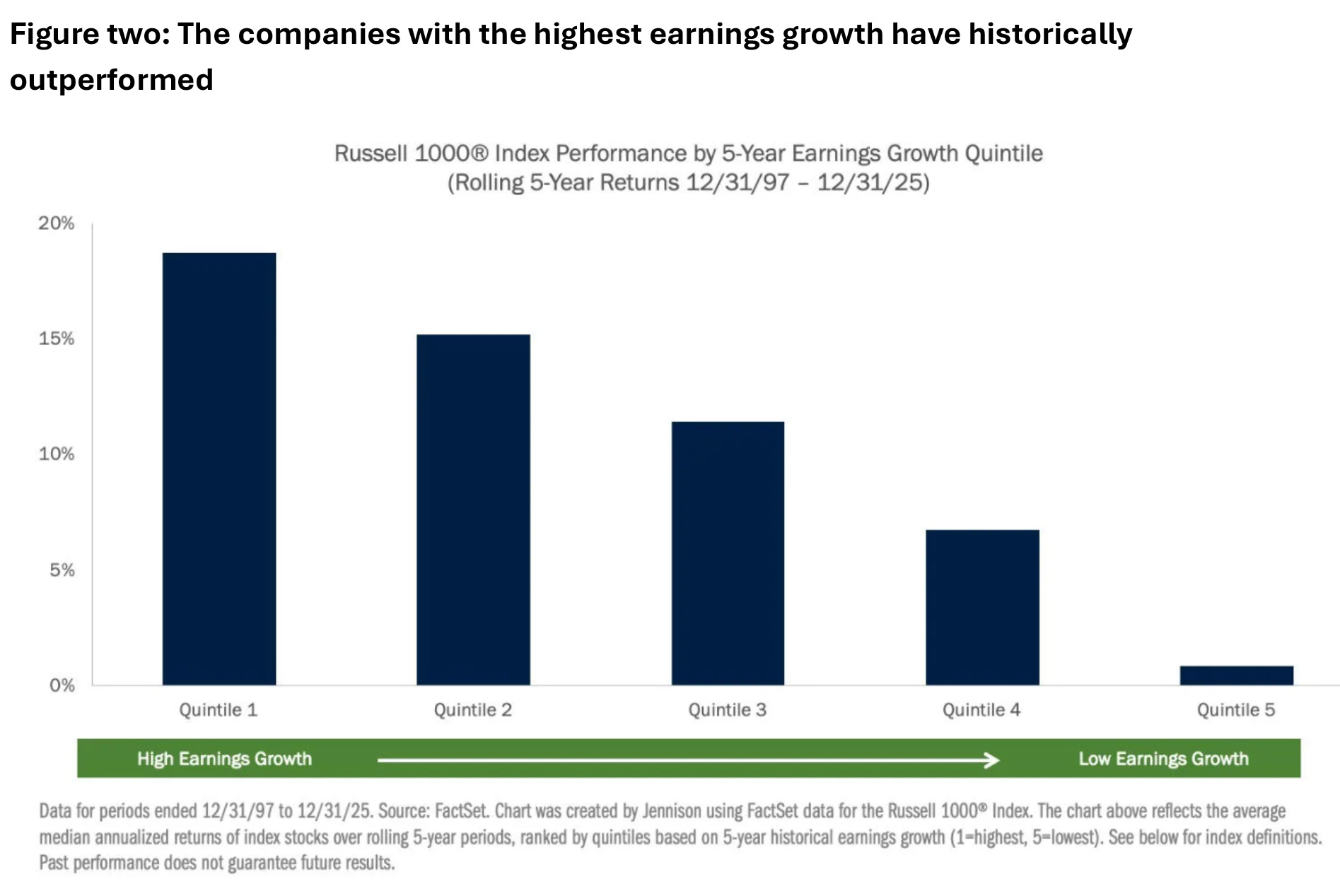
Over nearly three decades, data demonstrating the relationship between company fundamentals and share price returns is unambiguous: the companies with the fastest earnings growth in the Russell 1000 Index have delivered the strongest performance consistently over multi-year time periods (figure two).
Looking at rolling five-year returns of the Russell 1000 Index from 1997 through 2025, the top earnings-growth quintile produced annualized returns near 19%, compared with less than 1% for the slowest-growing quintile. Over time, investors have clearly rewarded businesses that can compound profit growth at a high and durable rate.
There is, however, a concentration problem. If the long-term case for growth investing is straightforward, the case for accessing it through a passive growth benchmark has quietly become more complicated. The top 10 holdings in the Russell 1000 Growth Index now account for 61% of the index – more than double their average weight over the past three decades.
For most of the index’s history, top 10 weights oscillated between 20% and 35%. The current level is without precedent, and it was reached in a remarkably short window: top 10 weights have nearly doubled since 2013, driven by a handful of mega-cap names whose market values have grown faster than the rest of the universe combined.
As a result, a benchmark that was historically a broad expression of secular growth has become, in practice, a concentrated wager on a few of the world’s largest businesses.
In addition to being heavily concentrated in just a handful of individual stocks, 50% of the Russell 1000 Growth Index is in the technology sector. And when you add tech-related names from other sectors, that number soars to 68%.
The Magnificent 7 growth deceleration
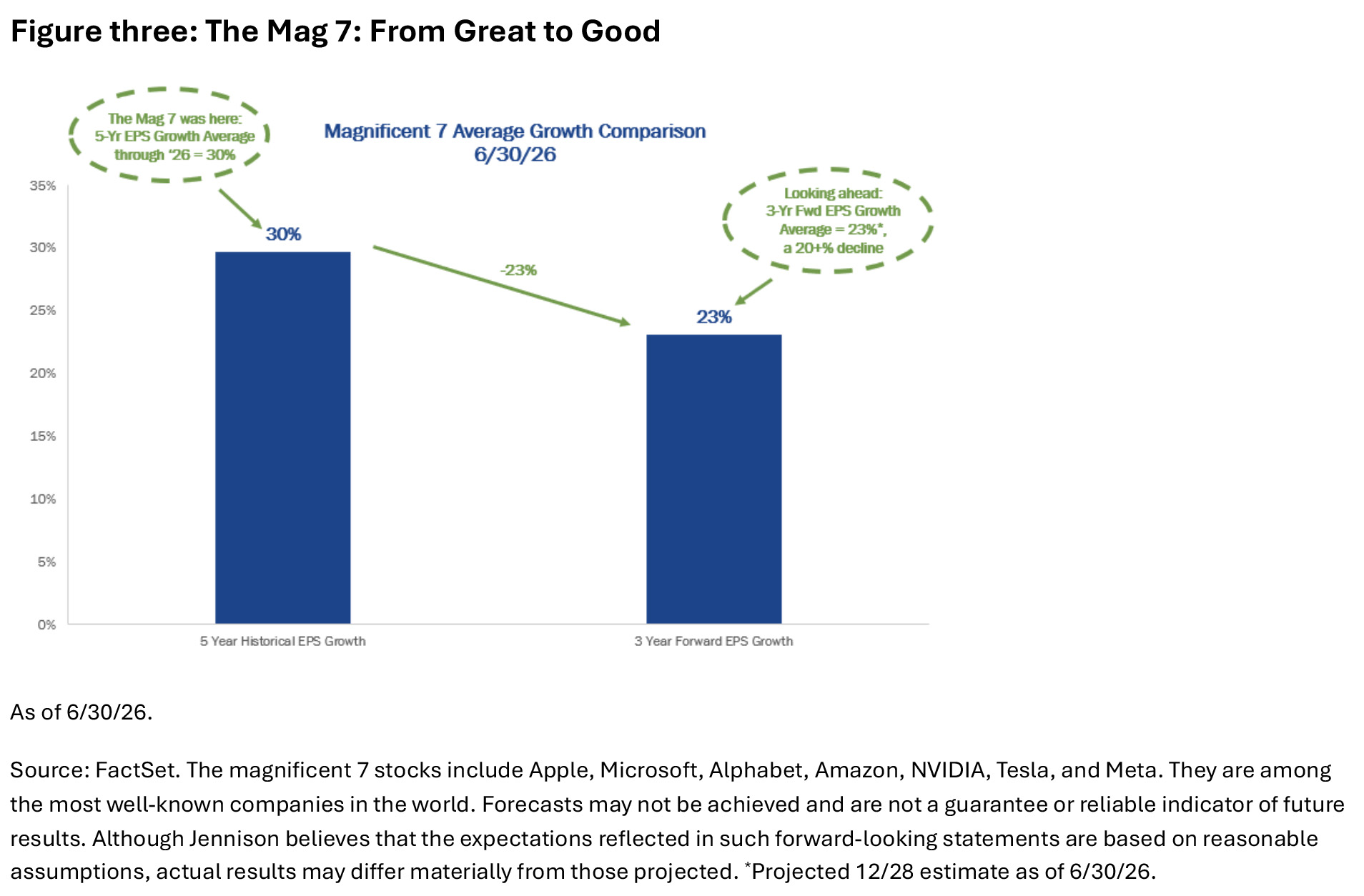
While the Magnificent 7 have been among the fastest growers for years, the reality today is that the cohort’s growth rate has been slowing. They are no longer among the top quintile of growers in the Russell 1000.
The 5-year average earnings per share growth for the Mag 7 was 30% through June 2026. Looking ahead, the 3-year average forward earnings per share growth for the Mag 7 is 23%, which represents a 20+% decline (figure three). The law of large numbers is doing what it usually does to dominant incumbents: making the next double harder than the last. These companies are on a path of normalisation toward a still-attractive but no-longer-exceptional growth rate. The companies that were the index’s growth engine are now poised to grow roughly in line with, rather than well ahead of, a long list of less dominant peers.
None of this is a critique of the Magnificent 7 as businesses. These are high-quality companies with durable competitive advantages, exceptional cash generation, and a leading position in the AI build-out. This is simply what mega-cap scale eventually does to the rate of growth.
The next generation of leaders
Growth investment specialists Jennison looks for two types of growth companies – those with above-average and potentially accelerating growth and those with more stable and consistent growth.
The first are generally the emerging winners in a new and evolving industry or inflecting growers that are innovating within an existing way of doing business. Companies such as these have large and expanding addressable markets and are investing significantly in growth, understating their profits. Many times, the market underappreciates the scale of opportunity as they produce earnings that are well below their potential and before the opportunity is fully reflected in benchmark weights. By design, those companies are underrepresented or absent from a top-heavy passive index.
The second are durable compounders – those with defensible business models, significant competitive moats and long runways of growth ahead of them. These stable growers are high-quality companies, generally with pristine balance sheets, and significant cash flow generation. The market often underestimates the duration of growth of these companies, and the better-than-average returns that their consistent, above-average growth can drive. Many of today’s mega-caps fit this profile.
History shows that market leadership is dynamic: the companies that dominate one era seldom lead the next with the same force. For growth investors, the opportunity is not to abandon proven leaders, but to complement them with quality companies that are emerging winners and inflecting growers that benchmarks may not yet fully recognise. This is where active, diversified growth investing can add meaningful value.
Quality remains an important component of successful investing. Businesses with strong competitive advantages, attractive returns on capital and disciplined capital allocation should continue to create value over time.
However, quality alone is not growth. The characteristics that defined quality during the previous decade may not be the same characteristics that identify the next generation of growth leaders.
Jennison believe growth remains the primary driver of long-term equity returns. Quality should support growth, not replace it. As markets evolve and new sources of growth emerge, investors must continually reassess where future growth resides rather than relying solely on the characteristics that defined success in the past.
Periods of paradigm change have historically created both risk and opportunity. Investors who remain anchored to the characteristics that defined the previous cycle may struggle to identify emerging leaders, while investors willing to look beyond traditional frameworks may discover new sources of growth before they become widely recognised.
The challenge is not abandoning quality. It is recognizing that the characteristics associated with future growth may evolve as the opportunity set evolves.
Many investors focus on identifying today’s quality companies. We believe investors should focus on identifying tomorrow’s quality companies.
Take the FAAA accredited quiz to earn 0.5 CPD hour:
CPD Quiz
The following CPD quiz is accredited by the FAAA at 0.5 hour.
Legislated CPD Area: Technical Competence (0.5 hrs)
ASIC Knowledge Requirements: Securities (0.5 hrs)
please log in to start this quiz
———–
Important Disclosures (as of July 2026): Jennison Associates LLC (“Jennison”) is a registered investment adviser under the U.S. Investment Advisers Act of 1940, as amended, and a Prudential Financial, Inc. (“PFI”) company. Registration as a registered investment adviser does not imply a certain level of skill or training. Jennison has not been licensed or registered to provide investment services in any jurisdiction outside the United States. Additionally, vehicles may not be registered or available for investment in all jurisdictions. Prudential Financial, Inc. of the United States is not affiliated in any manner with Prudential plc, incorporated in the United Kingdom, or with Prudential Assurance Company, a subsidiary of M&G plc, incorporated in the United Kingdom.
Please visit https://www.jennison.com/important-disclosures for important information.
This material is not intended as an offer or solicitation with respect to the purchase or sale of any security or other financial instrument, or any investment management services. It does not constitute investment advice, should not be used as the basis for any investment decision, and does not purport to provide any legal, tax or accounting advice. This is for informational and educational purposes only and should not be construed as investment advice or an offer or solicitation in respect of any products or services to any persons who are prohibited from receiving such information under the laws applicable to their place of citizenship, domicile or residence.
The views expressed herein are those of Jennison investment professionals at the time the comments were made and may not be reflective of their current opinions and are subject to change without notice and should not be considered investment advice. Forecasts may not be achieved and are not a guarantee or reliable indicator of future results. Although Jennison believes that the expectations reflected in such forward-looking statements are based on reasonable assumptions, actual results may differ materially from those projected.
Certain third-party information in this material has been obtained from sources that Jennison believes to be reliable as of the date presented; however, Jennison cannot guarantee the accuracy of such information, assure its completeness, or warrant such information will not be changed. Jennison has no obligation to update any or all such third-party information.
MSCI information may only be used for your internal use, may not be reproduced or redisseminated in any form and may not be used as a basis for or a component of any financial instruments or products or indices. None of the MSCI information is intended to constitute investment advice or a recommendation to make (or refrain from making) any kind of investment decision and may not be relied on as such. Historical data and analysis should not be taken as an indication or guarantee of any future performance analysis, forecast or prediction. The MSCI information is provided on an “as is” basis and the user of this information assumes the entire risk of any use made of this information. MSCI, each of its affiliates and each other person involved in or related to compiling, computing or creating any MSCI information (collectively, the “MSCI Parties”) expressly disclaims all warranties (including, without limitation, any warranties of originality, accuracy, completeness, timeliness, non-infringement, merchantability and fitness for a particular purpose) with respect to this information. Without limiting any of the foregoing, in no event shall any MSCI Party have any liability for any direct, indirect, special, incidental, punitive, consequential (including, without limitation, lost profits) or any other damages.
References to industries are for illustration of the investment process only and should not be considered a recommendation to buy, hold or sell any security.
Your investment objectives, risk tolerance and liquidity needs must be reviewed before suitable programs can be recommended. Asset allocation and diversification strategies do not assure a profit or protect against loss in declining markets. Investors should consult with their attorney, accountant, and/or tax professional for advice concerning their particular situation.
Please remember that there are inherent risks involved with investing in the markets, and your investments may be worth more or less than your initial investment upon redemption. Further, there is no assurance that any strategies, methods, sectors, or any investment programs herein were or will prove to be profitable, or that any investment recommendations or decisions we make in the future will be profitable for any investor or client. Professional money management is not suitable for all investors. There is no guarantee our objectives will be met. All investments contain risk, including possible loss of principal.
CPD Quiz
The following CPD quiz is accredited by the FAAA at 0.5 hour.
Legislated CPD Area: Technical Competence (0.5 hrs)
ASIC Knowledge Requirements: Securities (0.5 hrs)
please log in to start this quiz
———–
Important Disclosures (as of July 2026): Jennison Associates LLC (“Jennison”) is a registered investment adviser under the U.S. Investment Advisers Act of 1940, as amended, and a Prudential Financial, Inc. (“PFI”) company. Registration as a registered investment adviser does not imply a certain level of skill or training. Jennison has not been licensed or registered to provide investment services in any jurisdiction outside the United States. Additionally, vehicles may not be registered or available for investment in all jurisdictions. Prudential Financial, Inc. of the United States is not affiliated in any manner with Prudential plc, incorporated in the United Kingdom, or with Prudential Assurance Company, a subsidiary of M&G plc, incorporated in the United Kingdom.
Please visit https://www.jennison.com/important-disclosures for important information.
This material is not intended as an offer or solicitation with respect to the purchase or sale of any security or other financial instrument, or any investment management services. It does not constitute investment advice, should not be used as the basis for any investment decision, and does not purport to provide any legal, tax or accounting advice. This is for informational and educational purposes only and should not be construed as investment advice or an offer or solicitation in respect of any products or services to any persons who are prohibited from receiving such information under the laws applicable to their place of citizenship, domicile or residence.
The views expressed herein are those of Jennison investment professionals at the time the comments were made and may not be reflective of their current opinions and are subject to change without notice and should not be considered investment advice. Forecasts may not be achieved and are not a guarantee or reliable indicator of future results. Although Jennison believes that the expectations reflected in such forward-looking statements are based on reasonable assumptions, actual results may differ materially from those projected.
Certain third-party information in this material has been obtained from sources that Jennison believes to be reliable as of the date presented; however, Jennison cannot guarantee the accuracy of such information, assure its completeness, or warrant such information will not be changed. Jennison has no obligation to update any or all such third-party information.
MSCI information may only be used for your internal use, may not be reproduced or redisseminated in any form and may not be used as a basis for or a component of any financial instruments or products or indices. None of the MSCI information is intended to constitute investment advice or a recommendation to make (or refrain from making) any kind of investment decision and may not be relied on as such. Historical data and analysis should not be taken as an indication or guarantee of any future performance analysis, forecast or prediction. The MSCI information is provided on an “as is” basis and the user of this information assumes the entire risk of any use made of this information. MSCI, each of its affiliates and each other person involved in or related to compiling, computing or creating any MSCI information (collectively, the “MSCI Parties”) expressly disclaims all warranties (including, without limitation, any warranties of originality, accuracy, completeness, timeliness, non-infringement, merchantability and fitness for a particular purpose) with respect to this information. Without limiting any of the foregoing, in no event shall any MSCI Party have any liability for any direct, indirect, special, incidental, punitive, consequential (including, without limitation, lost profits) or any other damages.
References to industries are for illustration of the investment process only and should not be considered a recommendation to buy, hold or sell any security.
Your investment objectives, risk tolerance and liquidity needs must be reviewed before suitable programs can be recommended. Asset allocation and diversification strategies do not assure a profit or protect against loss in declining markets. Investors should consult with their attorney, accountant, and/or tax professional for advice concerning their particular situation.
Please remember that there are inherent risks involved with investing in the markets, and your investments may be worth more or less than your initial investment upon redemption. Further, there is no assurance that any strategies, methods, sectors, or any investment programs herein were or will prove to be profitable, or that any investment recommendations or decisions we make in the future will be profitable for any investor or client. Professional money management is not suitable for all investors. There is no guarantee our objectives will be met. All investments contain risk, including possible loss of principal.


Have feedback on this article? Contact Us
Earn CPD Points
 CPD: US middle market private credit – the investment case
In today’s rapidly shifting investment landscape, traditional sources of fixed income are struggling to meet the yield and diversification needs of investors. They are also becoming more closely correlated with [...]
 CPD: A new global order and implications for investors
The new global order differs from its predecessor in four ways, as outlined in the following article from GSFM’s investment partner TD Epoch. For decades, the US has been unrivalled [...]
 CPD: Is your approach to client risk profiling putting you at risk?
Introduction The shockwaves that followed the announcement of ‘Liberation Day’ tariffs by Donald Trump brought an abrupt and unsettling end to a three-year bull market. Major global indices plummeted by [...]