

Integrating trend following into an investment strategy serves as a structural mechanism for portfolio resilience rather than a short-term market play.
Trend following strategies aim to generate returns by capturing sustained price movements across a diverse range of asset classes. Unlike traditional investment approaches that rely on valuation or forecasting, trend following is fundamentally reactive. It is built on the premise that asset prices exhibit momentum; that is, rising prices tend to keep rising, and falling prices tend to keep falling, for periods longer than pure randomness would suggest.
Trend following does not seek to forecast markets or prices. Instead, it identifies the direction of an established trend and positions the portfolio accordingly:
- In prolonged bull markets a trend following strategy takes long positions to profit from continued upward momentum
- In extended bear markets a trend following strategy takes short positions to capitalise on continuing downward price movements, providing a source of portfolio diversification and crisis alpha
While market selection, position sizing and risk controls dictate the intricacies of execution, the core objective remains constant: identify the direction of a market trend and assess its potential duration.
Traditional trend following markets
At face value, trend following is a simple strategy. Buy something that is going up; and sell something that is going down. However, Finance 101 says that trends should not exist; markets are efficient and information is instantaneously reflected in prices. This ignores the fact that decisions lag news flow, that economic cycles play out over years and that humans get emotional and sometimes make irrational choices.
Trend following strategies eliminates the factors that can impede good decision making. Instead, it identifies and captures trends across a range of sectors: stocks, bonds, currencies, agricultural investments, commodities, interest rates, energy and utilities and credit. Strategies typically invest across hundreds of markets and sectors at any one time.
Traditional trend-following markets are the large, exchange‑traded futures and forwards: equity indices (for example, S&P 500), government bonds (US Treasuries), major foreign exchange (USD/GBP) and core commodities (such as gold, copper or crude oil). They are highly liquid, transparent and operationally simple, with deep capacity, tight bid/ask spreads and long data histories, making them efficient to access at scale. Trend following across these markets offers the combined attractiveness of a positive expected long-run Sharpe ratio and positive expected crisis Sharpe ratio[1]. As a reminder, the Sharpe ratio is a metric for risk-adjusted return, which shows excess return per unit of risk.
Traditional markets can also proxy the key macro risk factors present in the global economy. For example, growth, inflation, monetary policy and world trade movements can all be captured using a combination of these liquid markets.
Figure one shows market combinations that may be sensitive to moves in each of these macro factors. These are illustrative examples – and trend following will capture many more effects – but in big macro events such as an equity collapse, these core markets typically feel the largest impact.
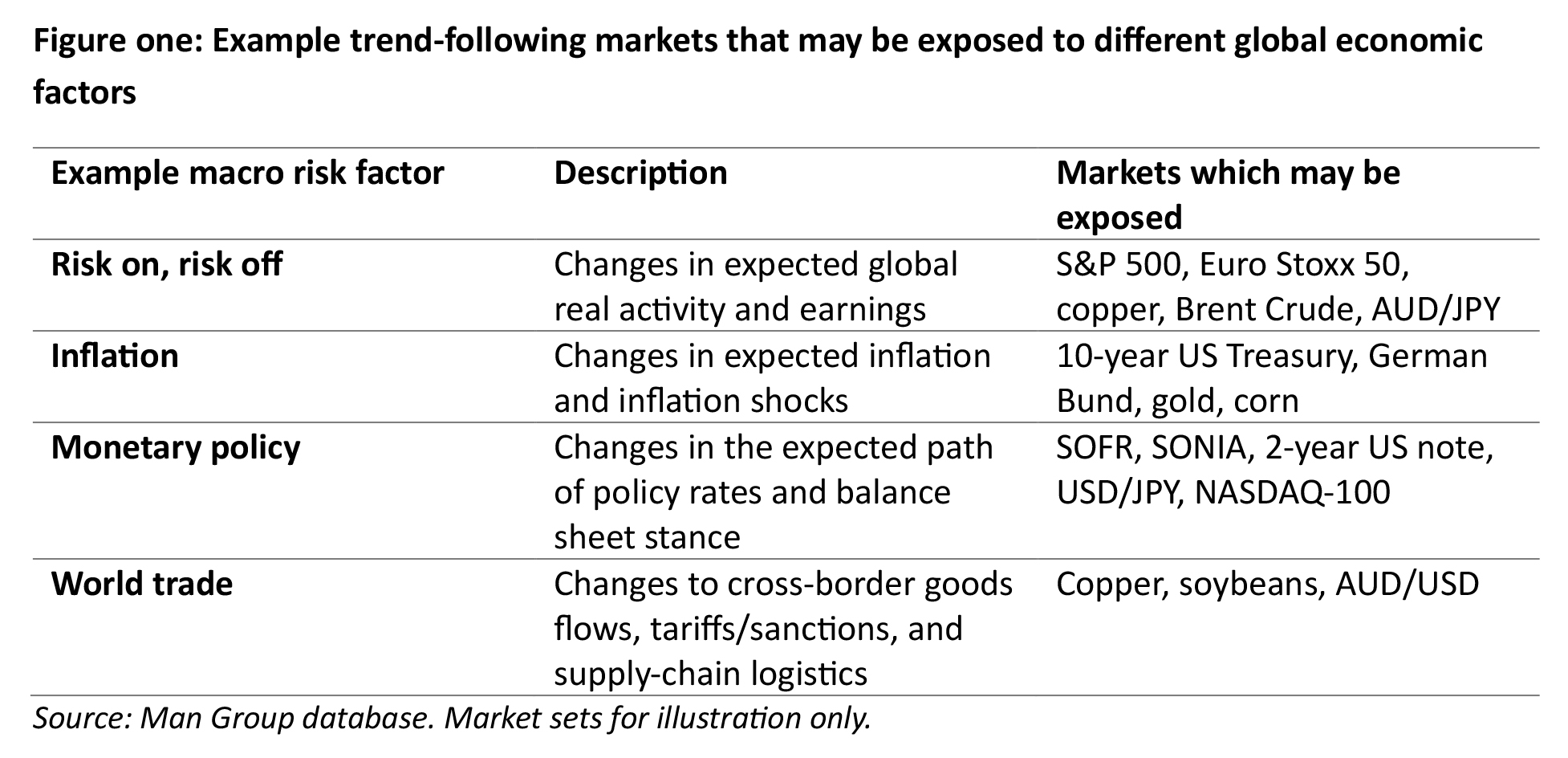

Since trend-following models can be both long and short, traditional markets tend to exhibit the strongest defensiveness (higher expected crisis Sharpe ratio) during broad, cross‑asset sell‑offs, providing potential ‘crisis alpha’ to multi‑asset portfolios. In stressed environments, movements in the largest macro risk factors are amplified, generating more opportunities for trend to position appropriately (long or short) and to benefit. However, the influence of these macro factors is not constant. They can go through periods of being more or less significant in the context of the global economy.
Given the unpredictable nature of price trends, trend following strategies often broaden their scope to encompass both traditional and alternative markets. Alternative markets offer exposure to idiosyncratic, market-specific risk factors that drive diversifying price trends.
Alternative markets come in many forms and historically, Man Group’s research demonstrates the application of trend following models to this diversified set of markets has delivered higher absolute returns. Importantly, classifying a market as alternative doesn’t equate to it being inherently less liquid.
Synthetic markets – which allow trend followers to trade themes in markets versus the markets themselves – can also provide further diversification from traditional markets. A well-documented example is equity styles; constructed by cross-sectionally ranking cash equities based on fundamental metrics representative of a particular investment style. Trend following applied to equity styles not only offers a more robust way to monetise equity styles but is also highly diversifying to traditional index-based trend following.
Why invest in trend following strategies?
There are five key reasons to consider a trend following strategy for clients:
1. Diversification
Diversification is the primary tool for increasing portfolios’ Sharpe ratio. Because trend following strategies trade across a broad spectrum of uncorrelated global assets, they provide a reliable mechanism for dampening volatility and enhancing portfolio diversification.
Many of traditional assets have similar underlying return drivers: stocks, fixed income, real estate and private equity all rely on a growing economy for price appreciation. When this driver breaks down due to geopolitical uncertainty and market events, these assets can sell off together. Diversification often fails when investors need it most.
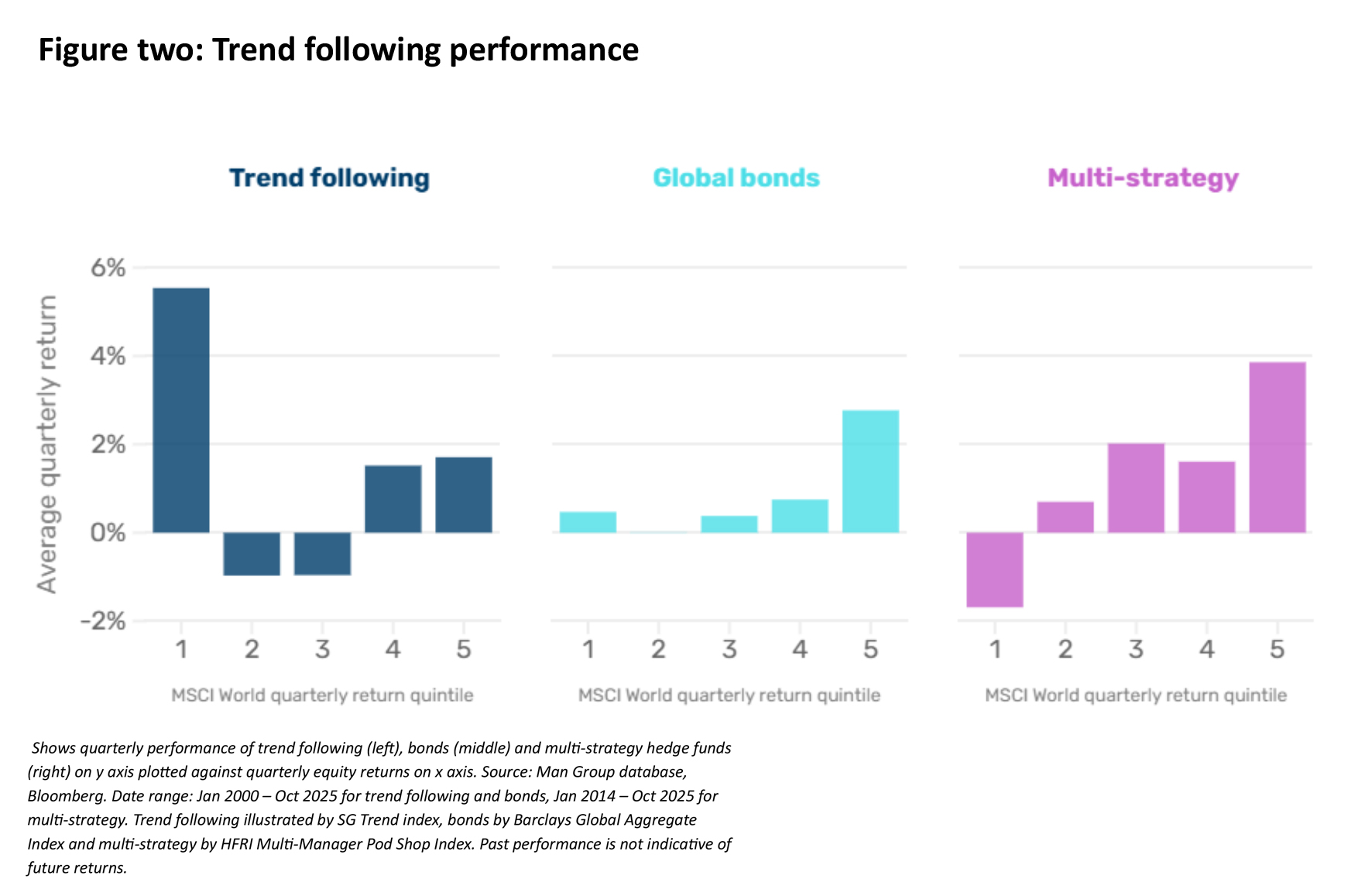
This is where trend following comes in. Unlike traditional assets, trend following does not rely on economic growth to generate returns and has historically been uncorrelated to equities, bonds, real estate and other asset classes. More importantly, it has tended to perform best precisely when other asset classes struggle, offering a valuable counterbalance when stocks are meaningfully down[2].
Figure two summarises this defensive property, with trend historically delivering in the worst periods for equities, while the performance of bonds and multi-strategy hedge funds are mixed.

2. Low correlation to traditional assets
In recent years, the traditional negative correlation between equities and bonds has broken down. Historically, bonds acted as a reliable cushion during stock market downturns. However, recent periods of high inflation and aggressive central bank interest rate hikes have caused both asset classes to move in the same direction, pushing their correlation into positive territory.
This shift has impacted the traditional 60/40 portfolio, most notably in 2022 when both equities and fixed income suffered simultaneous, double-digit losses. Because bonds can no longer be guaranteed to offset equity risk, financial advisers increasingly look beyond the 60/40 model, incorporating alternative strategies to achieve true portfolio diversification. Trend following strategies are a good example because they are structurally agnostic to asset class correlations and can take short positions.
Furthermore, because these strategies trade across dozens of uncorrelated global sectors, they provide exposure to return drivers that are completely absent from a standard equity and bond portfolio.
3. Risk/return and ‘crisis alpha’
Integrating trend following into a portfolio of traditional assets generally improves performance consistency while reducing volatility and drawdowns. Because these strategies can profit from downward price trends, they offer critical capital preservation when traditional markets decline.
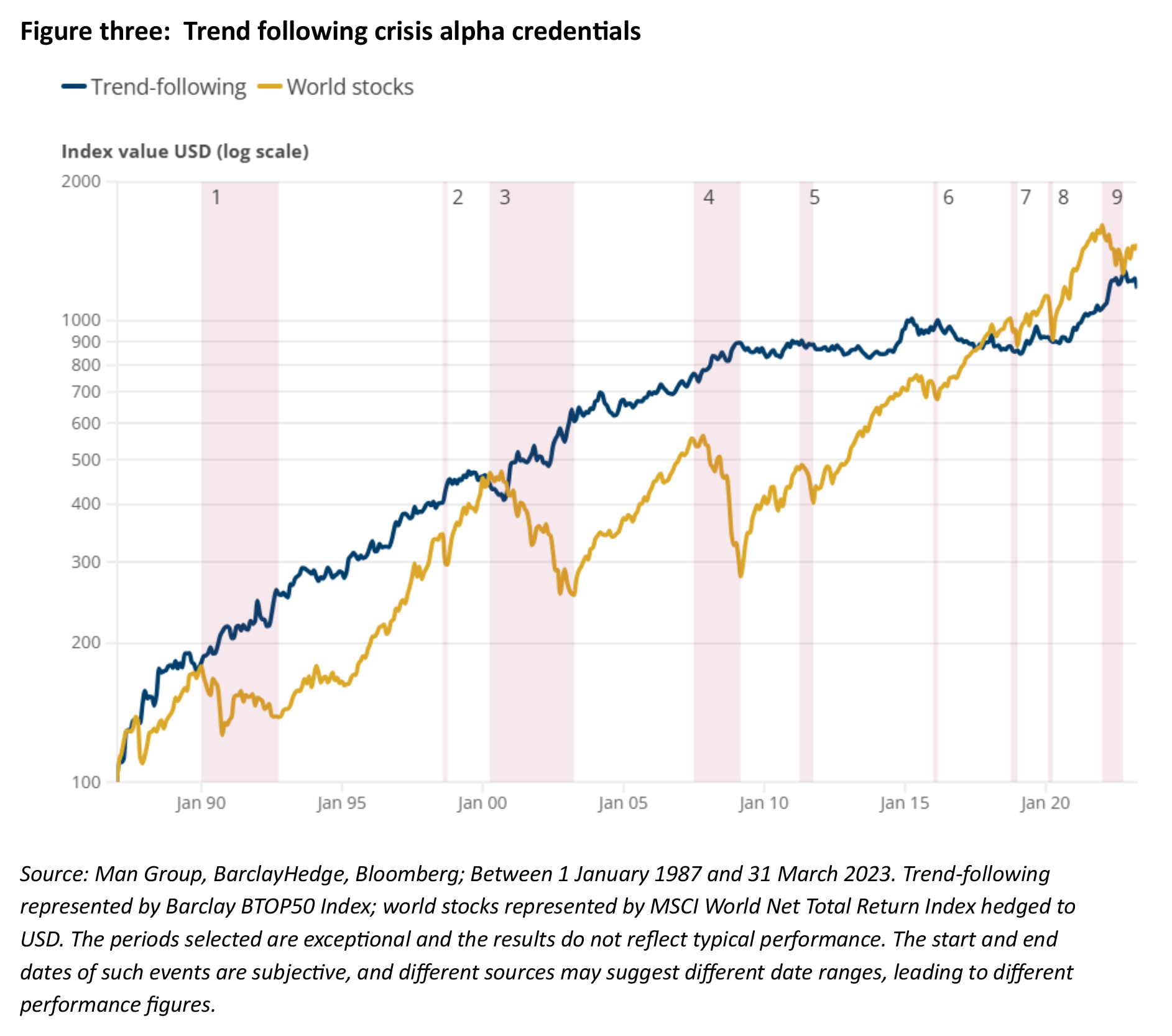
‘Crisis alpha’ is a term that describes the structural ability of trend-following strategies to generate positive absolute returns during periods of sustained equity market distress and economic shocks. The term was formalised by authors Greyserman & Kaminski who used centuries of historical market data to demonstrate that because trend following systems are automated, rules-based and capable of taking short positions, they reliably provide a unique form of ‘insurance’ or alpha exactly when traditional 60/40 portfolios suffer major drawdowns[3].

4. Liquidity
Trend following strategies invest across hundreds of liquid markets and usually offer investors daily liquidity; trend following is much less likely to get ‘locked up’ in the event of a market crisis.
5. Manage investor behaviour
By removing human emotion and biases through an entirely systematic, rules-based process, trend following offers a powerful behavioural benefit. This disciplined framework prevents clients from panic-selling or chasing overvalued assets during market extremes.
Equity and trend make good friends
Most advisers have experienced first-hand the frustration of seeing parts of a portfolio designed to provide ballast not always hold up as markets turn volatile. A historic case in point was the 2022 sell-off, when stocks and bonds declined in tandem. Even during the more recent shock of the war in the Middle East, stocks initially slumped and yields shot up.
As outlined earlier in this article, trend following has historically displayed a diversifying edge in times of market stress (for both equity and bond crises), solidifying its role as an alpha component which is not only diversifying but also may provide portfolio insurance properties.
It works for three reasons. First, as noted earlier, human behaviour tends to be predictable. Investors consistently underreact to new information and overreact to fear, creating trends that persist longer than efficient-market theory (the idea that asset prices already reflect all available information, so you can’t ‘beat’ the market) would suggest. Second, economic cycles can potentially play out over years, driving sustained directional moves in interest rates, currencies, commodities and other drivers. Third, decisions lag news flow. Information doesn’t get priced instantaneously; it gets digested, debated and acted upon gradually.
The data shows trend following to be a complement to equities (figure four). Going back to 2000, comparing US equities (S&P 500) and trend following over 12-month periods, Man Group found trend following is additive most of the time (almost 95%) to US equities.
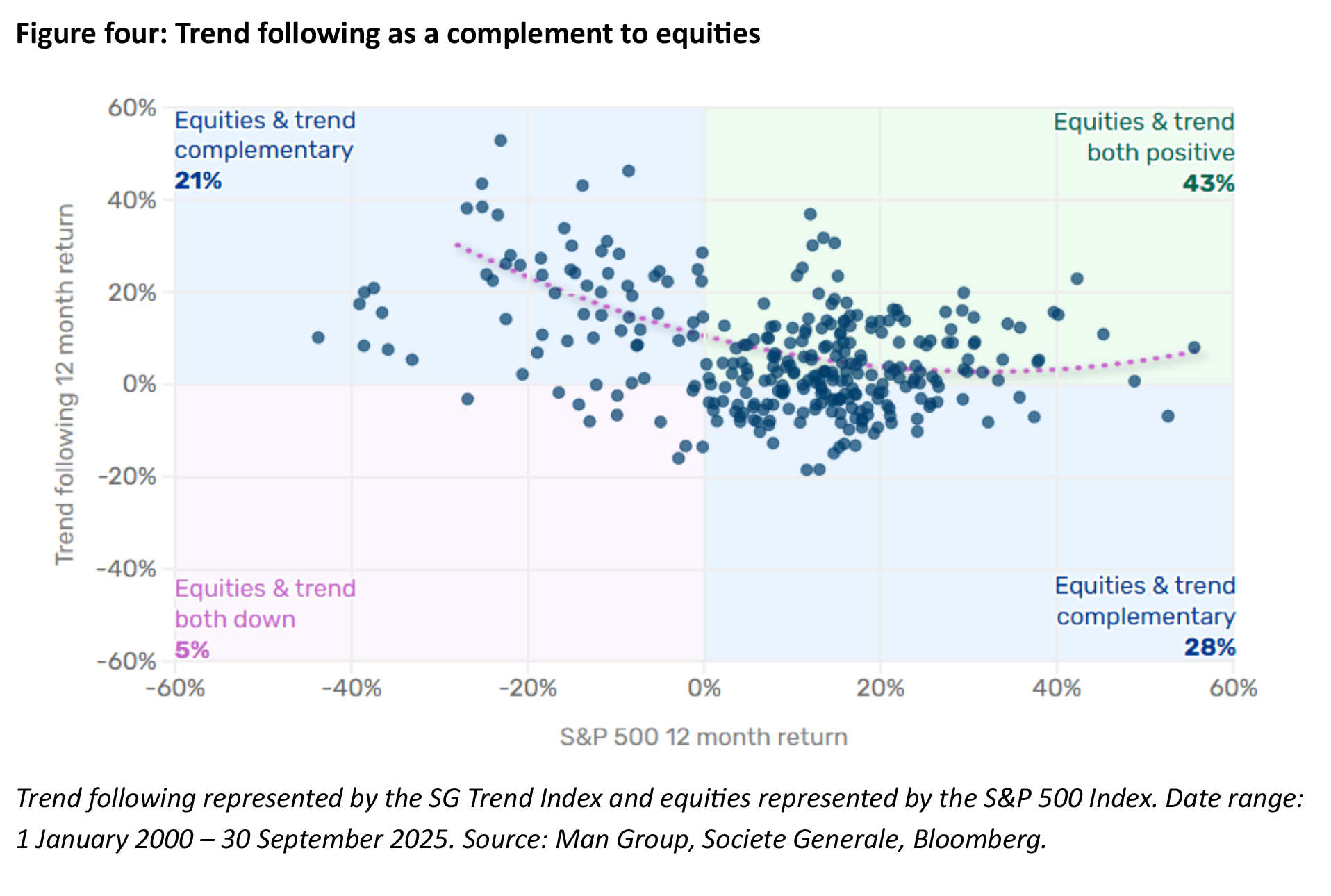

In 46% of 12-month periods, both trend and equities are positive while in 50% of 12-month periods, one component helps offset negative returns from the other. Only 4% of 12-month periods result in both components delivering a negative return. Finally, in about a quarter of the observations, when US equities are negative, trend following generated a positive return 82% of the time.
Trend following exhibits convexity: its returns grow more positive the more asset prices move significantly in either direction. During the dot-com crash, the Global Financial Crisis and the 2022 inflationary episode, trend following delivered competitive positive returns while traditional assets suffered. This ‘crisis alpha’ property is a key attribute which can differentiate trend following from other alternatives that tend to underperform in the left tail of equity markets. When markets move a lot, either up or down, trend following strategies tend to do well.
When considering a trend following strategy for your clients, there are some important questions to ask:
- Is the strategy true to label and has it remained so over time?
- Has the strategy delivered crisis alpha in times of market downturns?
- Is the strategy performing as expected during inflationary periods?
- Is the strategy liquid and transparent?
- Does the strategy harness the latest technology – machine learning, artificial intelligence, platforms for swift execution of trades?
Integrating trend following into an investment strategy serves as a structural mechanism for portfolio resilience rather than a short-term market play. By functioning as a form of portfolio insurance that generates positive expected returns over time, the strategy provides downside protection as a byproduct of growth, rather than as a net cost like traditional put options. Maintaining a long-term strategic commitment allows the strategy to effectively stabilise a portfolio during major market dislocations.
Take the FAAA accredited quiz to earn 0.5 CPD hour:
CPD Quiz
The following CPD quiz is accredited by the FAAA at 0.5 hour.
Legislated CPD Area: Technical Competence (0.5 hrs)
ASIC Knowledge Requirements: Managed Investments (0.5 hrs)
please log in to start this quiz

———-
Notes:
[1] A Trend Following Deep Dive: The Optimal Market Mix for a Trend Follower, Man Group, January 2026
[2] Ibid.
[3] Trend Following with Managed Futures: The Search for Crisis Alpha, Greyserman & Kaminski, 2014
Important information: The information included in this article is provided for informational purposes only and is general advice only. It does not take into account an investor’s own objectives. The information contained in this article reflects, as of the date of publication, the current opinion of Man Group plc and is subject to change without notice. Sources for the material contained in this article are deemed reliable but cannot be guaranteed. We do not represent that this information is accurate and complete, and it should not be relied upon as such. Any opinions expressed in this material reflect our judgment at this date, are subject to change and should not be relied upon as the basis of your investment decisions. All reasonable care has been taken in producing the information set out in this article however subsequent changes in circumstances may occur at any time and may impact on the accuracy of the information. Neither Man Group plc, GSFM Pty Ltd, their related bodies nor associates gives any warranty nor makes any representation nor accepts responsibility for the accuracy or completeness of the information contained in this article. Past performance does not guarantee future results.
CPD Quiz
The following CPD quiz is accredited by the FAAA at 0.5 hour.
Legislated CPD Area: Technical Competence (0.5 hrs)
ASIC Knowledge Requirements: Managed Investments (0.5 hrs)
please log in to start this quiz

———-