

Mano Mohankumar and Ian Fryer
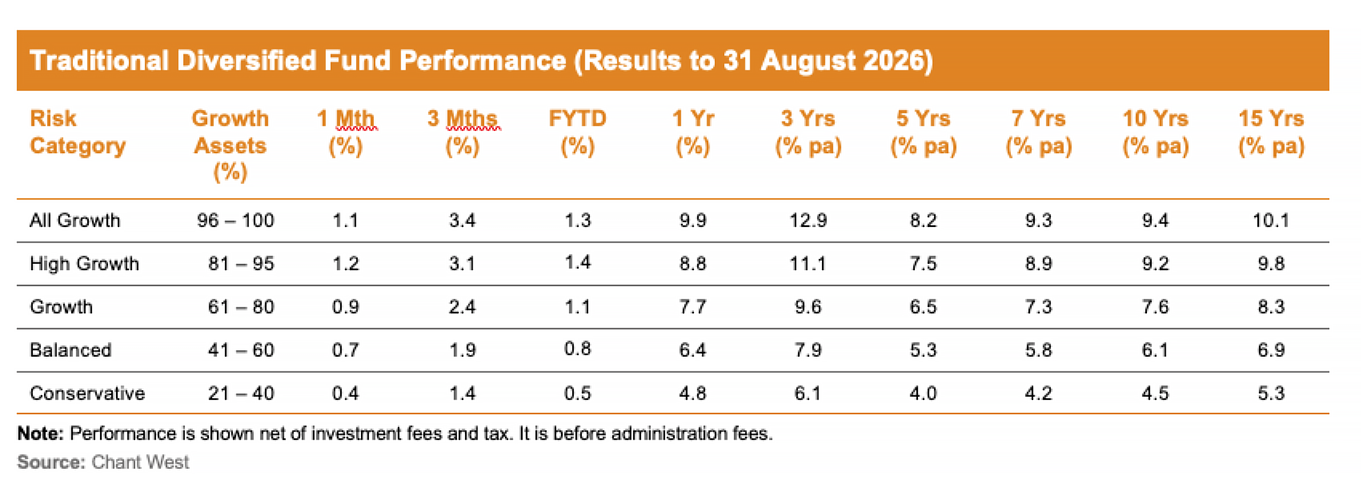
Despite concerns around inflation and ongoing geopolitical tensions, super funds were up in August with the median growth fund (61–80% growth assets) gaining 0.9%. That lifted the return over the first two full months of FY27 to 1.1%.
Chant West Head of Superannuation Investment Research, Mano Mohankumar, says the healthy return for August was driven by domestic and global share markets, which in aggregate account for about 55% of a typical growth portfolio. “Despite some volatility towards the latter part of August, over the full month, developed market international shares advanced 2.5% in hedged terms led by the US. Markets were supported by strong corporate earnings and the tech sector regained momentum after some AI-related companies had been sold down in July. The Australian dollar appreciated over the month, which pulled the 2.5% hedged return back to 0.5% in unhedged terms. On average, super funds have about 70% of international shares unhedged. Emerging markets also finished higher, returning 1.3%.
“Australian shares gained 1.6% over the month, which fell short of developed international markets, but it was still a solid result, with the resources sector leading the way and offsetting weaker performance from financials. In a volatile month for bond markets, performance was mixed with Australian bonds down 0.2% and international bonds up slightly at 0.2%.”
The table below compares the median performance to the end of August 2026 for each of the traditional diversified risk categories in Chant West’s Super Fund Performance Survey, ranging from All Growth to Conservative. All risk categories have generally met their typical long-term return objectives, which range from CPI + 1.5% for Conservative funds to CPI + 4.25% for All Growth.
Long-term performance remains above target
MySuper products have been operating for over 12 years, so when considering performance, Mohankumar says it’s important to remember that super is a much longer-term proposition.
“Since the introduction of compulsory super in July 1992, the median growth fund has returned 8% p.a. The annual CPI increase over the same period is 2.7%, giving a real return of 5.3% p.a. – well above the typical 3.5% target. Even looking at the past 20 years, which includes three major share market downturns – the GFC in 2007-2009, COVID-19 in 2020, and the high inflation and rising interest rates in 2022 – super funds have returned 6.9% p.a., which is still ahead of the typical objective.”
The chart below shows that for most of the time, the median growth fund has exceeded its return objective over rolling 10-year periods, which is a commonly used timeframe consistent with the long-term focus of super. The exceptions are two periods between mid-2008 and late-2017, when it fell behind. This is because of the devastating impact of the 16-month GFC period (end-October 2007 to end-February 2009) during which growth funds lost about 26% on average.
By Mano Mohankumar, Head of Superannuation Investment Research and Ian Fryer, General Manager.


