
Key points
- Australian housing is not in a bubble but it is very overvalued, and combined with high debt levels leaves Australian households vulnerable should anything significantly threaten house prices. It is a reason for the RBA to tread carefully in raising interest rates.
- Poor and worsening affordability will likely lead to soft house prices over the next year or so. Key factors to watch for in terms of the risk of a substantial housing slump are a collapse in China leading to much higher unemployment, excessive tightening by the RBA and a big increase in the supply of housing. None seem likely in the short term, but are worth keeping an eye on.
Introduction
Australia has come through the global financial crisis in good shape. However, there is one nagging concern – what I have long called Australia’s Achilles heel – and that is the excessive level of house prices and associated household debt. Lately the debate has focussed on whether Australian housing is a bubble, with some saying it’s expensive and therefore must be a bubble, which will burst with disastrous consequences.
This view is epitomised in a recent article in The Philadelphia Trumpet (a US newspaper) that warned “Pay close attention, Australia. Los Angelification (referring to the 40% slump in LA house prices) is coming to a city near you.” The counter view is Australian housing may be expensive but not dramatically so & can be justified by a severe undersupply.
Is Australian housing in a bubble?
It is natural for those in the US to look at Australian house prices and see a bubble. Australian house prices have left US prices for dead over the last two decades.

Source: Case-Shiller, Nationwide, ABS, AMP Capital Investors
But is it really a bubble? An asset bubble is thought to require: overvaluation, easy money fuelling price gains and speculators buying on the basis that past price gains will continue amidst euphoric investor psychology. In terms of overvaluation, Australian housing gets a tick. On most measures Australian housing is very expensive. Australian house prices are running around 35% above their long term trend (see the next chart). According to the OECD the ratio of house prices to incomes is about 36% above its long term average and the ratio of house prices to rents is 58% above its long term average, both of which are at the top end of OECD countries.

Source: ABS, AMP Capital Investors
But other signs for the presence of a bubble are absent.
- Housing credit is only growing at about 8% pa (well down from the 20% pace seen about seven years ago).
- Only 39% of housing finance is going to investors (compared to more than 50% seven years ago).
- There is no sense anymore that buyers are rushing in for fear of missing out.
- Weekend auction clearance rates have slumped.

Source: Australian Property Monitors
- The Australian housing market hasn’t seen the same deterioration in lending standards that occurred in other countries over the last decade: loan to valuation ratios for new dwellings are little changed over the last decade; homeownership rates haven’t increased – in fact they have fallen for the typical first home buyer age group; and non-conventional loans (eg sub prime loans, option ARMs, etc) have never had a strong foothold.
- Most of the increase in mortgage debt over the last few decades went to older and wealthier Australians.
- There is little evidence Australians are struggling with their mortgages. Non-performing housing loans are less than 1% of the total and have been around this level for years. In the US the comparable figure is 8%.
And finally, Australia does suffer from a shortage of housing. In contrast to the US which saw a huge supply surge during its period of strong price gains into 2006, the supply of housing has been subdued in Australia, particularly relative to the expansion in the population, which has been faster than in India over the last five years. As a result, according to the National Housing Supply Council there is now a cumulative net shortfall of about 200,000 dwellings. And on current trends this is set to get much worse. The undersupply is reflected in continuing low vacancy rates in rental housing – currently averaging 1.6%.
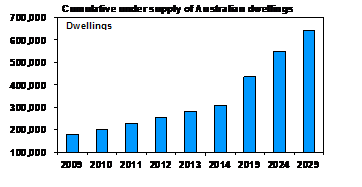
Source: National Housing Supply Council
Outlook
While Australian housing is very overvalued, it’s not inevitable it will have a bust. Many of the tell tale signs of a bubble are not present and just because house prices are overvalued doesn’t guarantee a bust. For example, the Bank for International Settlements found that of 16 housing booms studied over the 1970 to 2001 period only six ended in a bust. However, there is little doubt the intersection of high house prices with high household debt levels leaves Australia vulnerable. Key potential triggers for a bust would be a big increase in the supply of new dwellings, a big rise in unemployment perhaps on the back of a collapse in China or a big rise in interest rates. Right now none of these seem likely. There is no sign of any imminent large land release from state governments, China is trying to cool down a food driven increase in inflation but is not likely to tolerate a sharp slowdown in growth and the RBA is likely to tread carefully in raising interest rates, particularly after banks added more to the last rate hike.
The most likely outcome is an extended period of constrained range bound house prices as average income levels catch up. To some extent this is what has occurred in Sydney over the last six years. After strong gains into early this year, house price gains have since been flattened by a return to poor affordability. With mortgage rates rising sharply in November, and more increases likely next year, a further deterioration in affordability is likely and this could well see prices fall slightly over the year ahead. While the shortage of housing should prevent a sharp fall in prices, a rise in mortgage rates (currently around 7.8%) to much above 8.5% could prove to be a big dampener on house prices next year.

Source: Commonwealth Bank/HIA. REIA, AMP Capital Investors
Is housing a good investment?
After allowing for costs, residential investment property and shares generate similar long term returns. This can be seen in the next chart, which shows an estimate of the long term return from housing, shares, bonds and cash.

Source: ABS, REIA, Global Financial Data, AMP Capital Investors
Over the long term, the returns from housing and shares tend to cycle around each other at similar levels. In fact, both have returned an average of 11.5% pa over the last 80 years or so. While housing is less volatile than shares and for many seems safer, it offers a lower level of liquidity and diversification. The bottom line is once the similar returns of housing and shares are allowed for, and these characteristics are traded off, there is a case for both in investors’ portfolios over the long term. For the time being, with housing looking expensive and offering a net rental yield of around 1.5%, shares are probably a better bet as they are cheap on most valuation measures and offer a more attractive dividend yield of around 5 to 5.5% once allowance is made for franking credits.
Concluding comments
At this stage a housing bust in Australia seems unlikely. Key things to watch for though would be a surge in supply, much higher levels of interest rates and anything that sharply pushed up unemployment. In the meantime a lack of supply should prevent sharp falls in prices, but on the flipside, the continuing drip feed of higher interest rates will likely serve to weaken prices slightly over the year ahead.
Key points
· Australian housing is not in a bubble but it is very overvalued, and combined with high debt levels leaves Australian households vulnerable should anything significantly threaten house prices. It is a reason for the RBA to tread carefully in raising interest rates.
· Poor and worsening affordability will likely lead to soft house prices over the next year or so. Key factors to watch for in terms of the risk of a substantial housing slump are a collapse in China leading to much higher unemployment, excessive tightening by the RBA and a big increase in the supply of housing. None seem likely in the short term, but are worth keeping an eye on.
Introduction
Australia has come through the global financial crisis in good shape. However, there is one nagging concern – what I have long called Australia’s Achilles heel – and that is the excessive level of house prices and associated household debt. Lately the debate has focussed on whether Australian housing is a bubble, with some saying it’s expensive and therefore must be a bubble, which will burst with disastrous consequences. This view is epitomised in a recent article in The Philadelphia Trumpet (a US newspaper) that warned “Pay close attention, Australia. Los Angelification (referring to the 40% slump in LA house prices) is coming to a city near you.” The counter view is Australian housing may be expensive but not dramatically so & can be justified by a severe undersupply.
Is Australian housing in a bubble?
It is natural for those in the US to look at Australian house prices and see a bubble. Australian house prices have left US prices for dead over the last two decades.