
Headline developments of the past week
- There was good news out of China with January inflation coming in lower than expected owing to a lower than expected rise in food prices. However, this is unlikely to head of further monetary tightening as non-food inflation actually rose more than expected. Credit data also came in weaker than expected but Chinese import and export data both surprised on the upside but may have been distorted by the Chinese New Year. We remain of the view that China is unlikely to tighten aggressively enough to crunch its economy.
- While higher inflation has already hit emerging market shares, it hasn’t so far been much of an issue for shares in developed countries. Plenty of spare capacity suggests that central banks in the US and Europe have no need to tighten any time soon. However, this won’t necessarily stop investors from worrying about it. In fact, an up tick in inflation rates in the US, Europe and the UK is seeing the debate about when central banks will start to tighten in these countries hot up. As a result, worries about when and by how much interest rates will rise in key advanced countries could become a source of angst for investors.
Major global economic releases and implications
- US economic data continued to add to confidence that the US economic recovery is becoming stronger. Industrial production fell marginally in January but this followed a strong rise in December and manufacturing conditions surveys from the New York and Philadelphia regions point to strong industrial production going forward. While retail sales were subdued on the back of snow storms in January they are up a solid 7.6% from year ago levels. And although homebuilders can see no improvement in demand, at present, housing starts rose in January. On top of this mortgage delinquencies and new foreclosures are now falling and the US leading index rose in January. Meanwhile, in recognition of the improvement in the US economy the US Federal Reserve revised up its growth outlook slightly, but it remains sceptical that unemployment will come down fast enough and it remains relaxed about inflation. However, while the Fed remains relaxed for now a pick up in core inflation in January, albeit only to 1% year on year, is seeing debate about the timing of the Fed’s move towards tightening heat up.
- European GDP growth for the fourth quarter of 2010 was less than expected at 0.3% quarter on quarter or 2% year on year. This may have been due to cold weather. However, strong business confidence readings and rising consumer confidence point to a further acceleration in European growth. UK inflation reached 4% in January, but Bank of England Governor Mervyn King played down talk of an interest rate hike.
- Japanese GDP shrank by 0.3% in the December quarter of 2010, but most leading indicators point to a rebound in growth ahead. The main causes of the contraction were the expiry of government stimulus measures and negative external demand, which is likely now reversing..
- The strength of growth in Asia and the problem of rising inflation were highlighted by news that Singapore grew 12% through last year and that it has revised up its inflation forecast. This points to more monetary tightening which in Singapore’s case means further appreciation in the Singaporean dollar.
Australian economic releases and implications
- Australian economic data was mixed. Housing finance rose in December, adding to the impression that it has stabilised after a sharp fall into early 2010, and the Westpac leading index rose. Against this motor vehicle sales fell in January and skilled vacancies fell in February with the floods likely playing a role in both.
- In Australia, the December half earnings reporting season has been pretty solid so far. Certainly not the big downer many had feared. Of course BHP Billiton shot the lights out with an 88% rise in profits but good results were also seen from Dominos Pizza, Lend Lease, Qantas and Wesfarmers over the last week. So far 49% of companies have come in above expectations compared to a norm over the last seven years of 46% and 73% of companies have reported a rise in profits on a year ago. Interestingly despite the gloom and doom amongst many investors the ratio of positive to negative outlook statements is running at around 4 to 1 compared to 2 to 1 last August. However, we are still only 46% of the way through the reporting season. Two themes are apparent. First, there is a huge divergence between the very strong results seen from resources companies, solid gains from the banks and more mixed and constrained results from the rest of the market. Second, Australian companies are starting to return cash to shareholders via increased dividends or share buybacks. With corporate cash holdings at record levels and gearing low there is plenty of scope for further increases in dividends and more buybacks going forward, both of which are positive for the share market.
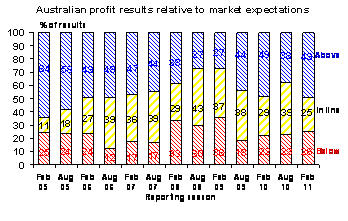
Source: AMP Capital Investors
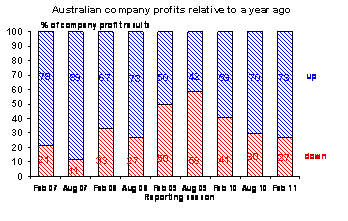
Source: AMP Capital Investors
Major market moves
- Despite increasing worries about inflation and ongoing unrest in various countries in the Middle East, share markets had another solid week on the back of increasing confidence in the global growth outlook. Australian shares were also supported by better than feared profit results.
- Despite stronger growth data and emerging inflation concerns in developed countries bond yields fell, partly on tensions in the Middle East.
- Commodity prices were mixed with oil, gold and food prices up but some metal prices falling. The Australian dollar continued to range around parity against the $US with no clear direction.
What to watch in the week ahead?
- In the US, consumer confidence data (due Tuesday) is likely to show a further improvement, durable goods orders (due Thursday) are likely to rebound after a weak December, existing home sales (Wednesday) and new home sales (Thursday) are likely to fall back a touch in January after strong gains in December and house prices are likely to have recorded a slight fall in December.
- In Australia, data for construction spending (due Wednesday) and business investment (Thursday) will help firm up expectations with respect to how weak December quarter GDP data due March 2nd will be. A speech by RBA Governor Glenn Stevens will be watched closely for clues regarding the interest rate outlook but it’s unlikely that the message will be any different from that of the last two weeks, ie, that the RBA retains an optimistic medium term outlook but is happy to leave interest rates on hold for now.
- In Australia, it will be the biggest week in the December half reporting season with about 90 major companies due to report including Amcor, Mirvac, Woodside, Oil Search, AGL, Coca Cola, IAG, Origin, GPT and Woolworths. The results are likely to continue to reflect the two speed Australian economy with resources and related stocks doing very well on the back of the surge in commodity prices but non-bank industrials likely to be much more constrained reflecting the soft housing and retail sectors and the strong $A.
Outlook for markets
- After months of strong gains globally, shares are overbought and due for a correction. With investor sentiment towards shares running at high levels a range of factors could provide the trigger including inflation worries, Middle East tensions and the renewed rise in bond yields in debt troubled European countries. However, any pullback in shares should be seen as a buying opportunity as the fundamental backdrop for shares is very positive. Valuations are reasonable, the global economic recovery is looking stronger, the corporate sector is cashed up and starting to buy back shares and boost dividends, and investors are only just starting to switch from bond funds into share funds.
- The broad trend in the $A is likely to remain up as the US dollar and the euro remain under downwards pressure, interest rates in Australia remain relatively high, and high commodity prices keep the terms of trade near early 1950s highs. By year-end, the $A is likely to have reached $US1.10.
- The risk of a sharp back-up in global bond yields this year is very high. Bond yields, particularly in the US are still below longer-term sustainable levels and bond funds are now starting to see outflows.
Important note: While every care has been taken in the preparation of this document, AMP Capital Investors Limited (ABN 59 001 777 591) (AFSL 232497) makes no representation or warranty as to the accuracy or completeness of any statement in it including, without limitation, any forecasts. Past performance is not a reliable indicator of future performance. This document has been prepared for the purpose of providing general information, without taking account of any particular investor’s objectives, financial situation or needs. An investor should, before making any investment decisions, consider the appropriateness of the information in this document, and seek professional advice, having regard to the investor’s objectives, financial situation and needs. This document is solely for the use of the party to whom it is provided.