When hiring the most common form of assessment is interviewing. Yet we know that the interview process has its flaws. Let’s admit it, we have all made poor hiring decisions in our careers and have suffered the consequences. The wrong hire ends up taking up all our time and energy and costs the organisation money.
With over 20 years Human Resource experience and having attended countless interviews, here are my views on the reasons why interviews fail and tips on how to avoid costly hiring mistakes.
Poor questioning skills
When recruiting is something you only do occasionally it is hard to be an expert. Interviewing is a learnt skill that needs practice. More often than not interviewers receive no training. They learn by interviewing on the job and never receive feedback on their interview technique. If interviewing was that easy we would make successful hiring decisions 100% of the time. However the reality is that even talented managers make poor hiring decisions.
Often interviewers do not probe candidates’ responses to interview questions. They simply accept or reject what they are told at face value. They move unthinkingly from one question to the next but do not probe, clarify or ask follow up questions. In my experience, interviewers do not feel comfortable probing and do not want to be perceived as interrogating candidates. Their reluctance is due to lack of experience and training.
Consider investing in interviewing training as it can, for example, develop good questioning and assessment techniques. Training can be instructor led or be as simple as working one on one with a skilled recruiter.
I don’t know what I need
A big mistake is when an interviewer does not take the time to identify the qualities required in the role. Lists of generic questions are asked in the interview regardless of the skills required for the role. If the list of generic questions focuses on good sales skills yet the role requires analytical skills, the questions are irrelevant.
We all know the generic question “What’s your biggest weakness?” You will not get an insightful or an authentic response. Candidates have already rehearsed the answer. Go to Google and you will come across thousands of internet sites which provide typical questions asked at interview. It is not hard for candidates to come up with rehearsed answers. So what do we do about this?
- Ensure the questions are relevant to the role.
- Write a job description and identify questions using the job description.
- Ask each candidate the same questions.
- Devise a marking system. This will make the selection process much easier.
- Use Behavioural Interviewing which is a questioning technique that asks for examples of past experience to predict a candidate’s future performance. For example “Tell me a time when you….” or “Give me an example of when…..”
- Ensure the candidate can apply past performance to the role by asking future focused questions. For example “How would you do….” and “In our organisation how would you accomplish….”
- Ask open questions which start with the following words what, why, how, describe.
- Don’t forget to probe for further information.
In addition make sure you know what questions you should ask at interview. There is Federal and state legislation that prohibits discrimination against candidates on a variety of grounds including:
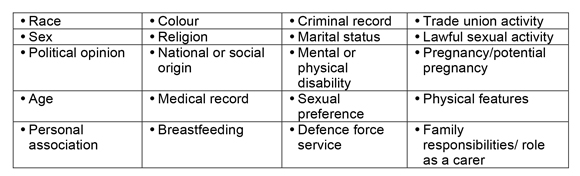

Examples of questions you can and cannot ask:
Can: What days can you work? What hours can you work?
Cannot: How many children do you have? Who looks after them when you are working?
Can Do you have any responsibilities that would interfere with travelling for us?
Cannot: Do you have children or are planning to have children?
Can: Are you legally eligible to work in Australia?
Cannot: What country are you from?
Can: Can you work on Sundays?
Cannot: What is your religion? Do you go to church on Sundays?
Evaluate a candidate on the wrong factors
Often interviewers try and find a new recruit with the same traits as current employees, or themselves. A candidate with complimentary, rather than identical skills is of greater benefit to a team. Look at the existing team dynamics including who fills what team role. Is there anything missing?
Similarly, interviewers rely on their first impressions. Whilst we cannot ignore our gut feelings be careful not to read too much into small observations such as how they engage with you or the quality of small talk.
Over reliance on the interview
Interviewers often assume all requirements for the role can be assessed through interview. Many things cannot be measured accurately during an interview for example technical skills and intelligence skills. Consider testing relevant to the role. For example: typing if you are recruiting a secretary. Numerical reasoning if you are recruiting an accountant.
Short term focus
Interviewers recruit for the short term by recruiting an employee who has all the skills required. Unfortunately the newly hired employee soon gets bored in the role. Hire employees for both immediate needs as well as future job requirements.
Too many or too few interviews
There is a common understanding that the more interviews the candidate attends the more accurate the hiring outcome will be. To a certain extent that is true. It is hard to assess in one interview that lasts about an hour. However numbers of interviews become repetitious and irrelevant. Candidates get frustrated when they are asked the same questions over and over. Candidates perceive that the interviewer does not know what they are looking for and are not decisive.
So what is the optimum number of interviews?
There is no magic number. However in my experience 3 or 4 interviews is optimum. The first interview should be all about building rapport and determine whether the candidate fits into the team. The second interview is about checking their skills and experience and asking probing questions. The third and/or fourth interview is about involving other key stakeholders to solicit their opinion.
By Angela Godfrey
——–